
Three Chinese Aircraft Carriers Liaoning Pass Through Miyako Strait, Reality of Joint Operations Command's First Training
 Tanaka Takashi
Three Chinese Aircraft Carriers Liaoning Pass Through the Miyako Strait, Reality of Joint Operations Command Training
About 130 kilometers east of Miyako Island. In a track chart released by the Joint Staff Office on June 22, what I first noticed was not the aircraft carrier itself, but the narrowness of the strait it passed through. Around midnight on June 20, the Japan Maritime Self-Defense Force confirmed three vessels of the Chinese Navy: the Kuznetsov-class aircraft carrier "Liaoning" (hull number 16), the Renhai-class missile destroyer 104, and the Luyang III-class missile destroyer 124. The formation was reported to have advanced northwest between Okinawa Island and Miyako Island, heading towards the East China Sea.
This is not merely a return. According to Joint Staff materials, the same formation was confirmed on May 25 in the Pacific Ocean, and from May 26 to 28, aircraft and helicopters were launched and recovered from the "Liaoning." On May 29, it was advancing southeast in the waters east of the Philippines. This means that for at least about four weeks, the operation of the aircraft carrier was continued outside the first island chain.
Significance of the Three-Vessel Formation Seen in the Miyako Strait
The "Liaoning" is China's first aircraft carrier, not the latest Fujian. However, the accompanying vessel 104 is of the 055 type, which is classified as a Renhai-class missile destroyer by Japan. With this class, which has a large vertical launch system, entering the escort of the aircraft carrier, the Chinese Navy can repeatedly conduct open-sea training that combines air defense, anti-ship, and anti-submarine operations. The addition of the 052D-class destroyer 124 means that this group of three, although small, was close to the core composition of an aircraft carrier strike group.
The JMSDF conducted surveillance and information gathering with the escort ship "Asahi" from the 5th Surface Fleet and the P-3C from the 5th Air Wing. It is noteworthy that surveillance around the southwestern islands still heavily relies on the classic combination of escort ships and patrol aircraft. Even with advancements in P-1 and unmanned aerial vehicles, the personnel and maintenance capacity to maintain patrol lines are not infinite.
The Initial Training on June 29 is Not Coincidental
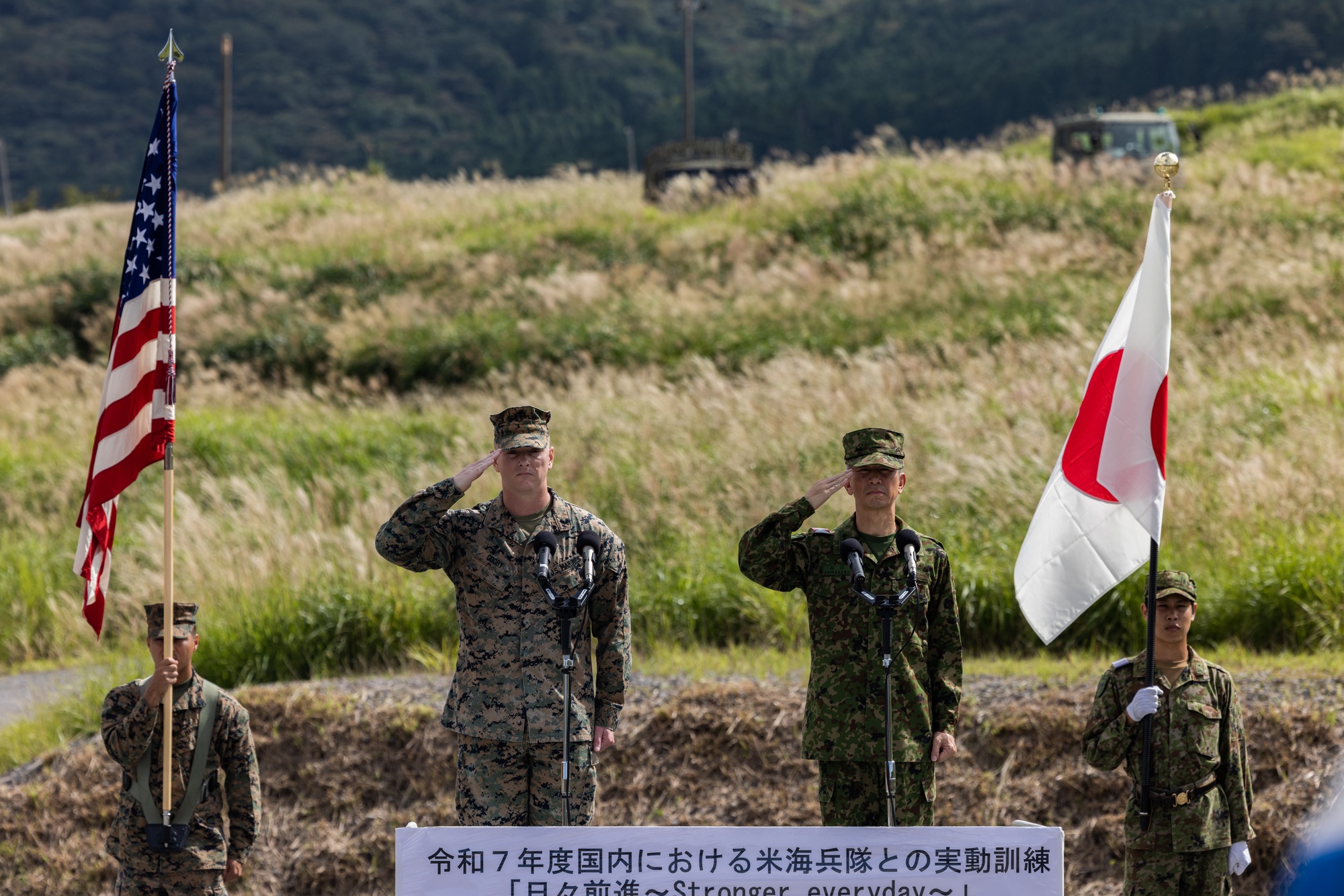
On June 19, the Joint Staff announced that it would conduct the first joint operational training for the fiscal year 2026 from June 29 to July 3. The location is Self-Defense Force facilities in Nakatsukawacho and Minamitanecho in Kagoshima Prefecture, and surrounding maritime and airspace areas. The training items include land operations and amphibious operations, with the Ground Self-Defense Force, Northern Army, Western Army, Maritime Self-Defense Force, various regional forces, Information Operations Group, Air Self-Defense Force, Space Operations Group, Cyber Defense Force, and the Joint Operations Command listed.
This long list of unit names is not bureaucratic formality. In Japan's defense in 2026, the ability to move units that find vessels, deploy to islands, support air superiority, and handle electromagnetic waves, space, and cyber operations on the same timeline is being questioned. The fact that the aircraft carrier formation passed through the Miyako Strait places that examination question on the real maritime chart.
Connection to Japan-U.S.-Philippines Activities in the South China Sea
In the same week, in the South China Sea west of the Philippines, the escort ship "Takanami" and the Philippine Navy frigate "Miguel Malvar" conducted maritime cooperative activities, with Chinese vessels reportedly monitoring from a distance. It was said that the focus of the training included anti-submarine warfare. For Japan, the South China Sea is not a distant sea. The SLOC (Sea Lines of Communication) from the Middle East to Japan passes through the Bashi Channel, the South China Sea, and the East China Sea as a continuous line.
Therefore, the "Liaoning" in the Miyako Strait and the "Takanami" in the South China Sea are not separate news items. The Chinese side is demonstrating the sustainability of open-sea operations with aircraft carriers and surface combatants, while the Japanese side is trying to connect island defense and maritime traffic route protection through cooperation with the Philippines and domestic joint operational training.
The Weakness of Deterrence Lies Not in Surveillance but in Decision-Making
In my view, the most precarious aspect of this movement is not overestimating the capabilities of the Chinese aircraft carrier. Rather, it is taking the surveillance system itself for granted because the JMSDF reliably confirms and announces it every time. The ability to confirm vessel silhouettes and the ability to quickly switch missions as a joint force in times of crisis are two different things.
When the "Liaoning" passed through the Miyako Strait, Japan was watching. The question is what comes next. When multiple Chinese formations move simultaneously in the same strait, joint activities between Japan and the Philippines come under pressure in the South China Sea, and decisions regarding the protection of residents in the domestic island areas become necessary, can Tokyo's political decisions keep pace with the speed of the units? The true bottleneck lies not on the radar screen, but in the clock of integrated decision-making.
Main References: Ministry of Defense Joint Staff Office announcement on June 22 regarding "Trends of Chinese Naval Vessels," announcement on June 19 regarding "Implementation of Joint Operational Training for Fiscal Year 2026," and Newsweek's report on Japan-Philippines maritime cooperative activities.
Chinese naval vessels, including the aircraft carrier Liaoning, passed through the Miyako Strait on June 20, 2023, heading towards the East China Sea. This movement is part of ongoing naval operations and training exercises, with the Japanese Self-Defense Forces conducting monitoring activities. The event highlights the strategic military activities in the region, particularly in relation to Japan and the Philippines.
- Three Chinese naval vessels, including the aircraft carrier Liaoning, were confirmed passing through the Miyako Strait.
- The vessels were observed moving northwest towards the East China Sea.
- This operation is part of ongoing naval training exercises by the Chinese Navy.
- The Japanese Self-Defense Forces monitored the vessels with destroyers and P-3C aircraft.
- The passage of the Liaoning is linked to broader military exercises involving Japan and the Philippines.