
Japanese Self-Defense Forces Participate in Southern Jackaroo 2026 Joint Exercises with Three Australian Countries
 Tanaka Takashi
Japan Self-Defense Forces Participate in Southern Jackaroo 2026, Tri-Nation Live Training Begins in Australia
A photograph taken at the Townsville training area shows U.S. Marines, Australian Army, and Japanese ground forces listening to the same briefing. It is not a flashy warship or missile. However, Southern Jackaroo 2026, which began on May 29, is a training exercise that is rather difficult to overlook when considering the defense of the First Island Chain.
Structure of the Training
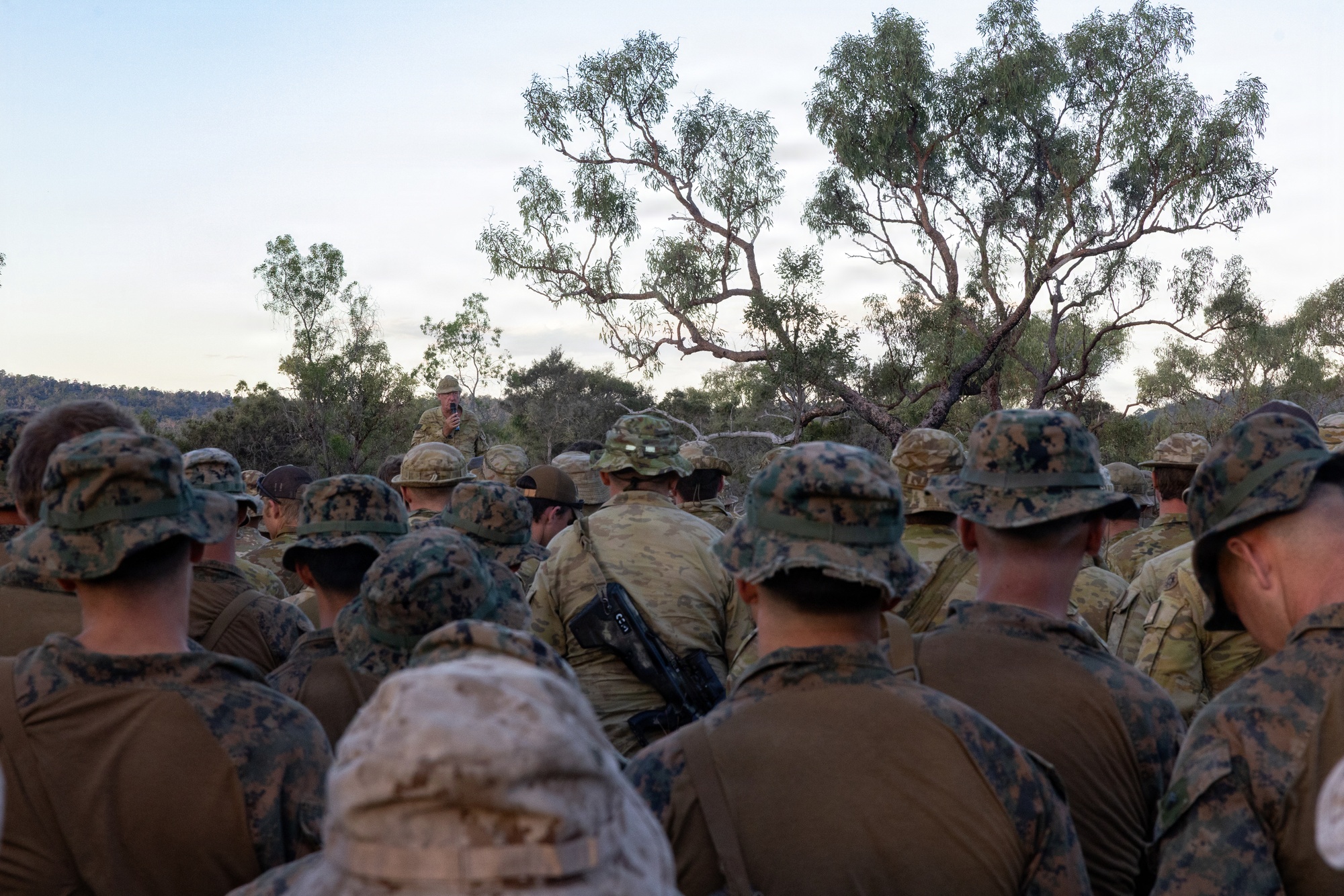
According to the U.S. Indo-Pacific Command and DVIDS, the training period is from May 29 to July 3, 2026, and takes place around Townsville, Queensland, Australia. The participating forces are centered around the U.S. Marine Corps' Marine Rotational Force Darwin 26, including the 5th Battalion, 1st Marine Regiment, Combat Logistics Battalion 5, the Australian Army's 3rd Brigade, the U.S. Army, and the Japan Self-Defense Forces' mobile units. USNI News reports that the main unit from Japan is the 7th Infantry Regiment of the Japan Ground Self-Defense Force.
The training items include communication procedure alignment, tactical actions, inter-unit procedures, force-on-force training for offense and defense, mounted machine gun firing, mortar operations, and a final phase of multinational combined live-fire exercises. From the perspective of the author, who has a background in the Japan Maritime Self-Defense Force, what is important here is not merely that "training is taking place in Australia," but rather that they are attempting to align firepower, logistics, and communications into a single combat rhythm without treating them separately.
Connection to Southwest Islands Defense
In Japan, attention tends to be drawn to Resolute Dragon 26 and Valiant Shield 2026, which will take place in late June. According to Ministry of Defense materials, Resolute Dragon will be conducted over a wide area including Kyushu, Amami, Okinawa, Miyako, Ishigaki, and Yonaguni, involving the U.S. side with the 3rd Marine Expeditionary Force, the 12th Marine Regiment, the 3rd Multi-Domain Task Force, the 7th Fleet, and the 18th Air Wing. Valiant Shield will also be conducted from June 22 to July 1 as a large exercise connecting Japan, Guam, and Hawaii.
Southern Jackaroo is positioned as a precursor to these exercises. When Japan conducts joint operations with U.S. forces in the Southwest Islands, the issue is not just the range of anti-ship missiles. The practical difference in combat will be how quickly dispersed small units can process requests for firepower and logistics through whose communication networks. The vast training area in Australia is not about island defense per se, but it is a suitable place to intentionally expose communication failures, supply delays, and language differences between units.
Not a Simple Message to China
It is easy to read this training as merely a "containment of China," but that is somewhat simplistic. Of course, it cannot be denied that Japan, the U.S., and Australia are enhancing tactical interoperability against the backdrop of the expanding activities of the Chinese Navy and Coast Guard, pressure around Taiwan, and actions in the South China Sea. However, more practically, it suggests that the U.S. Marine Corps' expeditionary forward base operations, the establishment of rear bases in northern Australia, and Japan's southwestern shift are beginning to overlap on the same operational map for the first time.
The advantages for Japan are clear. Training in Australia complements shooting and maneuver training that is constrained by domestic political factors and provides an opportunity to observe the logistics culture of both the U.S. and Australian forces. In particular, contact with the Australian Army's 3rd Brigade serves to remind Japan, which tends to think of island defense solely in terms of maritime and air operations, of the realities of land mobility and logistics.
Remaining Weaknesses
However, there are points that should be viewed with caution. From the publicly available information on Southern Jackaroo, it is unclear to what extent Japan has been integrated into the command and control center. Whether they simply participated and fired or were incorporated into decision-making for information sharing, firepower coordination, and logistics coordination makes a significant difference.
In the author's view, the true value of this training lies not in the footage of live-fire exercises but in how honestly they can record failed communications, delayed supplies, and misaligned command systems. What is ultimately lacking in the defense of the Southwest Islands is not the number of equipment but rather the habit of allies making decisions at the same speed.
Major Information Sources
Japan Self-Defense Forces participated in the Southern Jackaroo 2026 joint military exercise with U.S. Marine Corps and Australian Army in Townsville, Queensland, from May 29 to July 3, 2026. The training focused on operational coordination, including communication procedures and live-fire drills, emphasizing logistics and combat readiness among the allied forces.
- Japan Self-Defense Forces participated in Southern Jackaroo 2026 alongside U.S. and Australian forces.
- The exercise took place in Townsville, Queensland, Australia.
- Training included force-on-force exercises, communication procedures, and live-fire drills.
- The exercise runs from May 29 to July 3, 2026.
- The main Japanese unit involved is the 7th Infantry Regiment.