
Jordan intercepts 5 Iranian missiles in 2026 and reveals the limits of Arab air defense
 Ahmed Al-Rashid
Jordan Shoots Down 5 Iranian Missiles in 2026 and Reveals the Limits of Arab Air Defense
In the early hours of July 30, 2026, the Jordanian Armed Forces stated that its air defenses intercepted and shot down 5 missiles coming from Iran without any casualties. The number is small compared to the waves of missiles that the region has witnessed in recent months, but from a military perspective, it is not a trivial detail. Five missiles over a country like Jordan mean that the war is no longer just between Iran and the United States or between Iran and Israel, but is now passing over Arab territory, testing its readiness and sovereignty at the same time.
According to the text reported by Xinhua, Amman described the interception as professional and effective, and confirmed the heightened state of alert to protect the skies and sovereignty. This is a calculated formulation; it does not place Jordan in the discourse of an open war, but it indicates that the kingdom has practically been forced to operate as part of a broader warning and interception network. Here lies the problem known to every military personnel who has served in the region: air defense is not measured by the number of batteries in official photos, but by the speed of information transfer from radar to the command center and then to the launch platform.
An Iranian Missile Over Jordan is Not a Border Incident
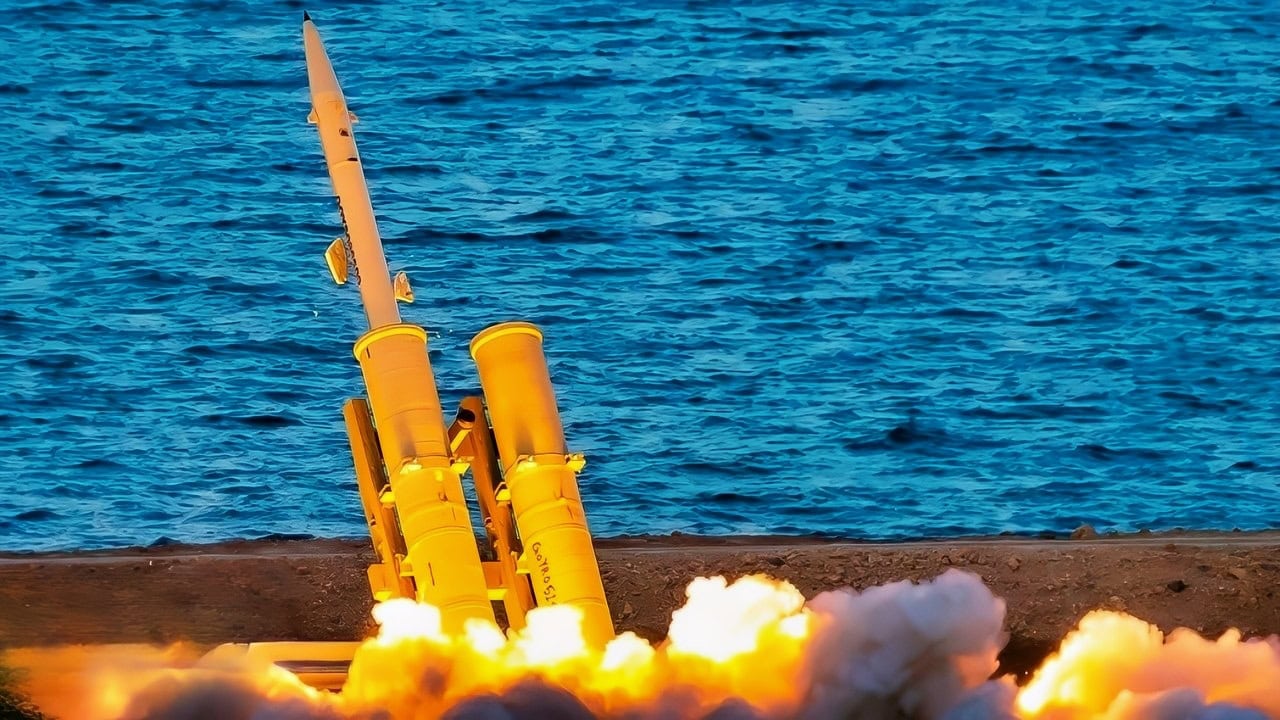
The broader scene is more dangerous. On July 29, the U.S. Central Command announced, according to media reports, the conclusion of a significant round of strikes inside Iran targeting Revolutionary Guard sites, including command centers, missile and drone facilities, coastal surveillance sites, and maritime operation capabilities. Washington also spoke about intercepting Iranian missiles launched on July 28 towards U.S. forces in the Middle East, and the presence of more than 50,000 American troops in the region.
These figures place Jordan in a sensitive position. The kingdom is not the owner of the war, but it is on the geographical and political flight path of the conflict. If Iran launches missiles towards American bases or forces in the Levant or the Gulf, and if Washington responds with deep strikes inside Iran, then relatively small Arab countries become part of the engagement trajectory, even when they try to remain outside the political decision-making of the war.
Jordanian Air Defense Between Efficiency and Dependence
The success of shooting down 5 missiles should not be underestimated. Intercepting a ballistic missile or a fast-moving target is not a police action, but a complex operation that includes early warning, threat classification, engagement decision, and linking different platforms. Jordan has extensive experience working with the United States and Western allies, and its joint exercises like Eager Lion were not just public relations showcases. There is a real professional layer in the Jordanian military, especially in command, control, and operational discipline.
But the question that concerns me is not whether Jordan succeeded that night. The question is whether Jordan or any medium-sized Arab country can replicate this success if the next wave is larger, or if the missiles coincide with low-flying drones, electronic jamming, and cyberattacks. Here the triad capability principle emerges: equipment alone is not enough, training alone is not enough, and the institution alone is not enough. There must be cohesion between equipment, training, and the institution under pressure.
In my estimation, Jordan is better than many in terms of institutional capacity and discipline, but it is limited in the depth of its stockpile, the density of its platforms, and the ability to conduct continuous days of costly interceptions. A successful interception may mask an impending economic crisis, as every defensive missile launched today must be compensated for tomorrow through an already congested American or Western supply chain burdened by Ukraine, the Gulf, and East Asia.
The American Paradox in Arab Skies
A Defense One report on July 29 indicated that the Iran war accelerated updates in communication and combat awareness on American KC-135 refueling aircraft, and that the Air Force pushed funding and personnel to enhance systems like RTIC and Link 16. This point may seem technical, but it is, in fact, the heart of modern warfare. The United States does not manage deterrence in the Middle East solely through F-35 fighters or long-range bombers, but through a network of fuel, communication, and data that allows the aircraft to know where the danger is, where the fuel is, and where a safe landing is.
Practically, when the American KC-135 network improves, Washington's ability to keep its fighters in the air over the Gulf and the Levant improves. And when these fighters remain in the air, Arab air defense networks become more dependent on the American umbrella, not less. This is the paradox that our capitals do not like to say out loud: every Iranian escalation pushes us to seek greater protection, and every greater protection makes defensive independence further away.
This does not mean that cooperation with the United States is a mistake. To say so would be political romanticism that does not hold up in an operations room. The problem is that many Arab countries have turned cooperation into a substitute for building local depth. We buy radar, then we need external support. We buy the missile, then we wait for the external production line. We declare sovereignty, then we request the aerial imagery from a network whose keys we do not fully possess.
Tehran's Message and Amman's Message
Iran, for its part, sends a dual message. It does not always need to hit the target to achieve a political effect. Simply forcing Jordan to announce the shooting down of missiles is enough to show that the battle can touch the borders of those who do not want it. This is a familiar pressure tactic in Iranian thinking: expanding the cost of the crisis without necessarily expanding the war to the point of suicide.
As for Amman, it sent a quieter message: Jordanian airspace will not be a testing corridor without cost. This is a necessary message for the domestic audience and for external partners. However, it does not negate the fact that Jordan cannot alone build a complete dome over itself in an open geography between Iraq, Syria, Israel, and Saudi Arabia. Geography here is not just a backdrop for the map, but part of the weapon system.
What Should Worry Gulf Capitals
The Gulf should read the Jordan incident as an early warning. Saudi Arabia, the UAE, and Qatar have more expensive and modern platforms, from Patriot to THAAD and long-range radars, but they face the same question on a larger scale: can the systems communicate with each other quickly enough, are there clear rules of engagement, and is the stockpile sufficient if the fighting lasts for two weeks, not just two nights?
Large spending gives a sense of reassurance, but it does not buy time. And time in air defense is measured in seconds. In real war, no one waits for a coordination committee or a diplomatic statement. A missile does not respect bureaucracy, as some of our veteran officers say.
The Jordanian lesson is not that Iranian missiles can be shot down, but that shooting them down reveals who owns the network and who only owns the facade.
In the end, shooting down 5 Iranian missiles over Jordan is a clear tactical success, but it opens a larger question about Arab military sovereignty. We want an independent sky, but we live within an American deterrence network. We want to deter Iran, but we fear that deterrence may lead to a wider war. This is not an equation that can be solved by simply buying a new battery. It is a gap between political ambition and military structure, and between what we declare about independence and what we actually need when radar screens light up before dawn.
Jordanian air defenses intercepted and shot down 5 Iranian missiles on July 30, 2026, without any reported casualties. This incident underscores the military readiness of Jordan amid escalating tensions in the region, particularly with recent U.S. strikes on Iranian targets. The interception reflects Jordan's role in a broader defense network against potential threats.
- Jordan intercepted 5 Iranian missiles on July 30, 2026.
- No casualties were reported during the interception.
- The incident highlights the military readiness of Jordan's air defense systems.
- The U.S. Central Command reported recent strikes on Iranian targets prior to this incident.
- The geopolitical implications of missile interceptions in the Arab region are significant.