
Kim Jong-un Demands "Absolute Advantage" in Drones as South Korea's Anti-Drone System Faces New Cost Calculations
 Tanaka Takashi
Kim Jong-un Demands "Absolute Superiority" in Drones as South Korea's Anti-Drone System Faces New Cost Calculations
The images from the drone exhibition released by the Korean Central News Agency (KCNA) on October 30-31 shifted Pyongyang's focus from a missile salvo to a repeatable and expandable unmanned combat chain. Kim Jong-un demanded to achieve "absolute superiority" in the drone field (as stated in KCNA), and proposed to accelerate technological development, expand production capacity, and apply military artificial intelligence. According to NK News, the exhibition showcased a new type of stealth drone; its model, power, payload, range, and whether it has entered mass production remain undisclosed and await confirmation.
The Exhibition is Not a Model List
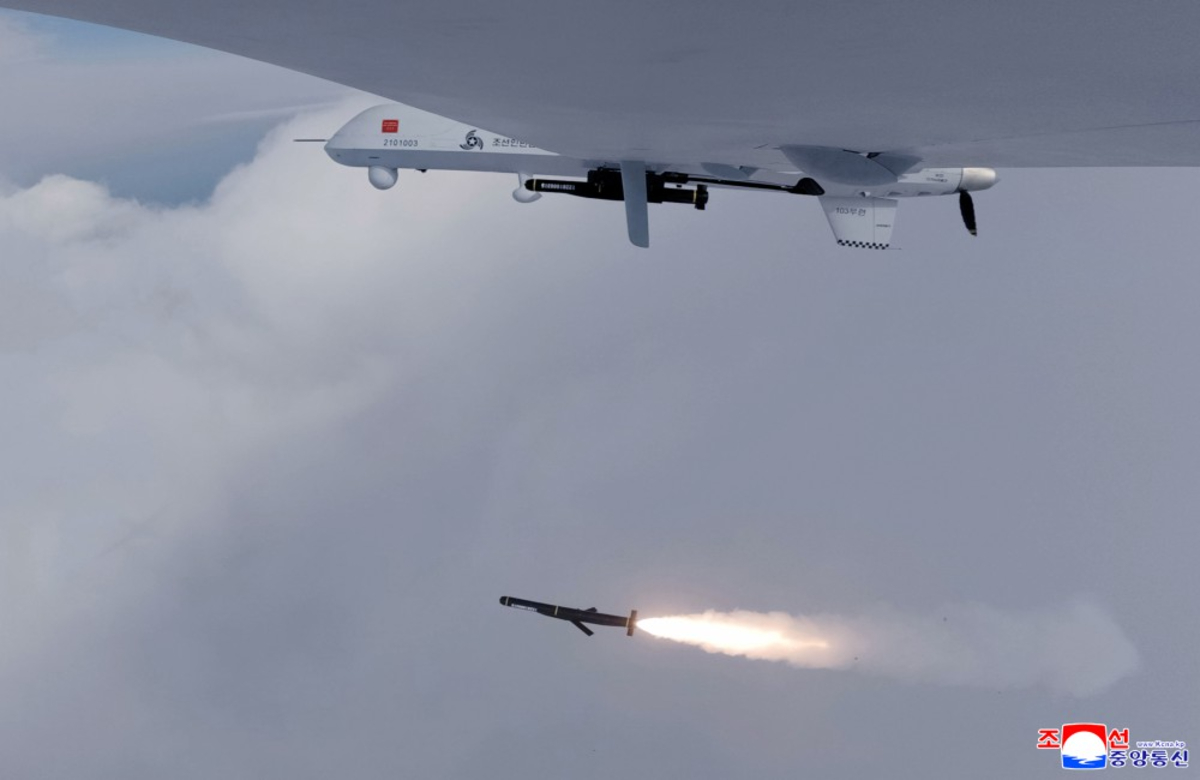
The visible part of this exhibition is the platform; the real signal is that "technology—algorithm—production line" is placed within the same mobilization framework. Ballistic missiles still bear the strategic deterrence and early warning pressure, but drones are more suitable for dispersing costs across reconnaissance, calibration, decoy, loitering attack, and battle damage replacement. Therefore, the approximately 10-12 ballistic missile launches on October 29 should not be recounted; it is worth observing whether Pyongyang can transform the display into stable mass quality, control chains, and troop training, all of which currently lack public data.
Two Spillover Paths: Border and Russia-Ukraine
At the inter-Korean border, drones and AI-assisted identification will make low-intensity, high-frequency, deniable friction easier to control below the threshold of artillery fire: small platforms can repeatedly test alert zones, supply lines, and response times, and can also be linked with artillery reconnaissance and calibration. However, "deniable" does not equal low risk; crossing lines, misjudgments, or crashes may still force Seoul to make a political response.
For the Russia-Ukraine battlefield, the exhibition appears more like a demonstration of industrial intent rather than a confirmed deployment report. The technological cooperation and battlefield experience flow between Russia and North Korea could theoretically accelerate learning in navigation, anti-jamming, components, and production management; however, there is no public evidence that the exhibited items have been transferred to the Russia-Ukraine battlefield or that North Korean personnel have participated in relevant drone units. This association should be listed as a risk indicator rather than an established fact.
The Cost Calculations of South Korea's Air Defense
The challenge facing South Korea is not to shoot down a target with high-end air defense missiles, but to continuously detect low, slow, small targets, identify them, and choose appropriate low-cost measures under mountainous, urban clutter, and close-range conditions. If each cheap platform forces radar, electro-optical, radio frequency detection, jammers, and interceptors to be activated simultaneously, the attacker exchanges quantity for the defender's duty, ammunition, and command burden. Seoul needs to layer the anti-drone system with the existing air defense network, prioritizing the development of sensor fusion, electronic suppression, and short-range artillery/interception means; otherwise, even if a single interception is successful, the long-term exchange ratio will be unfavorable.
The Boundaries of the Denuclearization Stance
The U.S., Japan, and South Korea reiterated their goal of "complete denuclearization" on October 31, maintaining political consistency within the alliance, but this cannot replace daily responses to conventional unmanned capabilities. Pyongyang's exhibition targets both external deterrence and internal military-industrial mobilization: it conveys the intention to upgrade capabilities while demanding that enterprises and troops invest resources around new priorities. Equating the images directly with a mature stealth fleet would overestimate its capabilities; treating it merely as propaganda would miss the alarm that capacity reconfiguration has already begun. What truly needs to be tracked is whether there will be repeated displays, large-scale training, supply chain traces, and verifiable tactical applications in the future.
Sources and Verification
- KCNA reports on the drone exhibition from October 30 to 31.
- Defense Blog: KCNA images and "absolute superiority" report.
- Follow-up reports from Reuters, Al Jazeera, and NK News after October 30-31; NK News's assessment of the new stealth drone still awaits official detail confirmation.
- Reports from Japan Times, Al Jazeera, and others on October 31 regarding the U.S.-Japan-South Korea "complete denuclearization" common stance.
Kim Jong-un demanded absolute superiority in drone capabilities during an exhibition in North Korea on October 30-31, 2023. The event highlighted advancements in drone technology and production, indicating a strategic shift from ballistic missiles to unmanned aerial systems. South Korea is challenged by the need to counter low-cost drone threats effectively.
- Kim Jong-un demands absolute superiority in drone technology.
- A new stealth drone was showcased, details pending confirmation.
- North Korea's drone capabilities are intended for reconnaissance and tactical operations.
- The exhibition signals a shift in military focus from ballistic missiles to drones.
- South Korea faces challenges in countering low-cost drone threats.