
Kuwait Purchases MASS for Eight Missile Boats in 2026 and Tests Gulf Maritime Independence
 Ahmed Al-Rashid
Kuwait Purchases MASS for Eight Al Dorra Missile Boats in 2026 and Tests Gulf Maritime Independence
On July 10, 2026, a small news item emerged in terms of financial size but was significant in its military implications: Rheinmetall will supply the Kuwaiti naval forces with Multi Ammunition Softkill System (MASS) systems for eight Al Dorra-class missile boats. The contract value is in the low tens of millions in euros, along with Omnitrap and Omnitrap-ER munitions with an additional value in the high millions, with deliveries set to begin in the second quarter of 2026 and conclude in the second quarter of 2029. Practically speaking, this is not a massive arms deal that shifts the balance in the Gulf, but it reveals a quieter and deeper trend: the survival of the small naval unit is now linked to its ability to deceive a missile before considering intercepting it.
A Limited-Scale Deal but Precisely Located
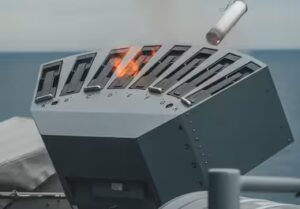
According to European Security & Defence, MASS will equip eight Al Dorra boats, which are stealth patrol boats built by Abu Dhabi Shipbuilding for the UAE's EDGE Group as the main contractor. Here lies a point that should not be overlooked. Kuwait is not purchasing a European system in isolation from its Gulf environment, but is integrating it into a ship program that passes through an Emirati industrial base. This is a relatively new model in the Gulf: the small state buys maritime survival from Europe, the hull from a Gulf partner, while the command, control, and operational layer remains the toughest internal test.
Technically, MASS is not an offensive weapon. It is a multi-spectral decoy launch system that covers radar, ultraviolet, electro-optical sensors, lasers, and infrared. Omnitrap-ER munitions add longer range and improved trajectory for deploying deception against newer radar and thermal imaging threats. This is important because the anti-ship missile in 2026 no longer relies on a single simple seeker. Many modern threats combine active radar and thermal imaging or trajectory correction via data link, so old metal chips alone are no longer sufficient.
The Gulf Learns a Harsh Lesson from the Red Sea
Kuwait has not been far from the lesson imposed by the Houthi attacks in the Red Sea and the Gulf of Aden in recent years. Even if the theater differs, the logic remains the same: a boat or patrol vessel operating near the coast, facing an adversary capable of using a maritime cruise missile, a suicide drone, or a relatively cheap guided munition, cannot rely solely on hard armor. The interceptor missile is more expensive, its numbers are limited, and the decision-making chain at sea is very narrow. In my estimation, every small Gulf navy will discover that the question is no longer just: how many anti-aircraft missiles do we have? But: how many seconds can we buy before the moment of impact?
This is the true meaning of MASS. The system does not create maritime superiority, but it gives the crew an additional chance. Any military personnel who have served in the region know that the distance between the Kuwaiti port, Iranian waters, oil corridors, and the American surveillance area is not just a geographical distance. It is a narrow political and tactical distance. When a small ship operates in this environment, survival depends on a mix of early warning, electronic discipline, maneuvering, and deception. Purchasing a deception system may not seem as attractive as buying a frigate, but it is sometimes more realistic.
Triad Capability and the Training Question
I like to read this deal through the capability triangle: equipment, training, and institution. On the equipment side, the choice makes sense. Rheinmetall states that MASS can be integrated into command and control systems or operated independently, which suits a fleet that does not want to complicate the upgrade of every platform at once. On the training side, the real question begins. The deception system does not work like a magic button. The crew must know the timing of the launch, the type of munition, the angle of maneuver, and when electronic silence is better than broadcasting. A two-second error could place the decoy cloud in the wrong location.
As for the institutional side, it is the most challenging in Kuwait, as in most of the Gulf. Will the Kuwaiti navy build an updated threat library? Will it link its data with American and British warnings in Bahrain and Qatar? And will it maintain a stock of deception munitions and crew training after the first year of delivery? The history of Gulf purchases indicates that the system enters service quickly, then begins the long test of maintenance, munitions, and repeated training. There is no respected softkill system without a precise operational culture.
A Political Aftermath within a Small Naval Deal
The presence of Abu Dhabi in the Al Dorra program is not just an industrial detail. Kuwait, like Oman and Qatar, usually tries to keep its defense relationships distributed so as not to become a complete follower of one axis. Choosing a hull through Emirati industry, protection through Rheinmetall, and a maritime security umbrella led by the United States reflects a policy of balance more than it does self-sufficiency. This is understandable from the perspective of a small state, but it creates an integration problem. The more suppliers there are, the greater the need for a naval institution capable of managing interfaces, contracts, munitions, and cybersecurity.
At the same time, the MASS contract sends a signal to Iran without direct provocation. Kuwait is not purchasing long-range offensive missiles nor announcing an escalation doctrine. It simply states that its boats will not be easy targets. This is an acceptable defensive language diplomatically, but it is understood militarily. After the mutual strikes and tensions over navigation in 2026, defensive messages are no longer entirely innocent. Even maritime deception has become part of deterrence.
What MASS Does Not Do
The mistake in reading the deal is exaggeration. MASS does not address the weakness of maritime reconnaissance, does not solve the layered air defense problem, and does not give Kuwait independent control over the Gulf waters. If the warning is late, or the operations center is slow, or munitions are not available in sufficient quantities, the system becomes a good German piece on an unprepared boat. Here lies the difference between purchasing survival and building capability.
In small armies, excellent defensive weapons do not compensate for the absence of daily practice in using them. The sea does not grant time for review.
Thus, Kuwait's deal with Rheinmetall appears beneficial yet limited at the same time. It is a correct step within a maritime environment filled with missiles and drones, but it remains a step within a larger equation: the Gulf wants greater tactical independence, but still relies on an American and Western network for warning, integration, and overall deterrence. This is the paradox that eight MASS systems do not resolve. They may make Kuwaiti boats harder to hit, but they do not make Kuwaiti maritime security self-sufficient.
Sources
- European Security & Defence, July 10, 2026 report on supplying Kuwait with Rheinmetall MASS systems.
- Rheinmetall, published product data and description for the Multi Ammunition Softkill System and Omnitrap munitions.
- U.S. Central Command, July 2026 materials on regional security dialogue in Bahrain and the maritime environment within the Central Command area.
Kuwait is purchasing eight missile boats equipped with the Multi Ammunition Softkill System (MASS) from Rheinmetall, with delivery scheduled from mid-2026 to mid-2029. This contract, valued in the low tens of millions of euros, aims to enhance the defensive capabilities of the Kuwait Naval Forces against modern threats. The procurement indicates a strategic shift towards improving maritime security in the Gulf region.
- Kuwait is purchasing eight missile boats equipped with MASS from Rheinmetall.
- The contract is valued in the low tens of millions of euros.
- Delivery is scheduled to begin in the second quarter of 2026 and end in the second quarter of 2029.
- MASS is a multi-spectral decoy system designed to protect naval vessels.
- The procurement reflects Kuwait's strategy to enhance its maritime defense capabilities.