
Lebanon's 2026 Ceasefire Stumbles After 50 Projectiles and 150 Israeli Targets, Threatening the Washington-Tehran Agreement
 Ahmed Al-Rashid
The Lebanon Ceasefire 2026 Stumbles After 50 Projectiles and 150 Israeli Targets, Threatening the Washington-Tehran Agreement
On June 20, 2026, the problem was not that a ceasefire in southern Lebanon had not been announced, but that the guns did not act as if someone had announced it. Within a few hours, field reports spoke of more than 50 projectiles fired by Hezbollah towards Israeli forces, and Israeli strikes that hit villages in the south, killing at least 16 people, including two children, after a previous day that saw a heavier toll of 47 dead in Lebanon and four Israeli soldiers. These are not just humanitarian details; they are military indicators that the temporary U.S.-Iranian agreement was born with a significant operational gap called Lebanon.
A Ceasefire on Paper and a Field Operating Under Old Rules
The most important information in recent hours is not just the number of strikes, but their timing. According to American reports, the renewed ceasefire came into effect at 4 PM local time through U.S.-Qatari mediation, but strikes and drones continued in the following hour. From a military perspective, this small moment reveals the entire problem. A ceasefire does not become a reality when politicians agree to it, but when frontline units know where they stand, who has the authority to fire, and what constitutes a "threat" that allows for a response.
Israel speaks of an advanced defense area within southern Lebanon and a yellow line that separates the actual area of occupation from the rest of Lebanese territory. Hezbollah claims it is committed to the calm but will respond to any Israeli advance. Between these two statements lies a gray area sufficient to undermine any agreement. Any soldier who has served in a border area knows that the most dangerous word in the rules of engagement is "threat," as it seems precise in the operations room but becomes very broad at the first valley, abandoned house, or motorcycle movement.
Equipment Is Not the Only Problem
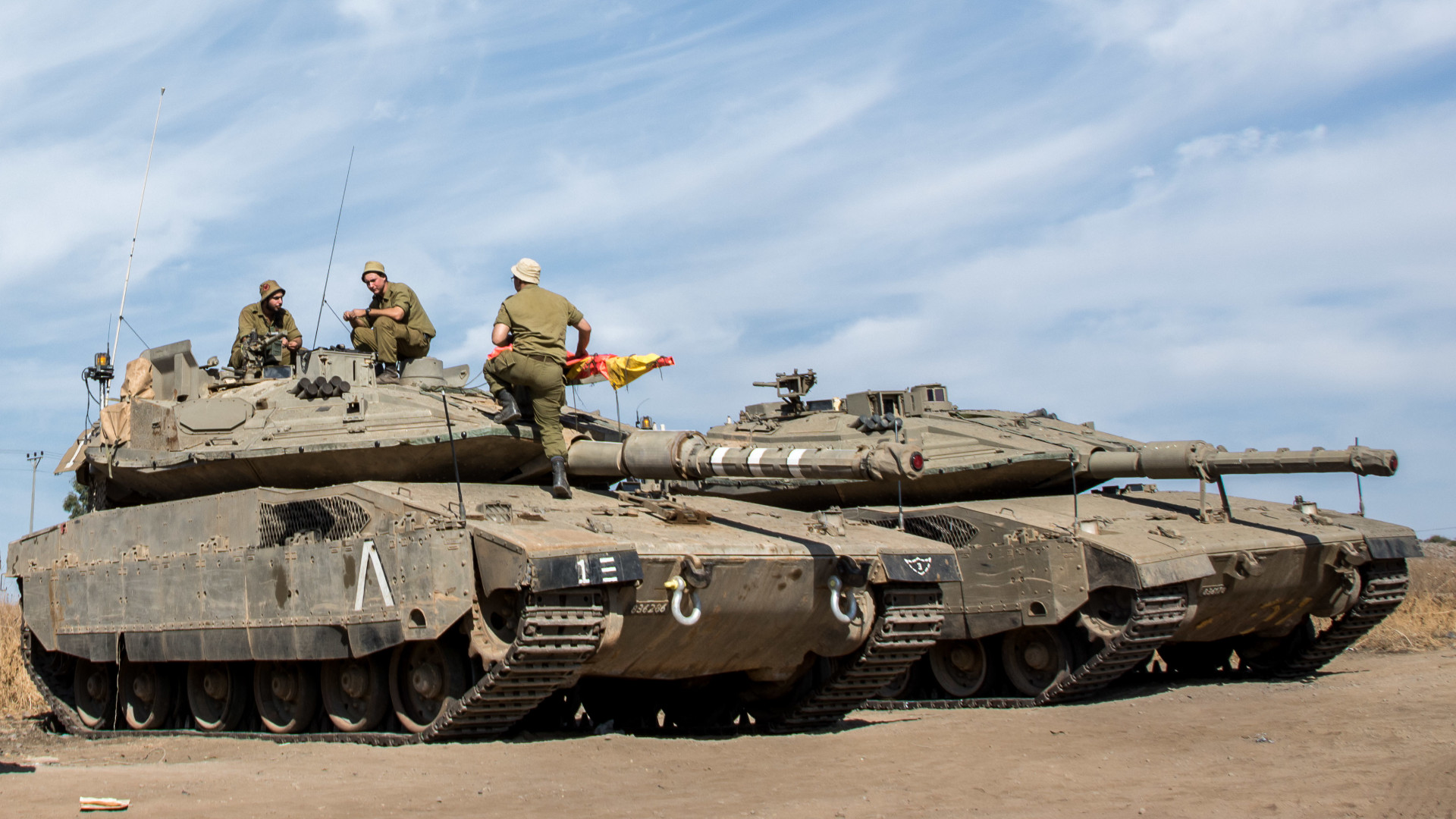
Israel has a clear advantage in air power, reconnaissance, and armor. The talk of targeting around 150 Hezbollah sites hints at the use of overlapping layers of aerial intelligence, precision munitions, and drones, as well as a command and control capability that allows for striking many targets in a short time. On the ground, the Merkava IV tank remains a clear symbol of Israel's method of imposing an armored security belt; it is a heavy tank with a front engine and an active protection system in its modern versions, originally designed to survive in anti-tank missile environments, not just for light maneuvering.
However, Hezbollah does not need technical parity to disrupt this advantage. Fifty projectiles in one night do not mean a decisive attack, but they indicate the ability to keep Israeli forces in a state of constant alert and to prevent the frontline from becoming a stable border. Here, an old equation in asymmetric warfare emerges: the superior party wants a clear end to the fighting, while the weaker party wants to make every end temporary and costly.
The Washington-Tehran Agreement Becomes a Hostage to a Front Neither Side Signs
The paradox is that Israel and Hezbollah are not signatories to the temporary U.S.-Iranian agreement, yet they can disrupt it. The agreement assumes the reopening of nuclear negotiation channels within 60 days and speaks of massive economic incentives for Tehran, including a gradual lifting of sanctions and a reconstruction fund worth hundreds of billions. However, it practically ties the success of the process to halting operations in Lebanon and respecting Lebanese sovereignty. This is a politically understandable formulation, but militarily it is not airtight.
Iran stipulates that Israeli operations must cease before negotiators move to Switzerland. Washington wants the process to begin so that the Strait of Hormuz does not become an open pressure point. Israel wants to retain the freedom to act against Hezbollah within what it calls an advanced defense area. Hezbollah wants Israeli withdrawal before it halts its attacks. Each side can claim it is defending its condition, but the practical result is the same: a broad agreement between Washington and Tehran becomes a prisoner of tactical decisions in a southern village.
The Gulf Reads the Lesson Differently
From a Gulf perspective, this crisis is not just about Lebanon. Saudi Arabia, Qatar, and Oman want a calm sufficient to restart trade, energy, and diplomacy. The UAE, which has paid a direct price in the war with Iran, tends to read more firmly towards Tehran and is moving closer to Israel security-wise. This divergence is not a detail, as it means that Washington no longer manages a single Gulf bloc, but rather a group of capitals with conflicting security and economic calculations.
The closure of the Strait of Hormuz and its subsequent reopening under temporary arrangements reminded everyone that Gulf defense is not measured solely by the number of Patriot and THAAD batteries. Yes, interception systems are important, but real capability requires a complete triangle: equipment, training, and decision-making institutions capable of operating under pressure. Many Arab capitals have purchased equipment, but they still rely on the American umbrella for leadership, early warning, and coordination between fronts. Practically, the Lebanese crisis tells them that the decision for war and peace may come from a front over which they have no direct influence.
Israel Between Deterrence and Entanglement
The Israeli calculation is militarily understandable but politically dangerous. After months of war with Iran, Tel Aviv does not want Hezbollah to appear as if it has emerged retaining its ability to threaten the north. Therefore, it tries to turn southern Lebanon into a controlled friction area, not into a normal Lebanese border. The problem is that this model requires daily operations, constant reconnaissance, implicit American acceptance, and Arab silence that no longer seems guaranteed.
In my estimation, the potential Israeli mistake is confusing fire control with political control. Aircraft and tanks can prevent Hezbollah from moving freely in certain sectors, but they cannot force Tehran to accept a nuclear agreement if it believes that its Lebanese ally is being drained under American cover. Moreover, every strike that kills civilians, even if it comes after the firing of projectiles, gives Israel's opponents political material to undermine the ceasefire.
Where the Breaking Point Lies
The breaking point is not in the number of missiles or the number of airstrikes, but in the absence of a reliable separation mechanism. Ceasefire agreements require monitoring, maps, withdrawal lines, direct or indirect communication between field commanders, and a timeline for retreat. So far, we see general statements about halting operations and respecting sovereignty, against a field reality where Israeli forces are inside the south and Hezbollah refuses to cease fire without withdrawal.
Thus, the coming days seem decisive. If the ceasefire is indeed established, Washington can bring the Iranian delegation back to the table and sell the agreement as the beginning of de-escalation. However, if clashes continue, every economic clause in the agreement will become worthless, as Tehran will discover that what it gained in negotiations can be lost in southern Lebanon. And as the old military saying goes, the map does not lie, but it does not fire either. What is firing now is not the text of the agreement, but frontline units that do not trust each other.
Conclusion
The Lebanon ceasefire reveals the biggest contradiction in Middle Eastern security in 2026. Washington can negotiate with Tehran, Tehran can moderate part of its rhetoric, and the Gulf can push for de-escalation, but a relatively small front can disrupt the entire structure if it remains outside the engineering of the agreement. This is not just a mediation crisis, but a crisis of a deterrence system that relies on unsigned powers and unwritten rules of engagement. Therefore, the question is not whether the U.S.-Iranian agreement succeeds on paper, but whether the parties can translate it into field discipline before it is swallowed by southern Lebanon.
Hezbollah launched over 50 projectiles at Israeli forces in southern Lebanon on June 20, 2026, while Israeli airstrikes targeted villages, resulting in at least 16 casualties. The ceasefire, brokered by U.S. and Qatari mediation, was violated shortly after its implementation, raising concerns about the stability of the U.S.-Iran nuclear agreement. The ongoing conflict highlights the complexities of military engagement in the region and the challenges of maintaining peace.
- Hezbollah launched over 50 projectiles at Israeli forces.
- Israeli strikes killed at least 16 people, including two children.
- 47 fatalities were reported in Lebanon and four Israeli soldiers the previous day.
- A ceasefire was supposed to be in effect but was violated shortly after its announcement.
- The situation threatens the temporary U.S.-Iran agreement regarding nuclear negotiations.