
Liaoning Aircraft Carrier Conducts 170 Takeoffs and Landings in 3 Days, PLA 054B Frigate's First Escort Mission Exposes Shortcomings in Deep Sea Operations
 Li Minghui
Liaoning Aircraft Carrier Conducts 170 Takeoffs and Landings in 3 Days, PLA 054B Frigate's First Escort Reveals Shortcomings in Open Seas
[Beijing Observation] A number in the track record released by Japan's Joint Staff on June 1 is easily exaggerated and misinterpreted: the Liaoning aircraft carrier conducted approximately 170 takeoffs and landings of carrier-based fighter jets and helicopters in the waters east of the Philippines from May 26 to 28. USNI News subsequently broke it down by day: about 80 on May 26, about 50 on May 27, and about 40 on May 28. While this number seems lively, I am more concerned about another matter—the 054B frigate Luhe, which entered the aircraft carrier formation training for the first time, indicates which shortcomings the PLA Navy's aircraft carrier formation is addressing.
What 170 Takeoffs and Landings Really Indicate
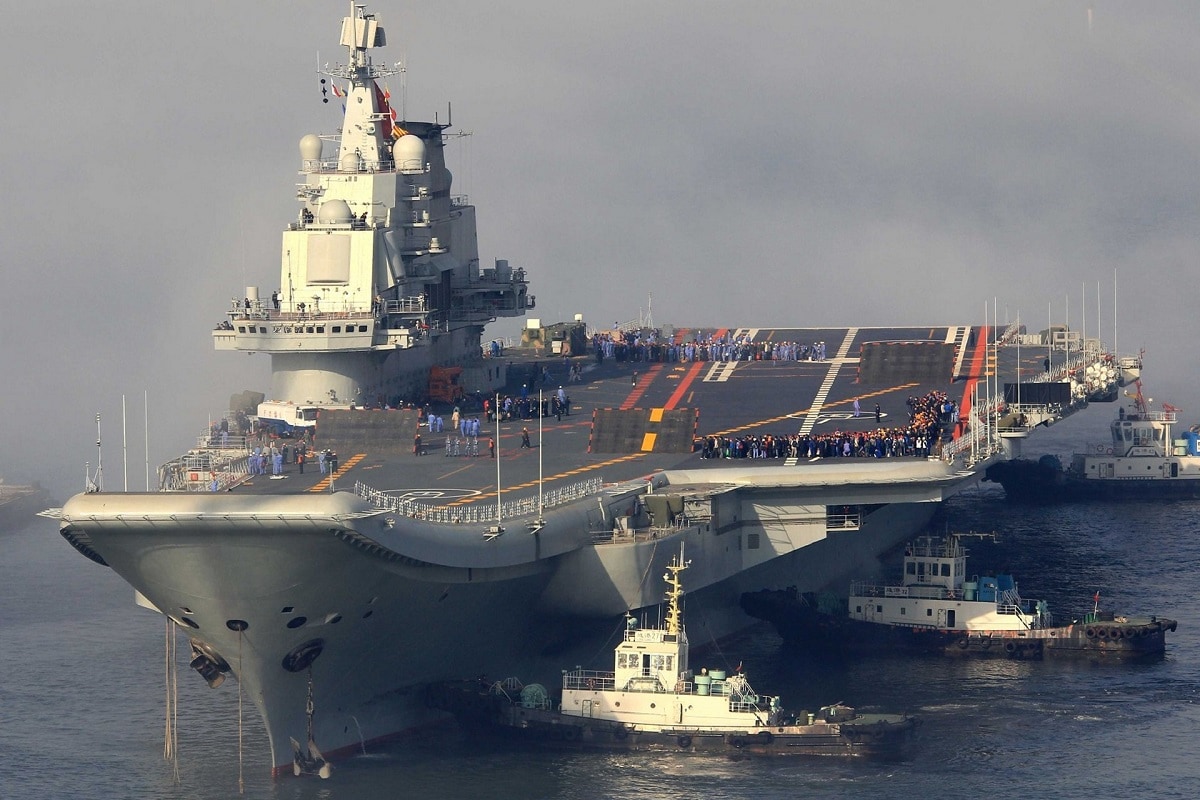
First, let's clarify the terminology. The Japanese side uses the number of takeoff and landing observations of carrier-based fighter jets and helicopters, which does not equate to 170 complete combat sorties. A flight typically includes both takeoff and recovery actions, and also includes helicopters. Therefore, directly comparing this number to the high operational tempo of U.S. nuclear-powered aircraft carriers is not rigorous.
Even so, maintaining a considerable rhythm of takeoffs and landings over three consecutive days is still significant. The Liaoning is a ski-jump takeoff carrier, primarily using the J-15 fighter jets, and cannot launch heavy fixed-wing early warning aircraft like a catapult carrier, which also limits the flexibility of the carrier-based aircraft in terms of fuel and armament combinations. What it can do is train deck scheduling, maintenance support, ship-aircraft coordination, and continuous operations in open seas. In short, what the Liaoning demonstrated this time is not its maximum combat capability, but how stable the naval aviation can operate an older platform.
The Signal of 054B Joining the Formation
The English report from Japan on May 28 listed the formation as including the Liaoning, the Wuxi (104), the Kaifeng (124), the Luhe (545), and the Hulun Lake (901). Among them, the Luhe was marked as a Jiangkai-III class frigate, commonly referred to as the 054B. The South China Morning Post reported on May 27 that this is the first time the 054B has participated in carrier formation training with the Liaoning in the Western Pacific.
- The Wuxi is a 10,000-ton class 055 destroyer, serving as a key player in regional air defense and formation command.
- The Kaifeng is a 052D destroyer, providing air defense, anti-ship, and general escort capabilities.
- The Luhe is a 054B frigate, generally believed to have a full-load displacement of about 6,000 tons, focusing on enhancing anti-submarine, short to medium-range air defense, and helicopter operations.
- The Hulun Lake is a 901 class comprehensive supply ship, serving as the logistical base for the Liaoning's long-term offshore activities.
This combination is more interesting than merely discussing the aircraft carrier itself. The long-standing question regarding Chinese aircraft carriers is not whether they can go to sea, but whether the formation can maintain awareness, anti-submarine capabilities, and supply lines beyond the first island chain. While there are many 054A frigates, their tonnage, sensors, and helicopter support space are limited; the entry of the 054B into the carrier escort sequence indicates that the PLA Navy is upgrading its "cheap and numerous" frigate system towards a direction that can keep pace with the aircraft carrier's rhythm.
The Waters East of the Philippines Were Not Chosen Randomly
This activity began around April 20 when the Liaoning entered the South China Sea to monitor the U.S.-Philippines "shoulder-to-shoulder" exercises, and then shifted to the waters east of the Philippines. Japanese records show that the formation was located about 880 kilometers southwest of Okinotorishima on May 25, and then operated in the waters south of Miyako Island and east of the Philippines. This location connects the Taiwan Strait, Bashi Channel, Ryukyu direction, and northern Philippines, which are waters the PLA must be familiar with for future long-range maneuvers around the first island chain.
At the same time, the U.S. aircraft carrier USS George Washington also completed carrier-based aircraft qualification training around Japan, while Japan's "Kaga" was originally scheduled to conduct training with U.S. F-35Bs from June 4 to 12 but was canceled due to a typhoon. When looking at these events together, a norm is emerging in the Western Pacific: China, the U.S., Japan, and the Philippines are all practicing aircraft carriers, quasi-aircraft carriers, and island chain support systems in the same maritime area. The Liaoning does not need to match the performance of U.S. aircraft carriers; as long as it allows the Chinese Navy to stabilize the integration of fixed-wing carrier-based aircraft, 055, 054B, and 901 supply ships into a system, it will change the early warning pressure on neighboring countries.
The Real Shortcoming Lies in the Air
I believe that the most overlooked aspect this time is precisely what did not appear. Public information did not show the J-35 on board, nor was there any fixed-wing carrier-based early warning aircraft involved. The Liaoning and Shandong, constrained by the ski-jump deck, still rely on helicopter early warning and shore-based systems for coverage. The 054B can improve the formation's underwater and short-range defense, and the 901 can extend the operational range, but air warning and heavy-load operational capabilities ultimately need to be resolved by the Fujian's catapult system.
Therefore, this round of training for the Liaoning is not evidence that "the PLA Navy's aircraft carriers have matured," but more like a process flow chart: the deck rhythm is improving, the escort structure is being reinforced, and long-range logistics are taking shape, but the generational transition of carrier-based aircraft has not yet been completed. The real question worth pursuing is, when the Fujian and J-35 enter the same track chart, will today's training data centered around the Liaoning become the minimum baseline for the next generation of carrier formations.
Main Sources
Reference sources: USNI News report on June 2, 2026, Japan's Joint Staff report on May 28, South China Morning Post report on May 27, Nippon.com report citing Japanese Ministry of Defense information on June 2.
The Liaoning aircraft carrier conducted approximately 170 takeoffs and landings of J-15 fighter jets and helicopters from May 26 to 28, 2023, in the Western Pacific, east of the Philippines. The 054B frigate participated in these exercises for the first time, indicating an upgrade in the People's Liberation Army Navy's operational capabilities. These activities are part of China's ongoing efforts to improve its naval presence and operational readiness in the region.
- Liaoning aircraft carrier conducted approximately 170 takeoffs and landings from May 26 to 28, 2023.
- 054B frigate joined the carrier group for the first time during these exercises.
- The exercises took place in the Western Pacific, east of the Philippines.
- The operations are part of China's efforts to enhance naval capabilities beyond the first island chain.
- No fixed-wing early warning aircraft were reported to be involved in the exercises.