
Liaoning Aircraft Carrier Returns to Port After 40 Days of Open Sea Training, PLA Aircraft Carrier and 075 Amphibious Ship Conduct Joint Training for the First Time
 Li Minghui
Liaoning Aircraft Carrier Returns to Port After 40 Days of Open Sea Training, PLA Navy's First Public Joint Exercise with 075 Amphibious Assault Ship
On June 22, the Liaoning carrier group returned to its home port in Qingdao. On the surface, this news appears to be a routine end to a long-distance training mission, but the truly interesting detail is not that "the aircraft carrier has been out for over 40 days," but that it is the first time the Liaoning carrier group and the 075-class amphibious assault ship, the Anhui, have been publicly reported to be in the same open sea coordinated training scenario.
The Chinese military's report is relatively restrained: the Liaoning carrier group organized tactical flight operations for carrier-based aircraft, formation search and rescue, air defense, maritime strikes, support and cover, comprehensive rescue in open seas, and live ammunition use in various sea and air domains, including the South China Sea and the Western Pacific. CCTV and the Global Times added another key piece of information: in a certain area of the Western Pacific, the Liaoning carrier group conducted system confrontation and coordinated training with the amphibious assault ship group centered around the Anhui.
This is Not Just a Simple "Big Ships in the Same Frame"
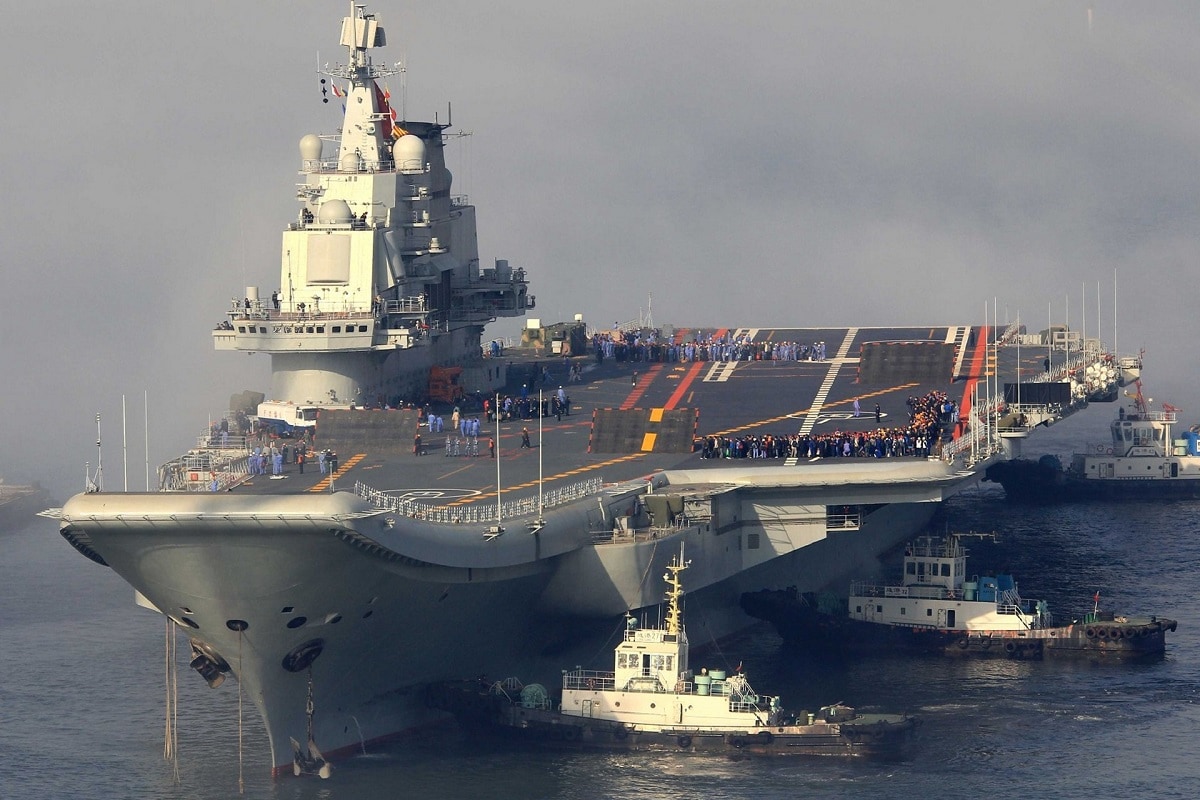
The Liaoning is a Type 001 ski-jump aircraft carrier, with a full-load displacement typically estimated at around 60,000 tons, primarily relying on the J-15 series of carrier-based aircraft to form fleet air defense and maritime strike capabilities. The Anhui is a Type 075 amphibious assault ship, with a full-load displacement of about 40,000 tons, whose core value lies not in high-speed air superiority, but in the comprehensive delivery capabilities of helicopters, landing forces, air-cushion vehicles, and command platforms.
Training these two types of platforms together presents technical challenges not in whether the two large ships can sail side by side, but in whether the command chain, communication chain, data chain, and task division can truly synchronize. The carrier group is responsible for outer air situation early warning, carrier-based aircraft deployment, air superiority, and anti-ship operations; the amphibious group must consider assault windows, vertical landings, casualty evacuation, supply rhythms, and safety in the offshore area. In simple terms, this is about integrating "striking out" and "delivering in" into the same operational process.
Public Details Reveal Three Signals
- First, the training cycle exceeded 40 days, indicating that the Liaoning was not just conducting short operations close to shore, but was engaged in sustained maneuvers between the South China Sea and the Western Pacific.
- Second, the training subjects included live ammunition use, air superiority, air defense, maritime strikes, and open sea rescue, which go beyond mere demonstration sailing and are closer to multi-subject stress testing.
- Third, CCTV footage showed J-15T aircraft taking off and landing day and night, Y-20 aerial refueling, and a suspected Type 054B frigate accompanying the group, indicating that the formation is testing longer ranges and more complete layers of air defense and anti-submarine capabilities.
It is important to be cautious here. The public reports did not provide the number of sorties for carrier-based aircraft, types of ammunition, or the scale of the amphibious units, nor did they specify whether the Anhui actually launched helicopters for open sea assault training. Therefore, this training should not be interpreted as the PLA having developed mature joint amphibious operational capabilities akin to those of the U.S. military. The author prefers to view it as a public process validation: first confirming that the two formations can coordinate in the open sea, and then gradually increasing the complexity of the subjects.
Japan's Monitoring Actually Provided Real Pressure
The Chinese reports specifically mentioned that Japanese ships and aircraft closely monitored the exercises multiple times. The China Daily also noted the appearance of the Japan Maritime Self-Defense Force destroyer "Asahi" in the footage, and stated that the Liaoning's carrier-based aircraft had monitored U.S. anti-submarine patrol aircraft. Such monitoring certainly carries political implications, but from a training perspective, it also provided the formation with external pressure that is difficult to simulate in normal conditions.
The biggest fear in open sea formation training is a "too clean script." If there are no foreign military ships or aircraft nearby, early warning, identification, air interception, formation changes, and radio control can easily turn into rehearsed performances. The continuous monitoring by Japanese ships and aircraft effectively forced the Liaoning carrier group to maintain a higher state of alert, and it also tested the speed of intelligence sharing between different vessels.
The Real Shortcoming Still Lies in Fixed-Wing Carrier-Based Aircraft
This training has publicly released system capabilities, but the physical limitations of the Liaoning have not disappeared. The ski-jump takeoff restricts the operational efficiency of carrier-based aircraft with full fuel and munitions, and the early warning system still primarily relies on helicopters and shipborne radars. Compared to aircraft carriers equipped with catapults and fixed-wing early warning aircraft, there is still a gap in open sea air situation coverage. Once the Fujian enters service in the future, the KJ-600 and catapult-equipped carrier-based aircraft may fill this gap.
Therefore, the significance of this joint training between the Liaoning and the Anhui does not lie in proving that the PLA has already established a U.S.-style amphibious expeditionary strike group, but in indicating that the navy is integrating different large-deck platforms into the same open sea task chain for refinement. Regarding the Taiwan Strait, this means that future landing operation scenarios involving offshore blockades, air cover, and vertical delivery will undergo integrated exercises earlier; regarding the outer side of the first island chain, it means that the Chinese navy hopes to transform the aircraft carrier from a "core of training fleets" into a "hub for multiple formation tasks."
The Chinese military network stated that this training was organized according to the annual plan and was not aimed at any specific country or target; the Global Times quoted experts as saying that this is the first public report of joint training in the open sea between the PLA's aircraft carrier group and amphibious assault ship group.
What is more worth watching next is not whether the Liaoning will conduct further open sea training, but whether the Anhui, Guangxi, and Hainan, these 075-class ships, will take turns entering similar formations. If such training becomes routine, the question will shift from "Can they operate together?" to "Can they conduct continuous operations in a complex electromagnetic environment for several days at the same rhythm?" The answer to that is still not publicly available.
The Liaoning aircraft carrier returned to Qingdao on June 22 after 40 days of training, marking the first public joint exercise with the Anhui amphibious assault ship. The training involved various tactical operations, including live-fire exercises, in the South China Sea and Western Pacific, while being monitored by Japanese naval forces. This exercise aimed to enhance coordination between different naval platforms and tested the PLA Navy's operational capabilities.
- Liaoning aircraft carrier returned to Qingdao after 40 days of training.
- First public joint training exercise between Liaoning and Anhui.
- Training included live-fire exercises and tactical operations in the South China Sea and Western Pacific.
- Japanese naval forces monitored the exercise closely, adding external pressure.
- The exercise tested coordination between different naval platforms.