
Liaoning's 350-Nautical-Mile Luzon Patrol Shows China Can Split US Attention
 Marcus Chen
Liaoning's 350-Nautical-Mile Luzon Patrol Shows China Can Split US Attention
Three hundred and fifty nautical miles east of Luzon is not a symbolic location. It is outside the Taiwan Strait, outside the South China Sea, and still close enough to force every U.S. and allied commander in the theater to ask the same question: which Chinese formation gets watched first?
That was the useful fact in USNI News' June 12 Western Pacific Pulse. The People's Liberation Army Navy carrier CNS Liaoning was reported operating in the Philippine Sea about 350 nautical miles east of the northeastern tip of Luzon, according to a map released by Taiwan's National Security Council secretary general Joseph Wu. At roughly the same time, the U.S. carrier USS George Washington was also in the Philippine Sea, while USS Boxer and USS Portland, with elements of the 11th Marine Expeditionary Unit, were operating in the South China Sea.
The Formation Matters More Than the Flag
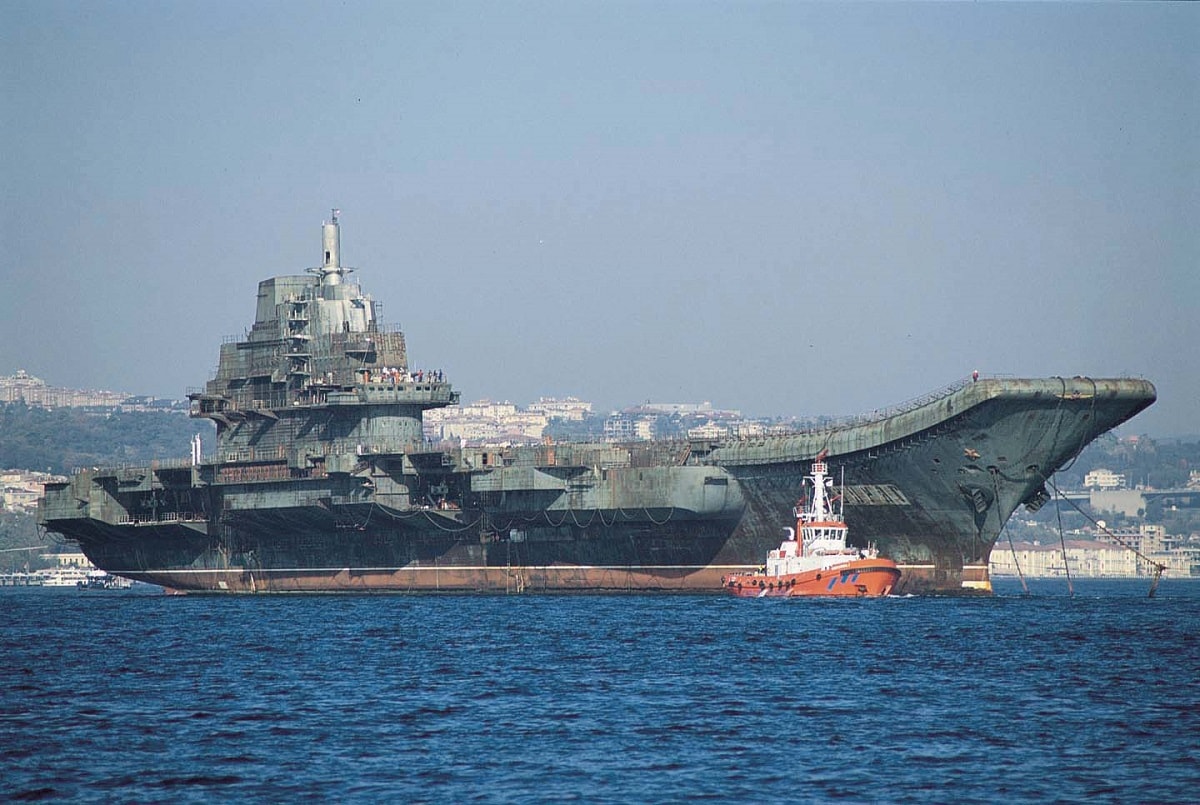
Liaoning is not China's most capable carrier. It is a refurbished Soviet hull with ski-jump launch limitations, a smaller air wing than a U.S. nuclear carrier, and no catapult system. Anyone who treats it as a peer of George Washington is doing brochure analysis, not naval analysis.
But the carrier does not need to match George Washington one-for-one to create operational problems. The reported group included Liaoning, the Type 055 cruiser CNS Wuxi, the Type 052D destroyer CNS Kaifeng, the frigate CNS Luohe, and the fast combat support ship CNS Hulunhu. That is a self-contained surface formation with air defense, command-and-control, escort capacity, and underway logistics. It is not a port-visit package.
Japan's Maritime Self-Defense Force destroyer JS Asahi had been shadowing the group, and Beijing confirmed the carrier's continued Western Pacific presence during a Ministry of National Defense press briefing. The Chinese spokesman described the deployment as planned training. That phrasing is routine, but the location is not trivial. A carrier east of Luzon is already beyond the first island chain.
The U.S. Navy Had Assets Nearby, But Not Excess Capacity
The U.S. side was not absent. George Washington was operating in the Philippine Sea and conducted fueling at sea with USNS Earl Warren on June 8. Boxer and Portland were in the South China Sea with Marine F-35Bs staged on Boxer's flight deck. That is real combat power, not a press release.
The problem is distribution. A U.S. carrier strike group in the Philippine Sea has to cover too many tasks at once: defend itself, reassure Japan and the Philippines, watch Taiwan's eastern approaches, keep aircraft and escorts ready for South China Sea contingencies, and preserve enough range to matter if China tries to complicate Guam's reinforcement lanes. Add a Chinese carrier east of Luzon and that task list does not merely grow. It splits.
A Nimitz-class carrier can generate more sorties and carry heavier fixed-wing aviation than Liaoning. But sorties have to be flown in the right direction, supported by tankers, protected by escorts, and sustained over days. The Philippine Sea is large enough that a formation 350 nautical miles from Luzon can force attention without being close enough for easy containment.
That is the carrier math Washington dislikes: China does not need superiority everywhere if it can create enough simultaneous uncertainty in two or three places.
The South China Sea Piece Is the Trap Door
Boxer and Portland operating together in the South China Sea sounds stabilizing. An amphibious assault ship with F-35Bs and a Marine Expeditionary Unit gives the United States a flexible package for presence, evacuation, limited strike, and crisis response.
But the Boxer group was not whole. USNI noted that USS Comstock, the third ship of the Boxer Amphibious Ready Group, was operating in U.S. Central Command. That is normal global force management, but it is also the point. The United States keeps talking about the Indo-Pacific as the priority theater while pieces of its amphibious and surface fleet are pulled elsewhere. A split ARG can still do work. It cannot do all the work.
If a crisis opened around Taiwan while the Liaoning group sat east of Luzon and Chinese coast guard or maritime militia pressure rose in the South China Sea, the U.S. commander would face a brutal allocation problem. Keep George Washington oriented toward the PLAN carrier? Push aviation toward Taiwan's east coast? Reinforce the Boxer group? Move escorts to cover logistics ships? None of those choices is clean.
China Is Practicing the Outer Screen
For years, Western debates about a Taiwan fight focused on the beaches, the missile salvos, and the immediate blockade line. Those remain central. But a Chinese carrier in the Philippine Sea points to a wider concept: an outer screen that complicates U.S. and allied movement before the decisive fight begins.
Liaoning does not have to defeat George Washington. It can help extend Chinese sensing, force Japan and Taiwan to track another axis, and create a moving air-defense and command node outside the first island chain. Its escorts matter because a Type 055 brings long-range air-defense and surface-strike capacity. Hulunhu matters because logistics is what turns a demonstration into a deployment.
The Taiwan HIMARS Drill Completes the Picture
Taiwan's own live-fire drill this week adds another layer. USNI reported that Taiwan fired newly procured M142 HIMARS on its west coast, with launchers relocating within three minutes after firing. TaiwanPlus reported 32 rockets fired, with four failing to launch. Taipei wants a force of 111 HIMARS after a planned order of 82 additional launchers, and the system can fire munitions from roughly 20 to 186 miles today.
That is the right direction for Taiwan: mobile fires, quick displacement, and weapons that make an amphibious crossing expensive. But HIMARS on Taiwan's west coast does not solve the Philippine Sea problem. It can punish landing forces, ports, and some staging areas. It cannot by itself keep a Chinese carrier group from complicating the eastern approaches.
That is why the week matters. Taiwan is improving denial inside the immediate fight. China is practicing how to stretch the outer fight.
The Judgment
The Liaoning patrol should not be inflated into proof that China has caught the U.S. Navy. It has not. George Washington remains the more capable carrier, and U.S. undersea forces remain the harder problem for Beijing.
But the patrol does show that China can now put a credible carrier surface group in a place where it changes U.S. calculations. That is enough. Sea control is rarely binary; it is usually a contest over time, attention, and risk. A Chinese formation 350 nautical miles east of Luzon eats all three.
The Pentagon can still win the carrier comparison on paper. The operational question is whether it can win the calendar, the geography, and the logistics at the same time. This week in the Philippine Sea suggests that margin is shrinking.
CNS Liaoning conducted patrol operations in the Philippine Sea, 350 nautical miles east of Luzon, in June 2023. The formation included the Type 055 cruiser CNS Wuxi, Type 052D destroyer CNS Kaifeng, frigate CNS Luohe, and support ship CNS Hulunhu. The U.S. carrier USS George Washington was also present in the area, highlighting the strategic implications of the Chinese naval presence. Taiwan conducted live-fire drills with HIMARS, further complicating the regional security dynamics.
- CNS Liaoning was operating 350 nautical miles east of Luzon.
- The U.S. carrier USS George Washington was also in the Philippine Sea.
- The Chinese formation included multiple naval vessels with air defense and logistics capabilities.
- Japan's Maritime Self-Defense Force destroyer JS Asahi was shadowing the Chinese group.
- Taiwan conducted live-fire drills with HIMARS on its west coast.