
Mi-8 with EW System Transforms Russian Defense Against Drones into a Mobile Dome 2026
 Dmitri Volkov
Mi-8 with EW System Turns Russian Defense Against Drones into a Mobile Dome 2026
The most important aspect of the story regarding the new Russian Mi-8 is not the helicopter itself. The machine, developed back in the early 1960s, has long been a military workhorse of Eurasia. What is more significant is that Russian engineers, judging by the published footage, are attempting to transform the mass transport helicopter into a mobile node for suppressing satellite navigation. This is not a flashy novelty for a parade, but a pragmatic response to the unpleasant fact of 2026: Ukrainian long-range drones are forcing Russia to defend not individual objects, but entire corridors of airspace.
What the Leaked Footage Showed
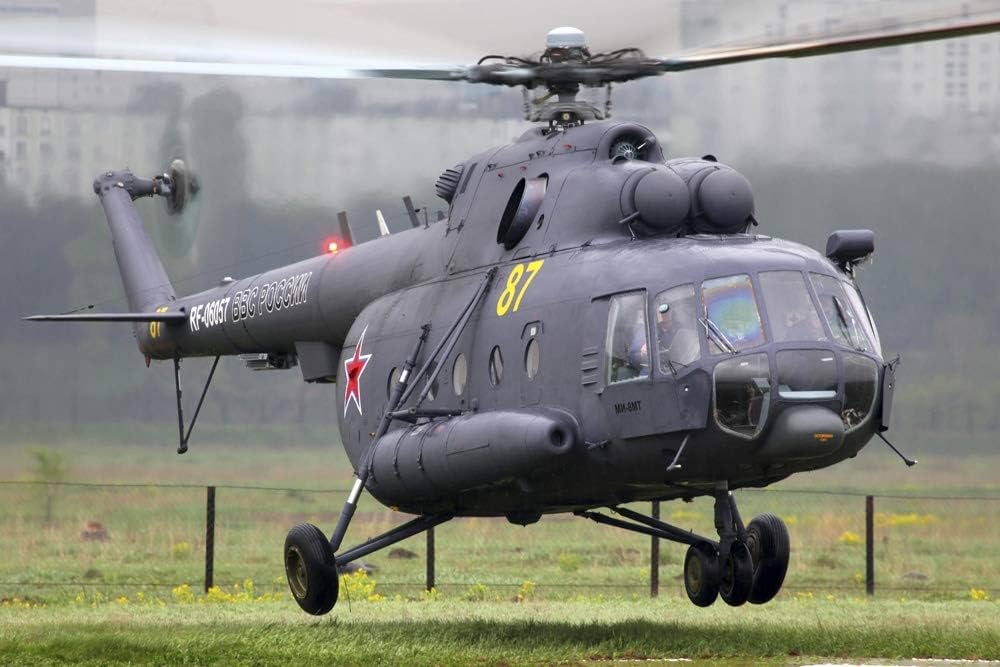
Militarnyi reported that a previously publicly unknown system was shown by a Russian propaganda Telegram channel, likely by accident. The photographs show a Mi-8 with several flat panel antennas mounted on board at various angles. This geometry provides a coverage sector of about 180 degrees; it is logical to assume that a similar set is installed on the other side of the fuselage, otherwise the system would be tactically too limited. According to Ukrainian analysts, only two cables are connected to each panel. This small number of cable inputs poorly aligns with the broadband suppression of radio-controlled FPV drones at the front line, where frequencies change rapidly and the enemy constantly evades interference. However, it is well-suited for the task of suppressing GNSS signals, that is, GPS, GLONASS, and adjacent bands used by long-range strike UAVs.
The technical logic here is quite clear. One explanation is that the two cables serve different polarizations, which reduces the dependence of the jamming effectiveness on the orientation of the drone's receiving antenna. Another option is that they operate across two satellite navigation bands: L1 around 1.5-1.6 GHz and L2/L5 around 1.2 GHz. In both cases, the focus is not on combating every small drone over the trench, but on creating a zone where the long-range device loses regular course correction. Inertial navigation allows for further flight, but the error accumulates. For striking an oil depot, airfield, or military factory workshop, even a few hundred meters of deviation can sometimes mean mission failure.
Why a Helicopter Was Chosen
A stationary EW complex protects a point. A helicopter protects a direction. This is a fundamental difference. Ukrainian attacks on Russian territory in recent months have shown that the line of threat is constantly shifting: today it is an oil depot, tomorrow a logistics warehouse, the day after tomorrow a long-range aviation airfield. A ground system requires transportation, security, camouflage, and time to deploy. The Mi-8 can lift antennas to altitude, quickly move to the required area, and create a temporary jamming dome along the presumed routes of the drones. In Soviet terminology, this resembles not classical air defense of an object, but a maneuver of support forces, only instead of an anti-aircraft battery, it is an electronic warfare shadow that maneuvers.
There is also a less pleasant side for Moscow. The very fact of such a solution indicates the inadequacy of conventional layered defense. If the combination of radars, air defense systems, small-caliber artillery, and ground EW reliably secured the rear, the helicopter variant would not be necessary. The Russian system for countering long-range UAVs is forced to become more mobile because the Ukrainian strike system has already become networked and distributed. This is an old Russian problem: a strong school of electronic warfare faces a cumbersome organization of application. Technology sometimes appears faster than the doctrine of its normal use.
Production Base and Scaling Costs
The production background is of separate significance. Dallas Analytics claims, based on obtained documents, that Russia plans to manufacture 72 multipurpose Mi-8MTV-1 helicopters at the Kazan Helicopter Plant in 2026-2027, of which at least 37 machines in 2026. If this estimate is close to reality, the Ministry of Defense will have a reserve of airframes that can be distributed among transport, search and rescue, airborne, and special tasks. There is no need to wait for a fundamentally new helicopter to convert them into EW carriers. A mass platform, electrical power, space for equipment, and a clear repair base are sufficient. In this sense, the Mi-8 remains the ideal Soviet product: not shiny, but resilient and repairable.
However, the figure of 72 does not mean the automatic appearance of 72 flying jammers. The same investigation by Dallas Analytics notes bottlenecks: funding for suppliers, cooperation among dozens of enterprises, dependence on engines and onboard electronics, including structures related to the radio-electronic technology concern. For Russia in 2026, producing the airframe is no longer the most complex part. It is more challenging to serially produce quality electronics that are protected from overheating, vibration, sanctions replacements, and operational negligence. The Russian defense industry knows how to create prototype solutions. Scaling them without degrading quality is a completely different task, and this is usually where the boring but decisive accounting of war begins.
Operational Consequences for Ukraine
For Ukraine, the emergence of such a complex does not negate long-range strikes, but it changes their calculations. Routes will have to be planned with consideration of possible mobile jamming zones, more frequently using combined navigation, terrain correlation, visual landmarks, or more complex autonomous flight algorithms. This increases the cost of each strike. But for Russia, the price is not zero either: the EW helicopter itself becomes a valuable and noticeable target. It requires a crew, airfield, maintenance, fuel, and cover. Unlike a ground antenna, its loss will be not only material but also personnel-related.
Most likely, Moscow will use such Mi-8s not constantly, but episodically — during periods of threat from mass strikes or over areas where routes of Ukrainian devices have already been recorded. This corresponds to the Russian habit of addressing problems not by reforming the entire system, but by creating a specialized crutch. Sometimes such crutches work surprisingly long. Sometimes they merely transfer vulnerability from the ground to the air.
In the military history of Russia, the Mi-8 has always been a symbol of adaptability. In 2026, it may also become a symbol of how the depth of the rear has ceased to be a geographical concept.
My forecast is cautious: EW helicopter complexes can reduce the accuracy of some Ukrainian long-range strikes, especially against simple UAVs dependent on GNSS, but they will not restore the previous inviolability of the Russian rear. For that, a dense system of detection, command, and fire defeat is needed, not just antennas on the good old Mi-8. The Russian army is once again buying time with a Soviet platform; the only question is how much time it will manage to buy and at what cost.
Russia is developing a mobile electronic warfare system on the Mi-8 helicopter to counter long-range UAVs, with plans to produce 72 Mi-8MTV-1 helicopters by 2026-2027. This system aims to create jamming zones for GNSS signals, allowing for rapid deployment in response to threats. The initiative reflects a shift in Russian defense strategy due to the increasing effectiveness of Ukrainian UAVs.
- Russia is developing a mobile electronic warfare system on the Mi-8 helicopter to counter long-range UAVs.
- 72 Mi-8MTV-1 helicopters are planned for production by 2026-2027.
- The new system aims to create a jamming zone for GNSS signals used by UAVs.
- The Mi-8 can quickly relocate to create temporary jamming zones in response to threats.
- The development indicates a shift in Russian defense strategy due to increased UAV threats.