
National Military Food Supply Accelerates into a New Stage of Multi-Modal Support
“Within the standard quota, military dining units can adjust according to needs, based on the principle of equivalent substitution.” Recently, relevant national departments and the Logistics Support Department of the Central Military Commission, based on the experience of pilot work, have launched standardized military food supply variety substitution across the country, marking the acceleration of national military food supply into a new stage of multi-modal support, with characteristics of readiness for combat becoming more pronounced, providing solid support for military training and preparation for war.
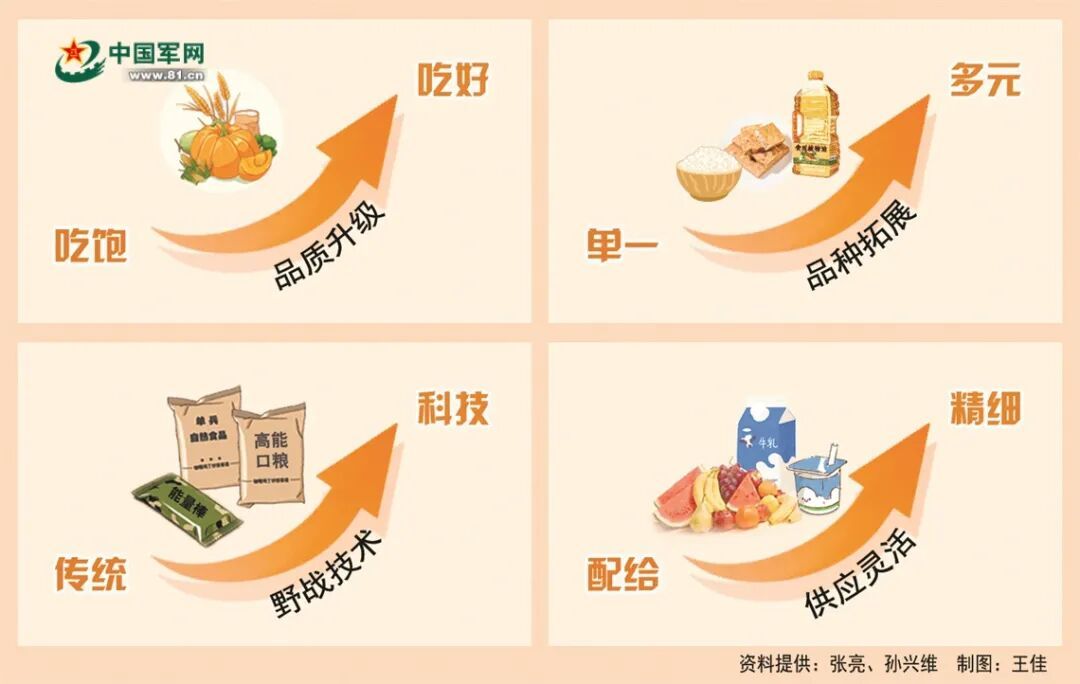
As military training and preparation for war continue to advance towards practical combat, the traditional varieties and scope of military food supply are increasingly unable to meet the diverse needs of the troops. Therefore, the national military food management departments adhere to a problem-oriented approach, adjusting traditional military food supply varieties and scope, and innovatively implementing a military food supply variety substitution system to better meet the dietary nutrition matching, combat readiness training, and diverse military task support needs of the troops.
Military food supply variety substitution refers to the military food procurement units at military food supply points exchanging military food indicators such as rice, wheat flour, edible vegetable oil, and soybeans for other grains, oils, beans, and their products. Among them, the quantity of staple food finished and semi-finished products substituted must not exceed 40% of the overall substitution quantity for the current year in the province (autonomous region, municipality directly under the central government).
It is understood that the substitution products are generally procured in a coordinated manner, primarily funded by provincial-level grain and material reserve departments, with municipal-level grain and material reserve departments providing supplementary support. The provincial and municipal grain and material reserve departments will procure substitution products in accordance with military food procurement methods.
Relevant departments have also strictly standardized the substitution procedures, clarifying the responsibilities for each link, including the substitution product list and substitution demand, according to the principle of “who approves, who is responsible.” The troops will carry out variety substitutions based on the submitted substitution demands, with the total annual substitution quantity of rice, flour, oil, and beans not exceeding 25% of the grain procurement plan. Military food supply points will process substitution documents through the military food supply management information system, serving as original accounting evidence for procurement units, and will report relevant data generated from substitution activities to provincial-level grain and material reserve departments on a quarterly basis.
Source: PLA Daily
Author: Zhang Liang, Sun Xingwei
The National Military Food Supply Department in China is implementing a new multi-form support phase for military food supplies, allowing units to adjust food types based on needs. This includes a system for exchanging various food types, with strict regulations on the total amount exchanged. The changes aim to better meet the diverse dietary and training needs of military units.
- The military food supply is entering a new multi-form support phase.
- Units can adjust food supplies based on needs and equivalent principles.
- A system for exchanging food types has been implemented.
- The total amount of food type exchanges cannot exceed 25% of the procurement plan.
- The process is regulated with strict approval and responsibility guidelines.