
Mitsubishi Heavy integrates Hivemind AI into drone
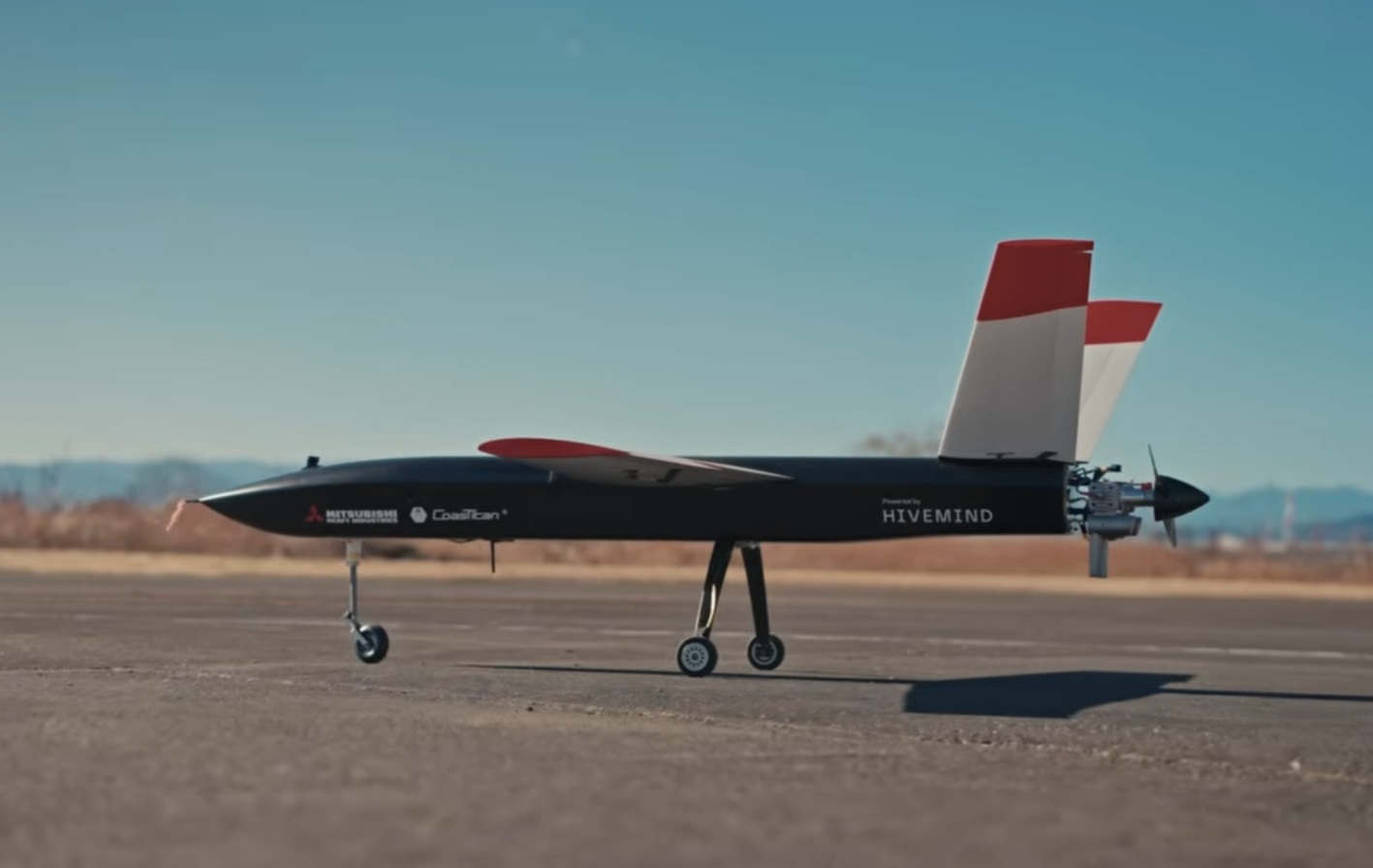
Mitsubishi Heavy Industries confirmed it has successfully conducted flight demonstrations of AI-powered mission autonomy for unmanned aerial vehicles, using the Hivemind Enterprise development environment from U.S.-based Shield AI.
According to Mitsubishi Heavy Industries, the full development cycle—from AI design and training to installation and flight—was completed in eight weeks.
The company stated that the use of Shield AI’s Hivemind Enterprise environment allowed engineers to focus more directly on mission autonomy rather than building and maintaining multiple development tools.
Flight demonstrations were conducted on November 7, 2025, in Inashiki District, Ibaraki Prefecture, and on December 18, 2025, in Ota City, Gunma Prefecture. The AI system was integrated into the company’s ARMD (Affordable Rapid-prototyping Mitsubishi-Drone initiative) unmanned aerial vehicle following simulation evaluation and Hardware-in-the-Loop testing.
According to the company, the UAV completed successful flight demonstrations after the AI system was trained and validated through simulation and testing phases.
In a statement, Mitsubishi Heavy Industries said it “successfully conducted flight demonstrations of AI-powered mission autonomy developed for use in unmanned aerial vehicles by leveraging an AI development environment through Hivemind Enterprise.”
The company added that mission autonomy development began in September 2025 and emphasized that domestic production of such capabilities is essential for Japan’s future UAV operations.
The ARMD UAV used in the demonstration has an overall length of 2.5 meters, a wingspan of 2.5 meters, and a takeoff weight of 20 kilograms, powered by an engine-based propulsion system.
Mission autonomy refers to the ability of a UAV to perform tasks such as navigation, targeting, and decision-making with minimal or no human intervention. This capability relies on artificial intelligence models trained through simulation and real-world testing to interpret sensor data and execute mission objectives.
The use of a development platform such as Hivemind Enterprise enables faster iteration of AI models, allowing developers to test and refine autonomous behaviors in simulated environments before deploying them on physical systems.
This approach reduces development complexity by consolidating coding, training, simulation, and testing processes into a single environment, rather than relying on multiple separate tools.
The collaboration between Mitsubishi Heavy Industries and Shield AI reflects growing international cooperation in the field of defense-related artificial intelligence, particularly in unmanned systems.
Shield AI has developed autonomy software designed to enable UAVs to operate in complex and contested environments where communication links may be limited or disrupted.
Content preview only. Full article available at source. View Full Article
Mitsubishi Heavy Industries successfully conducted flight demonstrations of AI-powered mission autonomy for unmanned aerial vehicles in Inashiki District and Ota City, Japan, on November 7 and December 18, 2025. The ARMD UAV, weighing 20 kilograms, was integrated with the Hivemind AI system, allowing for advanced autonomous operations. This development emphasizes the importance of domestic production capabilities for Japan's future UAV operations.
- Mitsubishi Heavy Industries conducted flight demonstrations of AI-powered UAVs.
- The demonstrations took place on November 7 and December 18, 2025.
- The UAV is part of the ARMD initiative and weighs 20 kilograms.
- The AI system was developed using Shield AI's Hivemind Enterprise environment.
- Mission autonomy development began in September 2025.