
Mogadishu opens two days of security conference in 2026 — Al-Shabaab already tests the post-AU mission
 Marie Dubois
Mogadishu Opens Two Days of Security Conference in 2026 — Al-Shabaab Already Testing the Post-AUSSOM Era
On September 1, in Mogadishu, federal officials, security agency heads, and representatives from member states gathered for a national conference on internal security. The setting is administrative, but the stakes are very concrete. By the end of 2026, Somalia must take on a much larger share of the tasks currently absorbed by AUSSOM, the African Union's support and stabilization mission. At the same time, Somali intelligence claims to have killed a key Al-Shabaab intelligence leader in the Jilib area with the support of international partners. These two pieces of news appear to align. In reality, they mainly tell the story of a still fragile transition.
A Conference Born from Institutional Urgency
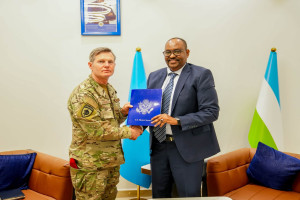
According to details published in Mogadishu, the conference will focus on three topics: the political oversight of security institutions, coordination between agencies, and funding capacity. These are exactly the three points that deteriorate first when an external mission withdraws too quickly. On the ground, a unit may still fight effectively for a few weeks. What breaks down next is the chain between the ministry, intelligence, police, local forces, and regional governors. Somalia is already familiar with this problem. Between Villa Somalia, NISA, the police, and the federal states, authority exists on paper, but it remains uneven as soon as one leaves Mogadishu and the main routes.
The very fact of dedicating an entire conference to funding is a useful admission. Offensive operations against Al-Shabaab do not rely solely on soldiers. They depend on fuel, bonuses, radio communications, medical evacuations, village informants, and the regular pay of deployed personnel. When these elements arrive late, checkpoints empty, patrols shorten, and secondary roads effectively fall back under insurgent control.
Jilib Shows Tactical Success, Not Yet Sustainable Superiority
The announced death of an Al-Shabaab intelligence official in the Jilib region is significant. Jilib is not just any symbolic locality. It is a hub of the insurgent rear in Middle Juba, a space where the organization protects its links, its cadres, and its decision-making circuits away from the political showcase of Mogadishu. Striking there, with the support of partners and based on sufficiently accurate intelligence, indicates that the Somali apparatus retains useful sensors. But caution is necessary. Official communication provides little detail about the exact identity of the targeted cadre, collateral damage, and how the information was verified. In this theater, claiming quickly and confirming slowly is a wartime habit.
Marie Dubois knows from experience: eliminating an intelligence chief is not enough to clear a logistical axis. In the Somali countryside, Al-Shabaab's real power lies less in the prestige of a name than in its ability to collect, intimidate, transmit an order, and mine a path at the right moment. As long as the state does not permanently control the roads, villages, and crossing points between Lower Shabelle, Middle Shabelle, and Middle Juba, the organization can replace one cadre with another and rebuild its depth.
The Post-AUSSOM Era Will First Be a Test of Local Coordination
The most concerning point is therefore not the current intensity of fighting. It is the timeline. The conference opens as the transition away from AUSSOM approaches rapidly and Somali forces must already absorb more security, investigation, static protection, and offensive action missions. However, these missions do not require the same reflexes. An army can succeed in a raid with external support and then fail to hold a town, register the population, reopen a market, and protect the road leading to it. This is where the insurgents return.
Signals from Mogadishu also show that the authorities understand the danger: they speak of oversight, coordination, and money long before discussing major victories. This is less spectacular language, but more serious. If the government had to choose its priority, it would not be to produce more triumphalist statements. It would be to link every air success or every intelligence coup to a credible ground presence, supported by local administrations and a reliable payment chain.
What to Watch Now
- The Mogadishu conference lasts two days, but its true value will be measured in the signed orders and released budgets.
- The areas between Mogadishu, Lower Shabelle, and the approaches to Jilib will remain the best indicators of the solidity of the transition.
- If Al-Shabaab regains the initiative on the roads or against isolated posts after this cycle of meetings, it will mean that Somalia is gaining strikes but not yet depth.
The operational warning is simple. As the end of 2026 approaches, the risk is not just a major Al-Shabaab offensive. The risk is more mundane and more dangerous: a series of small breakdowns in coordination, funding, and ground holding, modest enough to seem manageable from the capital, but sufficient to reopen corridors for the insurgents that they are already using. In this war, the map is often lost in segments of road, not by the theatrical fall of a city.
On September 1, 2026, a national security conference took place in Mogadishu, focusing on the transition from AUSSOM and the coordination of security efforts. Somali intelligence reported the killing of a significant Al-Shabaab intelligence leader in Jilib, highlighting ongoing military operations. The conference addressed critical issues such as political oversight and funding for security institutions, indicating the fragile state of security in Somalia as the country prepares to take on more responsibilities.
- A national security conference was held in Mogadishu on September 1, 2026.
- The conference focused on the political oversight of security institutions and funding coordination.
- Somali intelligence claims to have killed a key Al-Shabaab intelligence leader in Jilib.
- The transition from AUSSOM is seen as fragile and requires careful coordination.
- Al-Shabaab's ability to maintain control over regions remains a concern.