
"More than fifty ships 'sweep': It should be read as a test of grouping at the theater scale, rather than a blockade that has already been initiated."
 Li Minghui
More than fifty vessels "sweep": It should be read as a tactical probe at the theater level, rather than an initiated blockade
Li Minghui|Taiwan Strait/Indo-Pacific Analysis|October 30, 2026
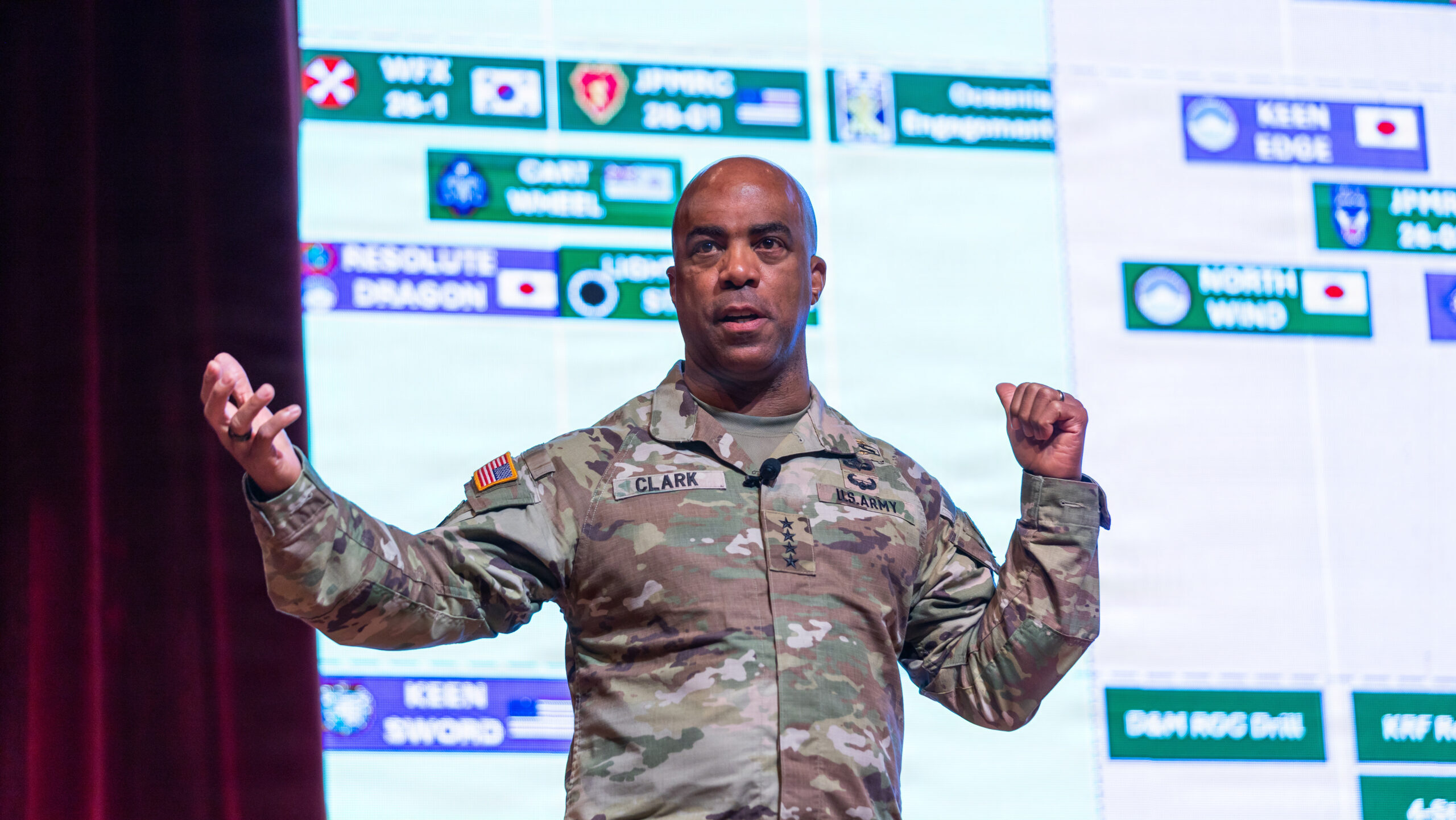 Cover image: Gen. Ronald Clark speaking at a public event in September 2026. Image: U.S. Army/Breaking Defense; not from this round of Chinese naval operations.
Judgment: The focus of this signal is not the single number "53," but rather the simultaneous distribution of vessels around Taiwan and in the broader Western Pacific, as claimed by Taiwan. If true, it indicates a theater-level maritime situation that integrates routine patrols, long-range maneuvers, reconnaissance, and external pressure within the same timeframe; however, public information is insufficient to prove that these vessels have been organized into a unified force for blockade missions, nor can it be concluded that mine sweeping, interception, or amphibious landing rehearsals have begun.
On October 29, Reuters reported that Taiwan's security chief stated that over 50 Chinese vessels had been detected and characterized them as an "obvious threat"; other Taiwanese sources referred to 53 vessels. The two figures are not necessarily contradictory: the former is a media summary of "50+," while the latter appears to be an exact value at a certain statistical point. The more critical gap is in the breakdown. Public reports did not provide the individual numbers for the navy, coast guard, auxiliary vessels, fishing boats, or maritime militia, nor did they release verifiable locations, headings, and images from the same timeframe. Therefore, at this stage, it should be referred to as "53 Chinese vessels, type not disclosed," and it is inappropriate to write "53 warships," nor should the mixing of militia and navy be treated as a given fact.
"Sweep" is not typically a fixed tactical term in a military context, but rather a media description of large-scale searches, patrols, reconnaissance, or sweeping deployments. If the operation covers directions such as the Taiwan Strait, East China Sea, Bashi Channel, and Philippine Sea, its value lies in simultaneously extending the monitoring front of Taiwan, Japan, and the Philippines, testing the response of sensors and command chains, and preventing adversaries from judging pressure solely based on the number of vessels in the Taiwan Strait. The Japanese Ministry of Defense has continuously released reports on individual vessels or formations crossing and operating, but as of the time of this writing, there has been no public summary that matches the total of 53 vessels reported by Taiwan, nor has there been confirmation that all activities are attributed to a single unified exercise; the methods for de-duplicating vessels and the scope of the maritime area still require cross-verification.
Blockade rehearsals require stricter evidence than just "large numbers and wide range": sustainable supply and command nodes, air and naval cover, inspection rules for coast guard or law enforcement platforms, control statements for ports and waterways, and identifiable divisions of labor between mine sweeping/mining, anti-submarine, and external denial forces. Only if these elements emerge subsequently can this round of operations be credibly elevated from scaled routine patrols to a blockade formation exercise. The current more prudent assessment is that this is a pressure test designed to create operational uncertainty through distributed presence; its threat lies in forcing surrounding countries to expend reconnaissance and alert resources, rather than a proven immediate intent to initiate conflict.
The Taiwanese side's use of the strong wording "obvious threat" at this time also has dual audiences. Internally, it provides a visible risk basis for air and naval reconnaissance, munitions, reserves, and asymmetric budgets; externally, it calls on the U.S., Japan, and the Philippines to view scattered tracks as a regional joint dynamic situation, rather than a gray zone event faced solely by Taipei. On the same day, General Clark of the U.S. Army Pacific Command stated in Hawaii that the "2027 window" remains valid for USARPAC, but he clearly stated that this is not a prediction of the date of conflict; the "Army Ready Forward" plan aims to rotate pre-positioned personnel, equipment, and supplies in the first and second island chains west of the International Date Line, with a readiness target of April 2, 2027. The two statements mutually reinforce deterrence while raising the risk of misjudgment: Beijing may view forward positioning as preparation for intervention, while surrounding countries may misinterpret dispersed patrols as a prelude to blockade.
Items to be confirmed
- The statistical start and end time for the 53 vessels, de-duplication rules, vessel type structure, and whether coast guard, auxiliary vessels, and maritime militia are included.
- The specific distribution of each vessel in the Taiwan Strait, East China Sea, Bashi Channel, and Philippine Sea; currently, public materials cannot confirm that each maritime area has this round of forces.
- Whether the Japanese Ministry of Defense will subsequently relate relevant individual vessel reports as part of the same operation and publish tracks that can be compared with Taiwan's figures.
- Whether evidence of blockade tasks such as supply, air force coordination, coast guard enforcement, mine sweeping/mining, or port and navigation control emerges.
Sources and verification
- Reuters, October 29, 2026, Taiwan flags 'obvious' threat from 50 Chinese vessels in wide sweep of waters (50+ figure, Taiwan's characterization, and regional activities).
- Taipei Times, October 30, 2026, Chinese warship threat ‘obvious:’ official (Taiwan's security chief's 53 vessels figure; specific article link pending archival verification by the site).
- Japan Ministry of Defense, Press Releases (successive vessel activity reports; not independently confirmed as the total of 53 vessels).
- Breaking Defense, October 29, 2026, Taiwan 2027 conflict window remains valid, Army Pacific commander says (Clark's public statement, Army Ready Forward, and April 2, 2027 readiness target).
original_url:https://www.reuters.com/world/asia-pacific/taiwan-flags-obvious-threat-50-chinese-vessels-wide-sweep-waters-2026-10-29/
Chinese vessels are conducting a wide sweep in the waters surrounding Taiwan, posing an obvious threat according to Taiwanese officials. The operation involves over 50 vessels, with some reports indicating 53, and is seen as a pressure test rather than an immediate blockade. The vessels are distributed across the Taiwan Strait, East China Sea, Bashi Channel, and Philippine Sea, but specific details on vessel types remain unverified.
- Taiwanese officials reported over 50 Chinese vessels in the vicinity, with some sources citing 53.
- The vessels are described as posing an 'obvious threat' to Taiwan.
- No specific breakdown of vessel types (navy, coast guard, militia) was provided.
- The operation is characterized as a pressure test rather than an immediate blockade.
- The Japanese Ministry of Defense has not confirmed the total number of vessels reported by Taiwan.