
North Korea's Wonsan Launches About 12 Missiles in a 250-Kilometer Barrage Test of South Korea and Japan's Early Warning System
 Tanaka Takashi
North Korea Fires About 12 Missiles in Salvo, Testing the 250-Kilometer Warning Chain of South Korea and Japan
Judgment Summary: The value of the salvo on October 29 lies not in setting another launch record, but in North Korea embedding a short-range firepower action of about 250 kilometers within a complete crisis management maneuver that rejects military contact, maintains border pressure, and avoids directly touching Japan's Exclusive Economic Zone (EEZ). It resembles a pressure test on the detection, classification, and decision-making chains of South Korea, Japan, and the United States, rather than a mere political gesture.
250-Kilometer Salvo Around 12:30 PM
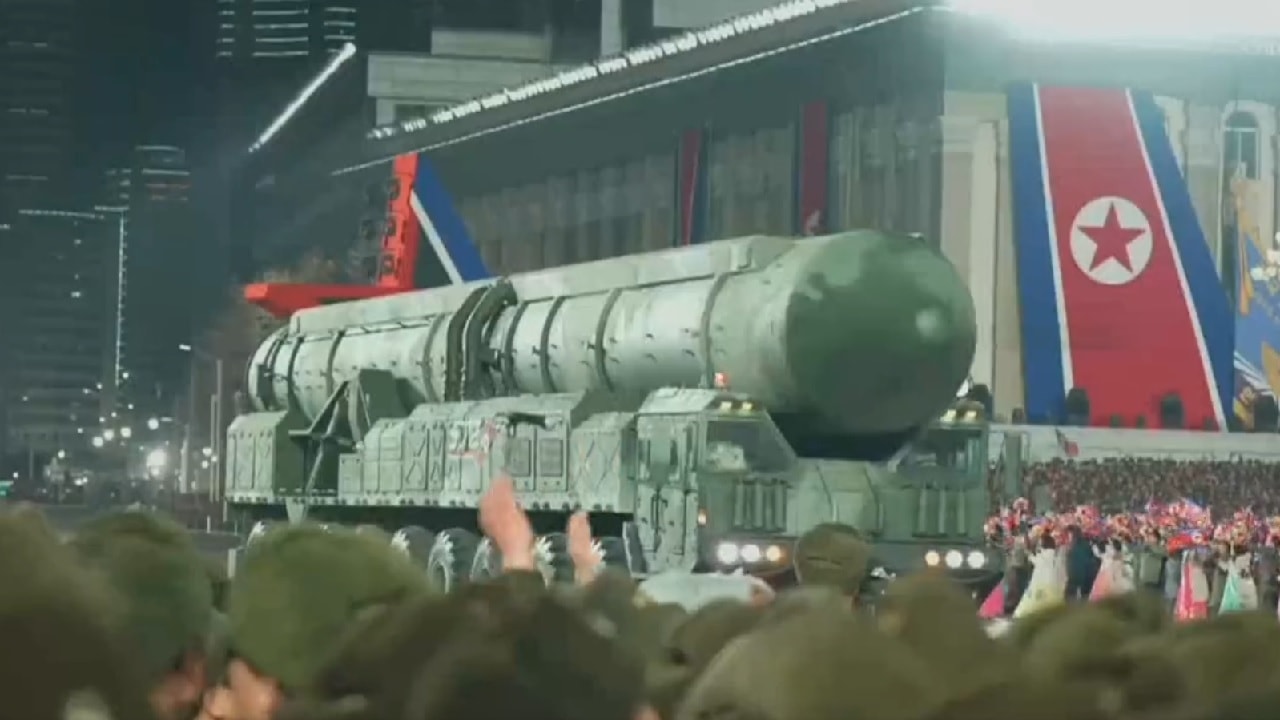 Cover image: North Korean missile launch reference image, not representative of the scene on October 29; HiWars internal assets.
The Joint Chiefs of Staff (JCS) of South Korea stated that around 12:30 PM (Korean time), North Korea launched "about 10/over 10" short-range ballistic missiles from the Wonsan area on the east coast towards the eastern sea; subsequent assessments by South Korea estimated the flight distance to be about 250 kilometers. Yonhap's follow-up report used "nearly dozen," while Reuters maintained "around 10," hence this article adopts "about 10-12," without writing it as a definitively confirmed exact number.
The Japanese Ministry of Defense initially reported that suspected ballistic missiles had fallen; Japan later assessed that the landing points were outside the EEZ, with no damage observed, and the Chief Cabinet Secretary lodged a formal protest and strong condemnation to North Korea. Choosing a 250-kilometer range for the missiles was sufficient to create an early warning burden towards the East China Sea, while not placing Japan's mainland or EEZ at direct risk of impact; this arrangement of "high visibility, low crossing degree" is part of the signal itself.
Not Confirmed as Multi-Axis, But a Saturation Test
The launch of over a dozen missiles in the same direction within a short time primarily tests not the interception probability of a single missile, but whether radar detection, trajectory association, model classification, intelligence sharing among Japan, the U.S., and South Korea, and interception resource allocation can be completed in parallel. If the launches came from different launch vehicles at different intervals, the defense side would also need to determine whether it was a live-fire salvo, mixed decoys, or a combination of rocket artillery and missiles. For Seoul, the focus of the 250-kilometer coverage is not Japan, but rather compressing the early warning and command window towards the eastern direction of the peninsula.
However, publicly available information does not yet confirm whether this round utilized multi-axis, various launch platforms, or mixed munitions. Some South Korean media speculate that it may include weapons like the 600mm super-large multiple rocket launcher (KN-25); the JCS has not publicly confirmed the models, batch timing, ballistic heights, or the number of launch vehicles. Until this data is released, defining this round directly as a "multi-axis saturation attack drill" is not rigorous. What can be confirmed is that the launch density is already sufficient to force the defense side to handle it as a saturation scenario.
The Language of Firepower After Refusal to Talk
The launch occurred about six days after Seoul proposed military talks between the North and South. Prior to this, North Korea rejected the talks and denied responsibility for the DMZ landmine explosion through a letter to the United Nations; border loudspeaker tests and artillery "demonstrations" had already heightened tensions. Therefore, the political logic of this salvo is not to repeat these events, but to provide a more specific rule: North Korea refuses to let military communication mechanisms determine border risks, while retaining the right to set its own escalation pace and intensity.
This also explains why the target was controllable eastward short-range firepower, rather than a longer-range over-the-top launch. Pyongyang can increase the immediate military costs for Seoul and the alert costs for Tokyo, while keeping the diplomatic narrative below the thresholds of "self-defense" and "counter-provocation." It is a calibrated display of force to reset the agenda when the negotiation entry is closed.
Russian Variables and the November Window
An analysis by The Diplomat on the 29th reminds that military cooperation between Russia and North Korea could allow the technical returns from North Korea's missile tests to be converted into capabilities more quickly: feedback from the Ukrainian battlefield, component and production experience exchanges could affect reliability, accuracy, and replenishment speed. However, there is no public evidence that Russian technology was directly used in this round of salvos, nor can the quantity of 10-12 be inferred to indicate a leap in production capacity. What is truly worth tracking is whether there will be more consistent hit distributions, shortened reloading rhythms, and repeated salvos of similar weapons in the future.
For the November U.S.-South Korea exercises, this round seems to place the "first round discovery—reporting—interception trade-offs" on the table in advance; the exercises should not only test whether a single missile can be intercepted, but also whether political authorization can keep pace with intelligence speed when border provocations, loudspeaker activities, and maritime salvos occur simultaneously. Regarding the possible window for a Trump-Kim meeting, Pyongyang is not simply closing the door: it is raising the threshold for contact, aiming to start the agenda with nuclear missile capabilities rather than North-South crisis management. The risk lies not in whether the meeting occurs, but in the fact that if Seoul is excluded, the shortest-range weapons are the most likely to cause misjudgments.
Items to be Confirmed
- The final confirmed number by the JCS and whether there were multiple batch launches; the current public statement is "about 10/over 10/nearly 12."
- Specific models: SRBM, KN-25 type 600mm super-large rocket launcher, or mixed groupings, none of which have been formally confirmed by the JCS.
- The launch timing, ballistic heights, and whether they came from multiple launch vehicles or launch sites; thus, "multi-axis" remains a tactical hypothesis to be verified.
- The precise landing points, flight trajectories, and details of official protests from the Japanese Ministry of Defense and the Japan Coast Guard.
- The Korean Central News Agency (KCNA) had not issued a formal statement on this round of launches by the time of this article's publication, and its subsequent statements need to be tracked.
Sources and Verification
- Statements from the South Korean Joint Chiefs of Staff, cross-verified through multiple rapid reports from Yonhap.
- Al Jazeera: Launch time, Wonsan location, and Japan's assessment outside the EEZ.
- Reports from the Japanese Ministry of Defense/Japan Coast Guard and subsequent coverage from NHK, Jiji Press, and Kyodo News: outside the EEZ, no damage, and Japan's protests.
- Reuters, AP, and NK News rapid reports on the same day: cross-verification of missile count and border tension background.
- The Diplomat: Risk assessment of Russian-North Korean military technology cooperation; KCNA subsequent monitoring.
North Korea launched approximately 10-12 short-range ballistic missiles from Wonsan towards the East Sea on October 29, 2023, around 12:30 PM KST. The missiles flew about 250 kilometers, testing the early warning systems of South Korea and Japan. This action follows North Korea's refusal to engage in military talks with South Korea, indicating a strategic military maneuver.
- North Korea launched approximately 10-12 short-range ballistic missiles from Wonsan towards the East Sea.
- The missiles flew approximately 250 kilometers, testing the early warning systems of South Korea and Japan.
- The launch occurred shortly after North Korea rejected military talks with South Korea.