
MQ-25A LRIP Will Not Fix the Carrier Range Problem by 2029
 Marcus Chen
MQ-25A LRIP Will Not Fix the Carrier Range Problem by 2029
The useful number in the MQ-25A decision is not 72 aircraft. It is 15,000 pounds of fuel at 500 nautical miles from the carrier. That is the advertised tanker problem the U.S. Navy has been trying to solve for years, and on May 19 Acting Navy Secretary Hung Cao cleared Boeing's MQ-25A Stingray for low-rate initial production. Army Recognition reported on May 20 that the first three production lots could cover up to 11 aircraft, moving the unmanned carrier tanker out of pure development and into controlled manufacturing.
That is progress. It is not a range revolution yet.
The Carrier Air Wing Gets Fuel Before It Gets Range
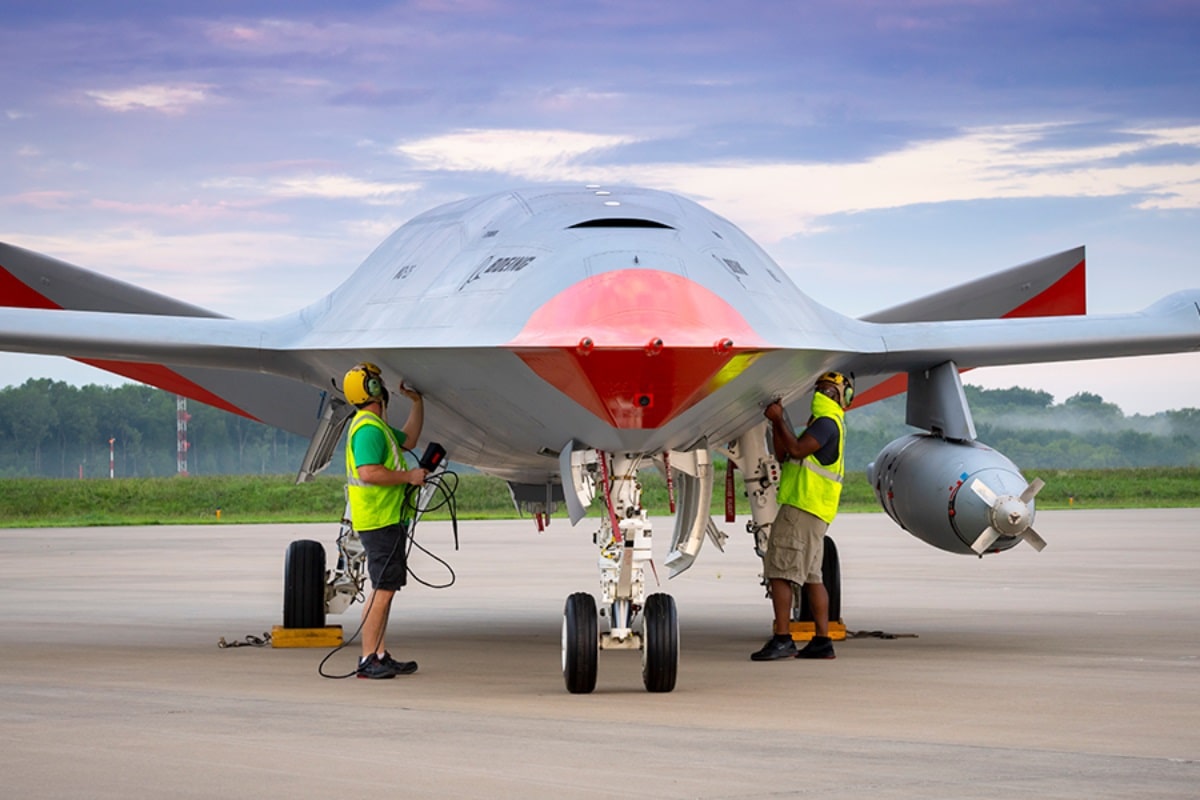
The Stingray is often described as a drone, but its first combat effect is not surveillance or strike. It is fuel. The aircraft is unarmed in the approved Navy role. Its job is to carry a probe-and-drogue refueling system, autonomous flight-control software, secure command links, and enough fuel to push manned aircraft farther from the carrier. The widely cited requirement is roughly 15,000 pounds of offload at 500 nautical miles.
Anyone who has served around a carrier strike group knows why that matters. A carrier air wing does not have unlimited F/A-18E/F Super Hornets. When Super Hornets fly with buddy stores as tankers, they are not carrying their best strike load, they are burning service life, and they are occupying deck-cycle capacity that could have been used for defensive counter-air, suppression, or maritime strike. The MQ-25A does not add a new missile to the air wing. It gives the air wing a chance to stop using fighters as gas stations.
For the Indo-Pacific, that is not a small thing. A carrier operating east of Taiwan, in the Philippine Sea, or near the approaches to the South China Sea is playing a distance game against land-based aircraft, anti-ship ballistic missiles, submarines, and long-range sensors. If the carrier has to stay farther out, the air wing either needs longer-range aircraft, more tanking, or both. The MQ-25A addresses the second requirement.
Low-Rate Production Is Not Fleet Service
The danger is treating Milestone C as if it puts operational tankers on every deck. It does not. Army Recognition notes that low-rate initial production follows the MQ-25A's first operational test flight from Boeing's MidAmerica St. Louis Airport facility and that carrier suitability work, flight-envelope expansion, mission-system verification, and operational test preparation still have to continue. Boeing's own MQ-25 page says its T1 test asset has flown since 2019 and logged about 125 flight hours, helping shape the engineering development model aircraft now in production and testing.
That is a development record, not a deployed detachment. The aircraft still has to live in the nastiest aviation workspace in the world: a moving carrier flight deck where deck handling, taxi, launch, recovery, maintenance, and command authority all collide inside tight minutes. Autonomous flight from a land base is hard. Autonomous integration into carrier cyclic operations is harder.
The production numbers also matter. Eleven aircraft across the first three lots sounds meaningful until it is spread across testing, training, maintenance attrition, and multiple carrier air wings. The Navy's larger plan has been described around a fleet of roughly 72 aircraft, while Rolls-Royce has referenced a program of record of 76 aircraft plus spare engines. Even if the final number lands near that range, the early production buy is a starter set, not a fleet-wide answer.
The 2029 Gap Is the Real Story
The Navy's schedule is the uncomfortable part. Army Recognition reports that budget documents moved initial operational capability to 2029, with the first carrier deployment no longer expected in the near term because of carrier availability and production delays. That means the Navy is still asking today's carrier air wings to manage tomorrow's Pacific range problem for several more years with the aircraft they already have.
Do the simple math. If an MQ-25A can deliver 15,000 pounds of fuel 500 nautical miles from the carrier, it can help a strike package stretch farther without forcing as many Super Hornets into tanker duty. But until the aircraft is operational, the carrier air wing remains dependent on organic buddy tanking and land-based support that may not be available when the carrier is operating under Chinese missile pressure. That is the gap.
It also exposes what the MQ-25A is not. It is not a replacement for a long-range carrier strike aircraft. It is not an F/A-XX answer. It is not a survivable penetrating reconnaissance system. In a Taiwan or South China Sea contingency, an unmanned tanker still needs protected routing, reliable command-and-control, and deck cycles that can absorb another specialized aircraft. If the Navy has to keep the carrier outside the densest threat rings, a tanker drone helps, but it does not make a short-legged air wing long-legged by itself.
China Will Measure the Deck Cycle
Beijing will not care that the MQ-25A is unmanned. Chinese planners will care whether it lets U.S. carriers launch more combat-loaded fighters from farther east, keep E-2D Hawkeyes on station longer, support EA-18G Growler jamming windows, and recover aircraft without burning Super Hornet life on recovery tanking. In other words, they will measure the deck cycle.
That is where the Stingray has real value. A dedicated carrier tanker can improve sortie quality even if it does not dramatically increase sortie quantity. More fighters can launch configured for the mission instead of carrying fuel for other aircraft. More aircraft can be recovered with a margin. More high-demand airframes can preserve service life. In a long campaign, those small efficiencies become operational endurance.
But the Navy should be honest about the timeline. Low-rate production in 2026 does not solve the western Pacific in 2026. A 2029 initial operational capability means the carrier force is entering the next three years still short of the organic range and refueling depth it says it needs. The MQ-25A is the right aircraft for a real problem. It is just arriving after the problem has already become central to carrier survival.
Sources
- Army Recognition, May 20, 2026: U.S. Navy clears Boeing MQ-25A Stingray carrier tanker drone for low-rate production.
- Boeing MQ-25 Stingray program page: T1 test asset flight history and engineering development model background.
- U.S. Navy and program reporting cited by Army Recognition: MQ-25A dimensions, fuel offload requirement, first three production lots, and 2029 IOC schedule.
The U.S. Navy cleared Boeing's MQ-25A Stingray for low-rate initial production in 2026, aiming to address the carrier's refueling needs. The aircraft is designed to deliver 15,000 pounds of fuel at 500 nautical miles, enhancing the operational range of carrier-based aircraft. However, initial operational capability is not expected until 2029, leaving current air wings reliant on existing support systems.
- MQ-25A cleared for low-rate initial production by U.S. Navy.
- The aircraft can deliver 15,000 pounds of fuel at 500 nautical miles.
- Initial operational capability is projected for 2029.
- The production will start with 11 aircraft across the first three lots.
- The MQ-25A is not a replacement for long-range strike aircraft.