
MQ-25A Stingray cleared for deployment, says Cao
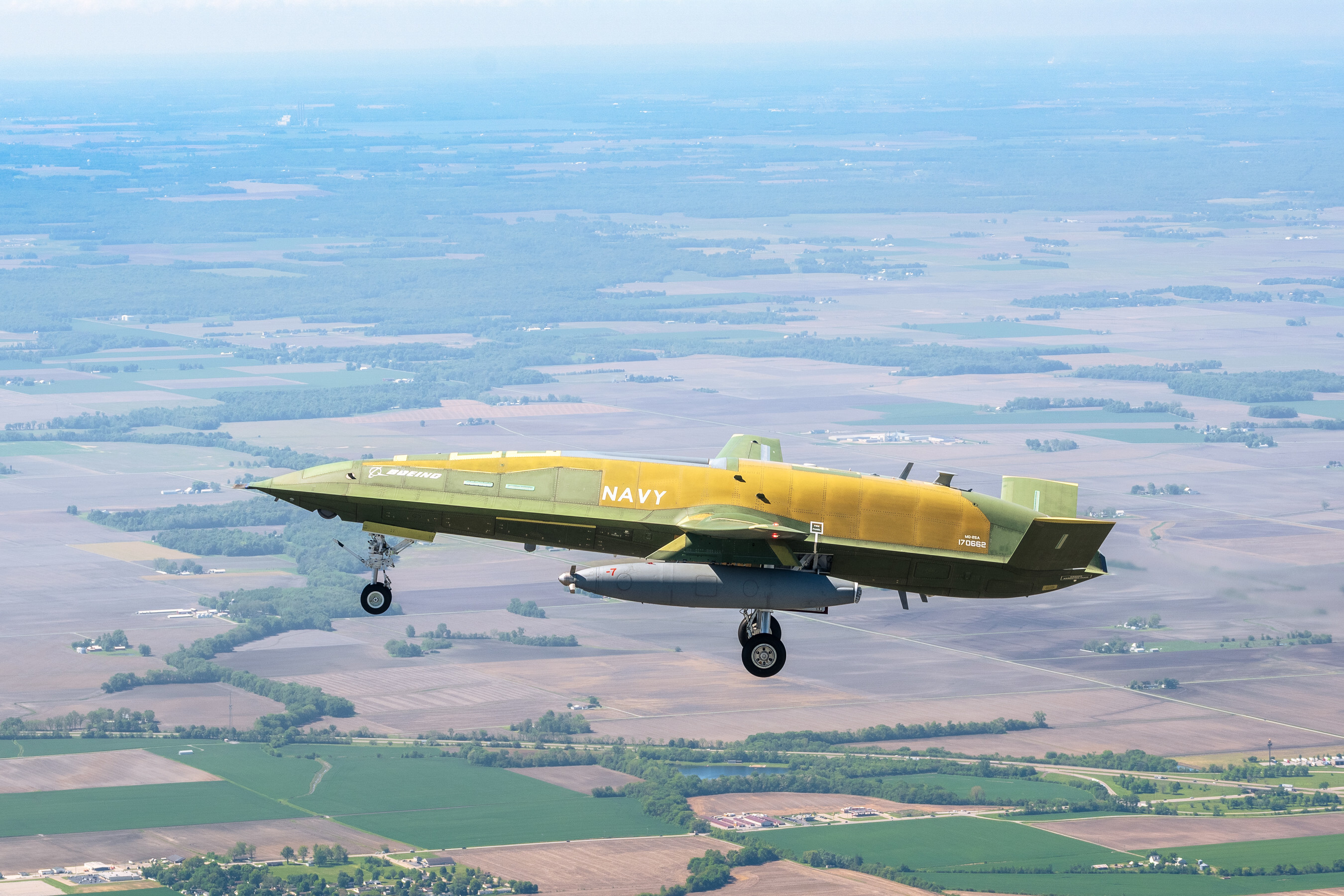
During the Senate Armed Services Committee Hearing today, Acting Secretary of the Navy, Hung Cao, announced that the MQ-25A Stingray is now moving into the low-rate initial production and deployment phase.
Boeing’s MQ-25A is the first operational carrier-based unmanned aircraft and as the Stingray enters the force, it is intended to relieve the Navy’s F/A-18 Super Hornets of their aerial refueling role.
“Integrating unmanned refueling extends the lethality of our Carrier Strike Groups and equips our force with a decisive advantage to fight and win against any adversary,” Cao wrote in a post on X.
The Stingray has reached milestone C, which in the defense acquisition process, authorizes a program to transition from the Engineering and Manufacturing Development (EMD) phase into production and deployment — a process that in this instance has been nearly eight years in the making.
Inked in 2018, the $805 million Boeing-Navy contract covered the design, development, fabrication, test and delivery of four Stingray aircraft, a program that the service expects will cost about $13 billion for 72 aircraft, according to previous Military Times coverage.
Despite its first test flight running a year later than previously planned, on April 25 the Stingray inched closer to operability when it successfully completed its first flight from Mascoutah, Illinois.
The MQ-25A was airborne for roughly two hours, according to a Navy release, with Navy and Boeing Air Vehicle Pilots controlling the Stingray from the Unmanned Carrier Aviation Mission Control System MD-5 Ground Control Station.
“Boeing is honored to work alongside our U.S. Navy partner in achieving this historic milestone in the MQ-25A Stingray’s development life cycle,” said Troy Rutherford, vice president, Boeing MQ-25 program. “We remain focused on getting this game-changing unmanned aircraft into the hands of the fleet and integrated into the carrier air wing.”
A low-rate initial production, or LRIP, Lot 1 contract for three aircraft is expected to be awarded this summer and include priced options for Lot 2 (three aircraft) and Lot 3 (five aircraft), according to the Navy release.
The role of the MQ-25A is intended to provide the Carrier Air Wing with unmanned refueling, freeing up F/A-18E/F aircraft to focus on strike missions.
“This will expand the operational reach of the air wing while preserving the service life of F/A-18E/Fs, improving readiness across the Super Hornet fleet,” the release said.
The U.S. Navy announced that the MQ-25A Stingray has entered the low-rate initial production and deployment phase as of April 25, 2023. This unmanned aircraft is designed to relieve F/A-18 Super Hornets of their aerial refueling role, enhancing the operational capabilities of Carrier Strike Groups. The program, which has been in development for nearly eight years, is expected to cost approximately $13 billion for 72 aircraft.
- MQ-25A Stingray is moving into low-rate initial production and deployment phase.
- The program has been in development for nearly eight years.
- The contract for the design and development of the Stingray is worth $805 million.
- The Navy expects the total cost for 72 aircraft to be about $13 billion.
- The first flight of the Stingray was successfully completed on April 25, 2023.