
NATO turns 5G towers into sensors in Baltic battlefield experiment
NATO linked a Maven targeting system to a national military system in a matter of hours using agentic artificial intelligence and ran a cross-border counter-drone engagement during a two-week experiment in Latvia, the alliance’s top transformation commander said on Oct. 30.
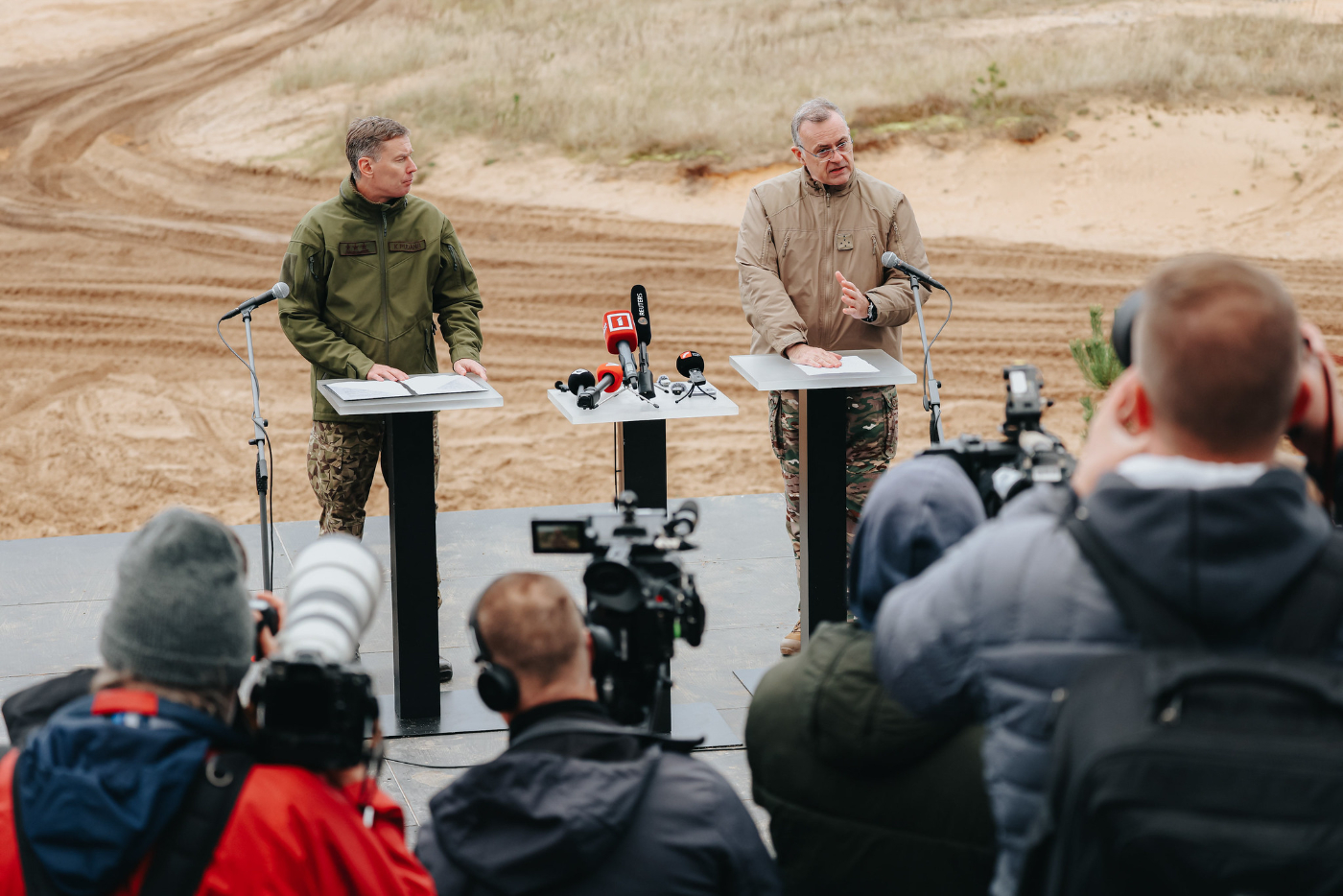
Adm. Pierre Vandier, NATO’s Supreme Allied Commander Transformation, described the results at Ādaži Military Base near Riga at the close of the Digital Backbone Experimentation, known as DiBaX 2026, which ran from Oct. 19 to 30. He said some tests failed along the way and that the alliance had deliberately accepted that risk.
“We have connected systems that were never designed to communicate with each other, using artificial intelligence to overcome interoperability barriers. It’s the first time that we have, for example, a Maven system that is speaking to a national system, and that has been fixed in hours with Agentic AI,” said Vandier.
NATO bought its own version of Palantir’s AI-enabled Maven Smart System in 2025 to help commanders pull together intelligence and speed up decisions, and has been rolling it out across its headquarters. Vandier did not say which country’s system Maven was connected to. Agentic AI refers to software that can carry out multistep tasks on its own, in this case working out how two systems exchange data.
The counter-drone test crossed a national border. A drone took off in Lithuania, flew into Latvia and was engaged there by a counter-drone system, Vandier said. It was one of several trials under NATO’s Layered Counter-UAS Initiative, which looks at how sensors and weapons from different countries and companies can work together as one layered defense against drones.
“Even if it didn’t work this morning, it has been done this week. So we had a drone taking off from Lithuania, arriving here and being engaged by a counter system,” said Vandier.
DiBaX itself tested three ways to keep NATO forces connected. In the first, organizers set up a private slice of a host country’s commercial 5G network, reserved and secured for military use, so arriving NATO forces could have command and data links from their first day before their own infrastructure arrived. The second tested automatic switching between communication paths when one is jammed, including radio across different frequencies, satellite links such as 5G direct-to-device, and troposcatter, which bounces radio signals off the lower atmosphere to reach beyond the horizon. The third used ordinary 5G cell towers as passive sensors to detect objects moving through their coverage, particularly in cities with dense tower networks. Vandier said a team of medics in the field also sent patient biodata over the network to doctors in the United States.
The scenarios were built around grey-zone incidents below the threshold of NATO’s Article 5 mutual defense clause, such as drone incursions and damage to undersea cables in the Baltic Sea. A third track, Next Generation Targeting, tested AI-enabled decision support to shorten the time between collecting information and acting on it, and Vandier said the targeting process ran noticeably faster by the end of the week than at the start.
“For us, as a NATO member of the Alliance Eastern Flank here in Latvia, we cannot afford to treat technological innovation and adaptation as a distant objective for us,” said Lt. Gen. Kaspars Pudāns, commander of the Latvian National Armed Forces.
Latvia, Lithuania, Germany, the United States, Canada, Finland and other allies took part, along with NATO bodies including the DIANA innovation accelerator and the NATO Communications and Information Agency. More than 60 technology companies joined, among them Ericsson, Nokia, Thales and Portuguese drone maker TEKEVER, with Latvian telecom company LMT acting as technical integrator. This was the fifth year in a row the experiment has been held in Latvia.
The event closed with NATO FUSE on Oct. 29 and 30, which included live field demonstrations. NATO’s Supreme Allied Commander Europe, U.S. Air Force Gen. Alexus Grynkewich, visited Latvia on Oct. 30 and met President Edgars Rinkēvičs. European Commissioner Valdis Dombrovskis used the event to announce two pilot European Drone Technology Hubs, one in Latvia and one in the Netherlands, to open in 2027 and speed up development and testing of drone and counter-drone technology in cooperation with NATO.
“The next challenge, and it’s the most difficult, is adoption,” said Vandier.
Content preview only. Full article available at source. View Full Article
NATO conducted a two-week experiment in Latvia from October 19 to 30, 2026, integrating a Maven targeting system with a national military system using agentic AI. This included a cross-border counter-drone engagement where a drone launched from Lithuania was engaged in Latvia. The experiment tested military communication methods, including a private 5G network, and involved over 60 technology companies.
- NATO linked a Maven targeting system to a national military system using agentic AI.
- A drone was engaged in Latvia after taking off from Lithuania during the experiment.
- The experiment tested various communication methods including a private 5G network for military use.
- More than 60 technology companies participated in the experiment.
- The event included live field demonstrations and discussions on technological innovation.