
NATO's 5 Percent Commitment 2026 Makes Rotterdam a Testbed for European Defense Capability
 Dr. Klaus Weber
NATO's 5 Percent Commitment 2026 Makes Rotterdam a Litmus Test for European Defense Capability
90 percent of military transport in large NATO operations depends on civilian or commercial actors. This figure is less spectacular than a new air defense system, but it better explains why Mark Rutte's speech on May 26 in Rotterdam was more significant in terms of security policy than some ministerial statements. The NATO Secretary General spoke not in a headquarters, but in front of companies, infrastructure operators, and local decision-makers. This was the message: Europe's defense capability is not only determined in barracks, shipyards, and ammunition factories, but also in ports, refineries, data centers, and vocational schools.
Rotterdam is Not a Symbol, but a Logistical Bottleneck
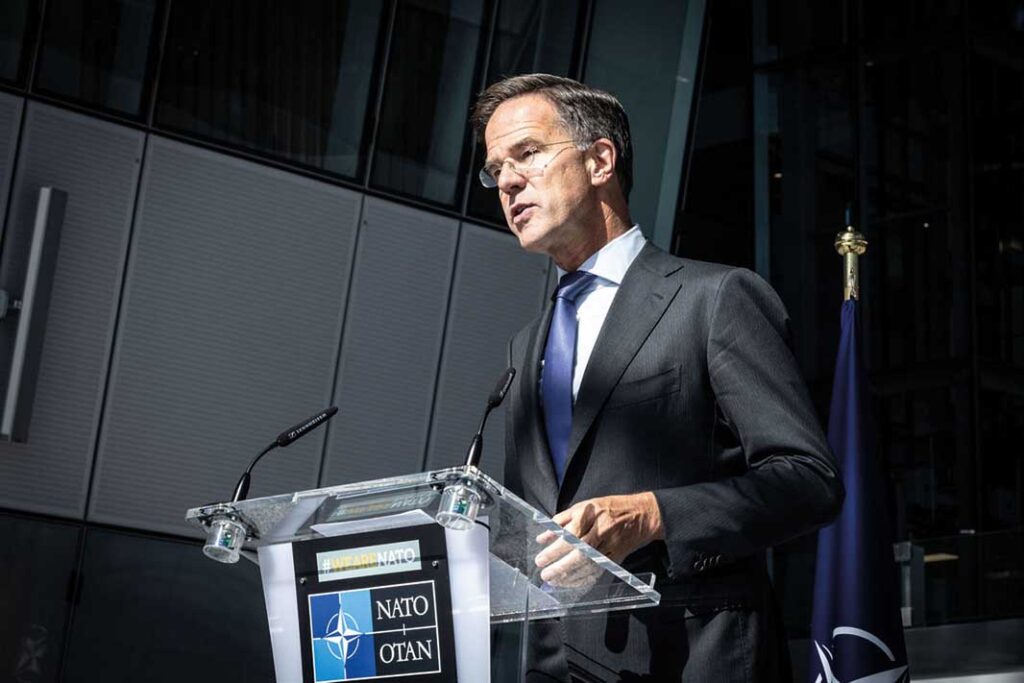
Rutte specifically mentioned the Port of Rotterdam because tens of thousands of American and Canadian soldiers would come to Europe through this hub in the event of a crisis. The question is not only whether the U.S. would be politically willing to send reinforcements. The less comfortable question is: Can Europe even accommodate, fuel, deploy, and supply these reinforcements?
The answer is institutionally uncomfortable. NATO defense planning increasingly treats ports, bridges, railways, and energy supply as military prerequisites. However, ownership, operation, and investment decisions mostly lie outside the defense ministries. This creates a gap between military needs and civilian governance. An alliance can alert a brigade faster than a member state can upgrade a dilapidated railway bridge or replace refinery capacity.
This is where the difference between defense spending and defense capability begins. Money for additional F-35s, Leopard 2A8s, or IRIS-T systems is visible. Money for reserve capacities in power grids, protected satellite communication, or resilient port logistics is politically grayer. But without this second category, the first category remains only conditionally usable.
The 1.5 Percent Category is the New Battlefield
The NATO commitment from The Hague 2025 obliges allies to annual spending of 5 percent of GDP for core defense and defense-related security expenditures by 2035. At least 3.5 percent should be used for defense spending according to the classic NATO definition. Up to 1.5 percent can be credited for critical infrastructure, network protection, civilian readiness, innovation, and strengthening the defense industry.
This second part is politically tempting. It allows governments to count spending on resilience in the defense budget without giving every euro to the defense ministry. This can make sense. However, it can also become a new accounting category where everything that sounds like security disappears. Strengthening bridges to allow heavy military transports to pass enhances defense capability. Selling a planned municipal digitization project as resilience afterward is statistical politics.
NATO has learned from the 2 percent target that input metrics can have political impact. By 2025, according to NATO, all allies reached the previous 2 percent target; European allies and Canada increased their defense spending by 20 percent compared to 2024 and together invested more than 574 billion USD at 2021 prices. This is significant. But the crucial question remains whether these sums generate capability, endurance, and industrial capacity or merely shift national budget lines.
Energy is the Underestimated Military Capability
Rutte's most concrete point was energy. He pointed out that an F-35 consumes about 60 percent more fuel than an F-16 and that modern tanks, frigates, drones, radars, and data centers require more energy, not less. At the same time, a large part of European refinery capacity could disappear by 2050. This is not a technical footnote, but a strategic warning.
Europe often discusses ammunition, air defense, and drone production. Too rarely is it asked whether the energy and fuel base would withstand a longer conventional crisis. A modern combat aircraft is not just a procurement program. It is a claim on refineries, pipelines, fuel depots, backup power supply, airfield infrastructure, and qualified personnel. Those who buy the platform but allow the energy architecture to shrink create a capability with built-in availability risk.
Germany knows this problem from its own turning point. The special fund has enabled procurement projects, but it has not automatically made civilian infrastructure NATO-compatible. Bridge loads, rail capacities, ammunition depots, industrial shift capacity, and reserve structures remain areas where federal, state, municipal, and private interests intersect. This is precisely where the German state is the slowest.
Private Infrastructure Requires Public Priorities
NATO documents on resilience identify three core functions of civilian readiness: continuity of government, continuity of essential services for the population, and civilian support for military operations. There are also specific dependencies: more than 70 percent of military satellite communication is provided by commercial providers, about 95 percent of transatlantic internet traffic runs over private undersea cables, and around 75 percent of host nation support comes from local commercial infrastructure.
This is a governance issue, not a PR issue. If private companies are to support military mobility, communication security, and energy supply in a crisis, contracts, liability rules, investment incentives, and training formats must be clarified in advance. Voluntary appeals to CEOs do not replace priority regulations for fuel, security clearances for technicians, and robust spare parts stocking.
The Nordic countries are further along here because total defense is not an academic formula there. Sweden, Finland, and Norway treat society, economy, and military more as a cohesive system. In contrast, Germany, the Netherlands, Belgium, and many Southern European countries have lived for decades under the assumption that civilian efficiency and military mobilization would somehow be compatible in a crisis. This assumption is no longer tenable.
The European Task Before Ankara
Before the NATO summit in Ankara in July, much will be said about the credibility of the 5 percent paths. This is necessary but insufficient. Credible is not the state that reports the highest number, but the state that can demonstrate how money translates into capability. For Germany, this means: less complacency about rising budget figures, more rigorous measurement of deployability, energy supply, spare parts chains, and industrial shift production.
For Europe as a whole, the lesson from Rotterdam is that strategic autonomy does not end with armament programs. It begins where civilian systems must bear military burdens. The NATO 1.5 percent category can address Europe's structural weakness if it is strictly scrutinized. It can also obscure the same weakness if it becomes a budgetary escape route.
More money creates political flexibility. But only resilient infrastructure transforms flexibility into defense capability.
Sources: NATO speech by Mark Rutte in Rotterdam on May 26, 2026; NATO thematic pages on the 5 percent commitment, resilience, and defense industry; NATO Foreign Ministers' meeting in Helsingborg on May 22, 2026.
NATO emphasizes the strategic importance of Rotterdam as a logistical hub for military operations, with tens of thousands of American and Canadian soldiers expected to transit through the port in a crisis. The alliance's commitment requires member states to allocate 5% of GDP to defense by 2035, highlighting the need for robust civilian infrastructure to support military readiness. Mark Rutte's speech underscores the critical role of energy supply and logistics in enhancing Europe's defense capabilities.
- 90% of military transport in NATO operations relies on civilian or commercial actors.
- NATO's commitment requires allies to spend 5% of GDP on defense by 2035.
- Energy supply is a critical military capability that is often overlooked.