
NATO's 9-Nation Drone Marketplace Tests Europe's Air Defence Gap
 Alexandra Reeves
NATO's 9-Nation Drone Marketplace Tests Europe's Air Defence Gap
Europe does not have a drone problem. It has a buying problem.
That is the uncomfortable lesson behind the U.S. Army's counter-UAS marketplace deal announced around Eurosatory 2026 in Paris. On paper, it sounds like another procurement experiment with a fashionable digital label. In practice, it is a small but revealing admission that NATO's existing acquisition habits are too slow for the battlefield Ukraine has already made normal.
According to U.S. Army Europe and Africa, Army Secretary Dan Driscoll used the Paris event to open the Counter-Unmanned Aircraft Marketplace to more allies and partners. The stated aim is to give participating governments access to counter-drone systems that have already been evaluated, reviewed by operators, and connected to a faster purchasing route. Defense One reported on June 25 that the U.S. Army already has drone and counter-UAS marketplaces, with roughly 45 companies represented and more than $200 million in sales through the unmanned aerial system marketplace.
That may sound modest in a NATO context. It is not. Small drones are cheap, attritable, and tactically decisive. The bureaucracies designed to buy tanks, aircraft, and national air-defence architectures are now being asked to buy electronic warfare boxes, sensors, jammers, low-cost interceptors, and software at wartime speed. Most of them are failing.
The Deal Is Really About Compatibility
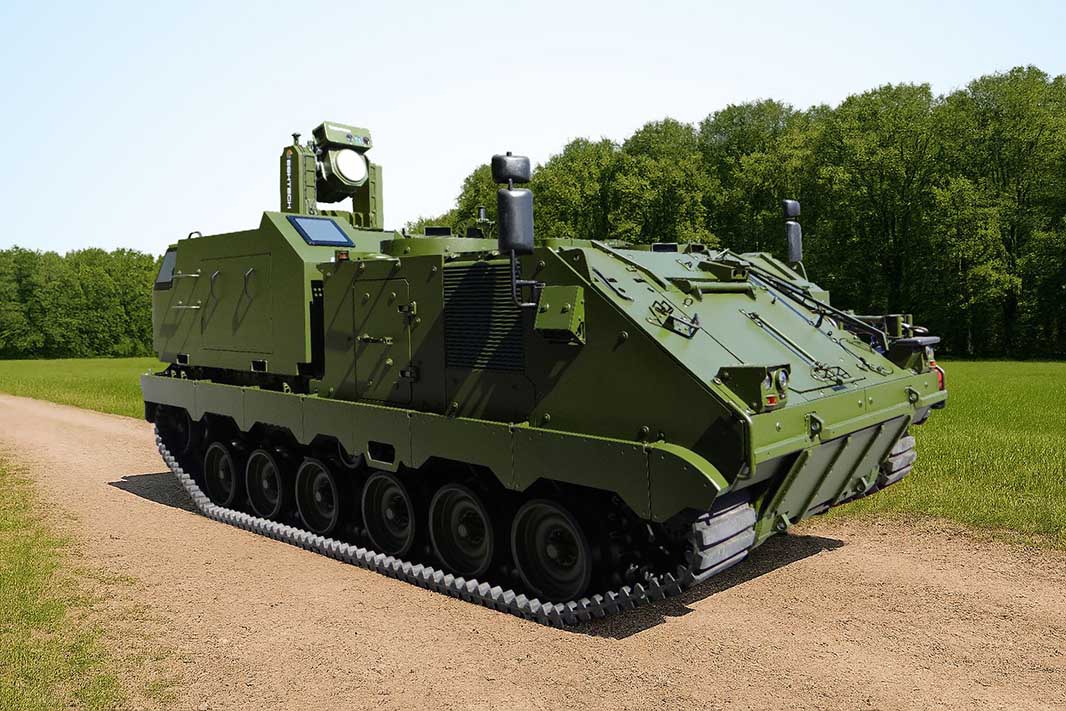
The public language around the agreement is acquisition reform. The military meaning is interoperability.
Driscoll put it bluntly at the event: air defence now requires allied equipment to be interoperable at a minimum. He framed the marketplace as a way to let soldiers and operators generate feedback, let vendors from participating countries compete, and let governments scale systems that actually work. That is not a normal NATO communique sentence. It is closer to a battlefield product review system.
The country list itself is slightly messy, which is useful to note rather than smooth over. The U.S. Army Europe release said representatives came from Sweden, Denmark, Norway, France, Poland, the United Kingdom, the Netherlands, Italy, and Lithuania. Defense One separately reported nine signatories as Denmark, Finland, France, Italy, Lithuania, the Netherlands, Norway, Sweden, and the United Kingdom, while noting that Poland was among eight countries already signed on. Either way, the geography is the point: Nordics, Baltic-adjacent states, major European militaries, and the United Kingdom are all trying to solve the same tactical problem.
The old NATO assumption was that interoperability meant common standards for radios, ammunition, fuel, command structures, and aircraft procedures. Those still matter. But Ukraine has shown that the more urgent layer may be software interfaces, sensor data, vendor access, and the ability to replace a failed drone-defence solution in weeks rather than years.
Ukraine Changed the Procurement Clock
The strongest argument for this marketplace is not efficiency. It is survival.
Russian forces have used reconnaissance drones, one-way attack drones, Lancet loitering munitions, and mass Shahed-type strikes to compress the time between detection and destruction. Ukraine has adapted by mixing military systems, volunteer-built gear, commercial drones, local software, electronic warfare, and rapid battlefield feedback. The lesson is not that every NATO country should copy Ukraine's improvisation. The lesson is that NATO cannot defend fixed bases, artillery positions, supply routes, or headquarters with a procurement cycle built for the pre-drone era.
That is why the U.S. Army's next step matters. Defense One reported that the Army plans to release a request for information for low-cost interceptors on July 6, with a four-week submission window and a goal of technology demonstrations by the first quarter of fiscal year 2027. Those dates are more important than the acronym. A four-week window is a different rhythm from the usual allied defence procurement culture.
Low-cost interceptors are also the right problem to test. NATO has expensive air defence systems. It does not have enough cheap, scalable answers for small drones. Using a Patriot-class interceptor against a cheap unmanned aircraft is strategically ridiculous unless the target threatens something so valuable that the exchange ratio stops mattering. Europe needs layered defences: detection, jamming, directed energy where mature, gun systems, small missiles, and expendable interceptors. The missing piece is not a miracle weapon. It is the ability to buy and integrate many imperfect tools quickly.
The Marketplace Will Not Fix Politics
There is a temptation in Washington to talk as if software and marketplaces can route around alliance politics. They cannot.
European governments still have domestic industrial priorities. France will not treat U.S.-run acquisition channels as neutral. Poland and the Baltic states will prioritise speed over industrial elegance. Britain will want access without losing sovereign procurement control. Smaller Nordic states may be more comfortable buying into a common platform if it gives them scale they could not obtain alone. None of that disappears because the portal looks efficient.
There is also a data problem. A counter-UAS marketplace only becomes strategically useful if the systems sold through it can share information, plug into wider command networks, and avoid creating another zoo of incompatible kit. Driscoll's reference to Project Jailbreak, the Army effort that reviewed about 100 systems in 30 days to identify data-sharing barriers, is therefore not a side note. It is the heart of the matter.
If NATO buys counter-drone gear faster but still cannot connect it across units and borders, the alliance will have bought speed without coherence. That is better than buying nothing. It is not enough.
Why This Matters Before the Next Crisis
The Eastern Flank Deterrence Initiative gives this story its strategic weight. The Army says it wants vendors building to allied requirements from the beginning, so systems are more compatible and easier to field. That is precisely what NATO should have been doing before Russian drones started landing near alliance borders and before Ukraine turned the tactical sky into a kill web.
The marketplace is not a revolution. It is an experiment in admitting that the enemy gets a vote in procurement timelines. Russia, Iran, and non-state actors have all learned that cheap unmanned systems can impose expensive defensive burdens. NATO's answer cannot be another decade of committees followed by bespoke national purchases.
The useful test is simple. By early 2027, will this effort produce fielded counter-UAS systems that allied units can actually train with, connect, and replenish? Or will it produce a handsome catalogue, several conference panels, and another set of incompatible national purchases?
My bet is that the marketplace will help at the margins, especially for smaller allies that need access to vetted systems quickly. But the hard part remains political: Europe has to decide whether drone defence is a shared wartime requirement or just another procurement lane for national industry. Ukraine has already answered that question under fire. NATO is still shopping for its answer.
Sources
- Defense One, June 25, 2026, reporting on the U.S. Army drone and counter-UAS marketplaces, allied participation, $200 million in UAS marketplace sales, and the July 6 low-cost interceptor RFI timeline.
- U.S. Army Europe and Africa, Eurosatory 2026 release on the Counter-Unmanned Aircraft Marketplace letter of intent and allied interoperability goals.
- U.S. Army statements at Eurosatory 2026 on Project Jailbreak, common digital interfaces, and the Eastern Flank Deterrence Initiative.
NATO's 9-nation drone marketplace was launched to enhance air defense capabilities in Europe, focusing on interoperability among member nations. The U.S. Army opened the Counter-Unmanned Aircraft Marketplace to facilitate faster procurement of counter-drone systems. A request for information for low-cost interceptors is scheduled for July 6, 2026, highlighting the urgency of adapting to modern warfare needs.
- NATO's 9-nation drone marketplace aims to improve air defense capabilities in Europe.
- The U.S. Army has opened a Counter-Unmanned Aircraft Marketplace to allies.
- The marketplace includes 45 companies and over $200 million in sales.
- A request for information for low-cost interceptors is planned for July 6, 2026.
- The initiative addresses the need for rapid procurement of drone defense systems.