
NATO's Ankara Summit 2026 Promises Billion-Dollar Contracts — But Europe's Production Problem Remains
 Dr. Klaus Weber
NATO's Ankara Summit 2026 Promises Billions in Contracts — But Europe's Production Problem Remains
Mark Rutte calls it an "incredible transformation": In Ankara, NATO states are set to discuss not only new defense quotas at the beginning of July but also present "tens of billions of dollars" in new industrial contracts. This is precisely where the problem lies. Contracts do not equate to production lines, production lines do not equate to deployable units, and deployable units do not automatically replace American bombers, satellites, and command structures.
The alliance is thus moving from political numbers to industrial reality. In The Hague, heads of state and government decided in 2025 to spend 5 percent of GDP annually on defense and defense-related security by 2035: 3.5 percent for classic military requirements, up to 1.5 percent for resilience, infrastructure, innovation, and industry. Ankara 2026 is now supposed to show whether this formula is more than just a budgetary placebo.
From Quota to Delivery Capability
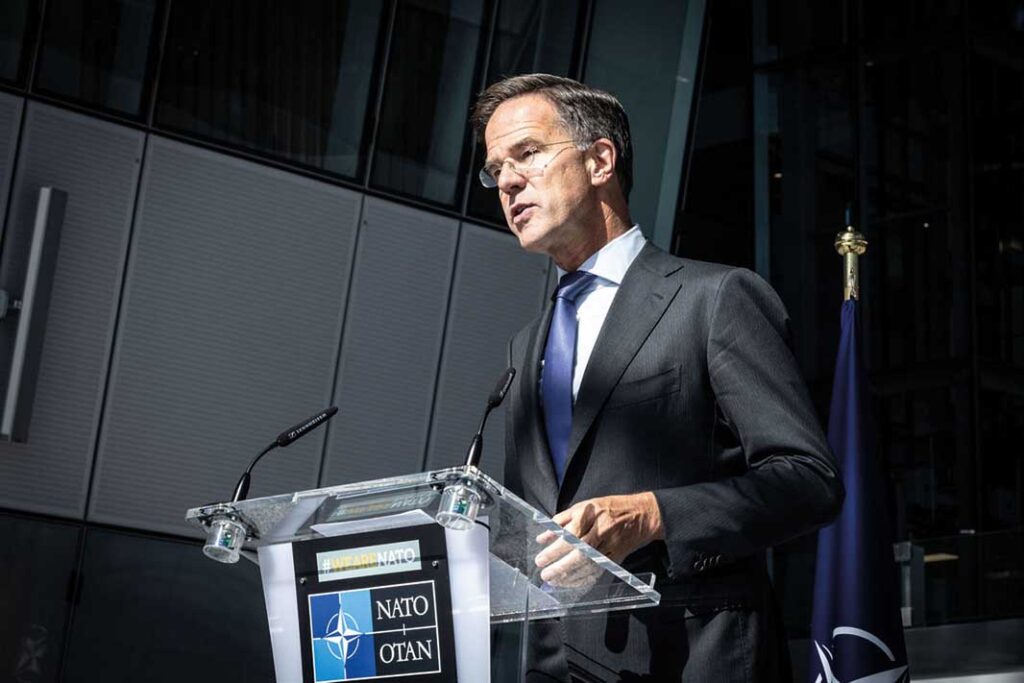
On June 25, Rutte stated at the Atlantic Council in Washington that the Ankara summit is "about delivery." This phrasing is more important than the usual summit rhetoric. Moscow fears not promises but their implementation, he implied. At the same time, he pointed out that European allies and Canada have increased their defense spending by $1.2 trillion over ten years, which he demonstratively referred to as the "Trump Trillion" at the White House.
However, from the perspective of European security policy, this figure is ambivalent. It demonstrates political pressure and fiscal movement. It does not prove that European industry can deliver ammunition, air defense, drone defense, long-range capabilities, and command systems in a timely manner. Rutte himself admitted that the required capabilities "simply aren’t available" at the speed and scale that the security situation demands. This is not a technical footnote. It is the core of the problem.
The difference between money and capability can be illustrated by ammunition production. NATO Deputy Supreme Commander Sir John Stringer told the Associated Press in London that some states have quadrupled their production of 155mm artillery shells. That sounds dramatic. But a quadrupling from a low starting point remains a slow correction, not a strategic turnaround. When Russia and Ukraine demonstrate industrial war logic daily, Europe cannot respond with annual budget paths and consider this deterrence.
The American Gap Remains Institutional
The second question from Ankara is even more uncomfortable: Which American capabilities do Europeans actually need to replace if Washington reassesses its forces in Europe? U.S. Secretary of Defense Pete Hegseth has announced a six-month review of the American troop presence. Therefore, European military leaders are not only waiting for political signals but also for concrete planning data: What air defense, what reconnaissance, what logistics, what long-range capabilities remain?
Stringer openly stated what many European capitals know internally: American B-1 and B-52 bombers cannot simply be replaced by European resolve. Theoretically, a loss of such capabilities could be compensated by a "cocktail" of ground, sea, and air-based systems. But this word reveals more uncertainty than strength. A cocktail is not a doctrine, and a doctrine is not yet a stock of cruise missiles, target acquisition data, and deployable crews.
Here, the limit of the European debate on burden-sharing becomes apparent. Washington demands more European responsibility, and this demand is justified. But responsibility is not identical to shopping lists. Those who indirectly utilize American ISR capabilities, strategic airlift, air refueling, missile defense, and nuclear deterrence cannot credibly claim that increasing national budgets already solves the dependency problem.
The 5 Percent Target Creates New Political Risks
NATO has deliberately split the 5 percent target. The 3.5 percent for core defense is intended to finance the capability targets; the 1.5 percent can also include infrastructure, cyber, civil protection, and industry. This construction was politically necessary because several states would not have accepted the mark otherwise. Institutionally, however, it creates room for what is all too familiar in Germany: expenditures that sound plausible from a defense policy perspective but generate only limited combat power.
The United Kingdom is already a warning signal for this. Following recent domestic political tensions regarding the Defense Investment Plan, London is under pressure to present a credible path to 3.5 percent core defense. Healey's resignation has shown that strategic ambition and financial planning can diverge. If the very state that provides the NATO Deputy Supreme Allied Commander Europe cannot back "thought leadership" with forces and resources, Ankara will not face a European PR problem but an alliance problem.
Germany should also not feel prematurely relieved. The special fund has closed procurement gaps, but many structural problems have only been postponed: personnel, maintenance, ammunition reserves, digitization of command capabilities, and the stubborn fragmentation of European armaments programs. Berlin can present higher numbers. But is that enough if the supply chains for air defense, missiles, and artillery ammunition continue to be hampered by national procurement rules, export policies, and industrial self-interests?
Ankara Must Politically Organize Supply Chains
Rutte calls for a "transatlantic defense industrial revolution." The term is grand, but the underlying question is very concrete: Can European and American manufacturers actually produce together more easily, or is the transatlantic market blocked by export controls, ITAR dependencies, national protection reflexes, and parallel programs? The NATO declaration from The Hague promised to reduce defense trade barriers among allies. Ankara must show whether this will lead to mechanisms.
Otherwise, the announced billions in contracts will primarily create one thing: waiting lines. States will then purchase the same scarce systems, book production slots years in advance, and call that deterrence. South Korea will become more attractive in this logic because it can deliver. Rutte explicitly stated that he would prefer to see the dollars and euros within NATO territory. This is understandable from an industrial policy perspective, but militarily only convincing if NATO industry becomes faster.
The Ankara summit will therefore not be measured by the length of its closing statement but by three sober benchmarks: concrete multi-year production contracts, robust national capability plans, and a response to the American Force Posture Review. Without these three elements, the 5 percent target remains a number with strategic ambition but operational ambiguity.
Europe's defense paradox in 2026 is: Without more money, there are no stronger armed forces. But with more money alone, only more expensive dependencies arise.
Source basis: NATO declaration from The Hague 2025, Mark Rutte's Atlantic Council appearance on June 25, 2026, and AP interview material with NATO Deputy Supreme Allied Commander Europe Sir John Stringer from June 26, 2026.
NATO states are set to discuss new defense contracts and production capabilities at the Ankara summit in July 2026. European allies have increased defense spending significantly, but concerns remain about the timely availability of military capabilities. NATO officials emphasize the need for concrete production contracts and national capability plans to address these issues.
- NATO states plan to discuss billions in new defense contracts at the Ankara summit in July 2026.
- European allies have increased defense spending by $1.2 trillion over ten years.
- There are concerns about the availability of necessary military capabilities in Europe.
- NATO Deputy Supreme Allied Commander Europe highlighted the slow increase in artillery production.
- The summit will focus on concrete production contracts and national capability plans.