
NATO's Drone Problem Is Now Europe's Problem
 Alexandra Reeves
NATO's Drone Problem Is Now Europe's Problem
Europe keeps talking about drones as if they are a Ukrainian battlefield problem. NATO's latest messaging says otherwise. A drone crossing Estonia's border on September 1, followed by Turkish fighter jets scrambling from Ämari, is the kind of incident the alliance now has to treat as a rehearsal for a much larger problem: cheap airborne systems, ambiguous attribution and an air-defence bill that arrives faster than governments can pay it.
The Incident NATO Cannot Dismiss
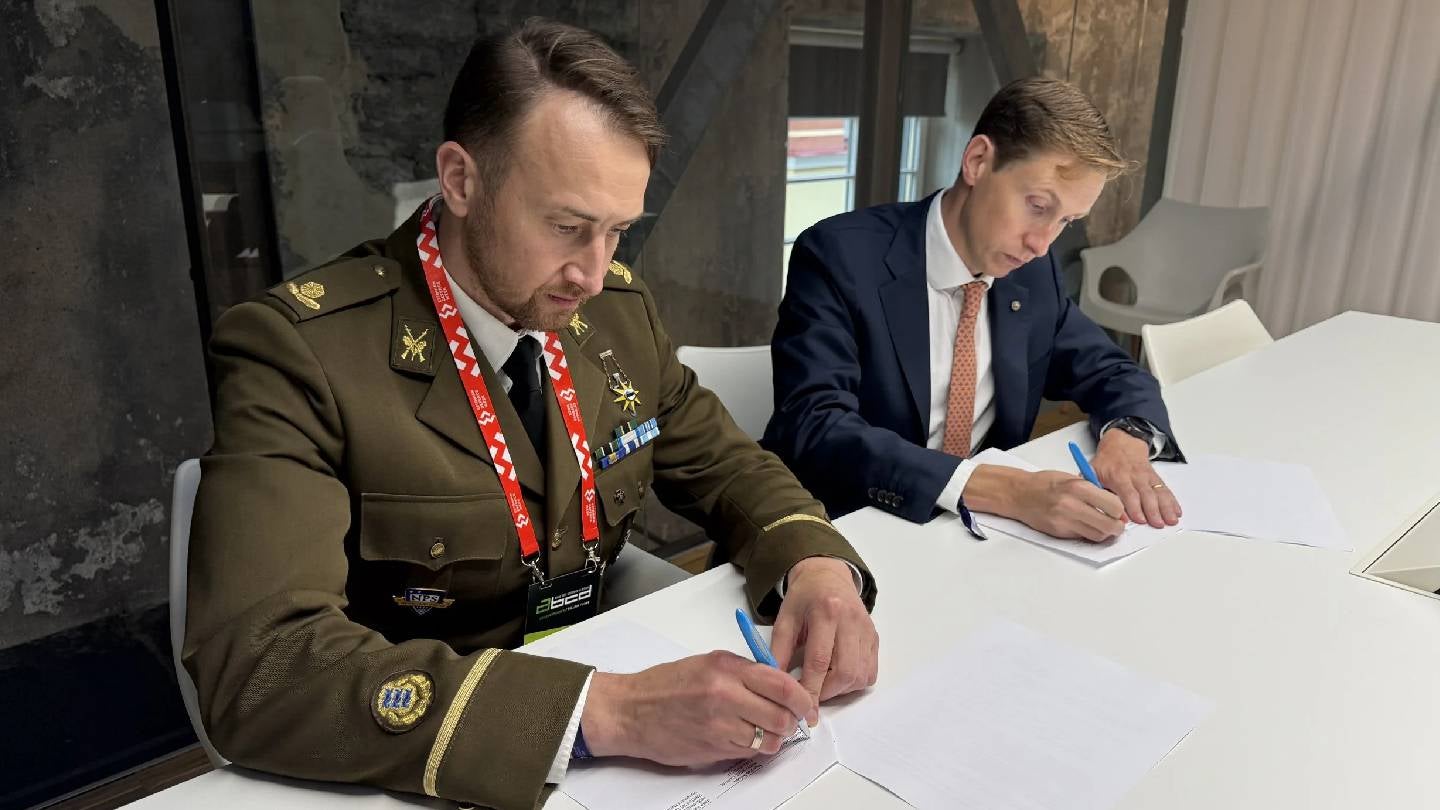
In a 14 October press conference in Tallinn, NATO Secretary General Mark Rutte said Turkish aircraft operating from Ämari had scrambled after a drone crossed Estonia's border. The important detail is not that the aircraft responded. Air policing is supposed to respond. The important detail is that NATO's eastern flank is increasingly being tested by objects that may be military, commercial, improvised or deliberately deniable.
Rutte also pointed to Russia's wider “hybrid campaign” against the alliance, including the arson attack at Milrem Robotics that Estonia attributed to Russian special services. NATO is careful with public attribution, and Estonia's claim should be treated as an official assessment rather than an independently proven fact. But the operational pattern is clear enough: airspace incidents, sabotage and cyber pressure are converging into one security problem.
That is why Tallinn matters. Estonia is spending more than 5 percent of GDP on core defence this year, according to Rutte, while hosting British forward land forces, the Cooperative Cyber Defence Centre of Excellence and NATO's Baltic Sentry activity. It is not a passive client waiting for Washington to solve European security. It is a front-line state building the warning system the rest of Europe wishes it had.
From “Block, Blunt, Break” to Cheap Mass
NATO's new language is moving in the same direction. Speaking at the Warsaw Security Forum on 12 October, Supreme Allied Commander Europe General Alexus Grynkewich described a “block, blunt and break” theory of victory for a Russian attack. The concept is straightforward: stop the advance at the border, attrit the force from multiple domains, then break its logistics and command networks.
According to Al Jazeera's account of the speech, Grynkewich said the plan draws on lessons from Ukraine and the Middle East, including the need for precision weapons with “affordable mass”. That phrase is doing a lot of work. NATO cannot defend every kilometre of its eastern border with expensive interceptors and fighter patrols alone. A $20,000 or $50,000 drone can force a response costing many times more. Repeat that across the Baltic region, the Black Sea and critical infrastructure, and the economics become strategically dangerous.
The alliance therefore needs a layered answer: passive sensors, electronic warfare, short-range air defence, directed-energy systems where they are mature, and low-cost interceptors that can be produced in large numbers. Fighters remain essential for fast or sophisticated threats, but using them as the default answer to every small drone is a budgetary trap.
Estonia Is Exposing the Alliance's Real Weakness
NATO has no shortage of high-end platforms. It has a shortage of affordable coverage. The alliance can deploy Patriot batteries, F-35s and advanced radar, but those systems are scarce, politically valuable and difficult to replace. The eastern flank needs something less glamorous: enough sensors to build a common picture, enough jammers to disrupt navigation and control links, and enough cheap missiles or guns to make saturation attacks unattractive.
Ukraine has demonstrated why this matters. Russian forces have used drones not only to strike targets but to force Ukrainian defenders to reveal radar positions, expend interceptors and keep aircraft away from threatened airspace. The lesson for NATO is not simply “buy more drones”. It is to treat the entire kill chain as a contest of cost, speed and adaptation.
Estonia's experience also highlights a political weakness. An incursion that is too small to justify escalation can still create pressure, confusion and public anxiety. Russia does not need to launch a conventional attack to test whether NATO's members share the same threshold for response. It only needs to keep incidents deniable and below the level that produces a unified political decision.
The American Question Still Hangs Over the Shield
NATO's military plan may be clearer than its political plan. European governments are spending more, and Estonia says it will continue supporting Ukraine with at least 0.25 percent of GDP. Yet the alliance remains exposed to uncertainty in Washington. The hardware for a European air-defence network may be bought in Europe, but command, intelligence, satellite connectivity and reinforcement still depend heavily on American capabilities.
That does not make the alliance hollow. It does mean that European officials should stop treating American reassurance as a substitute for magazine depth. Washington can provide exquisite capabilities; it cannot be expected to absorb every low-end threat indefinitely while European states debate production targets.
Rutte's message in Tallinn was that NATO has the plans and will defend every inch of allied territory. That is the right deterrent message. The harder question is whether the alliance can sustain the daily, expensive and unheroic work required to make the promise credible.
What to Watch Next
- Whether NATO turns “affordable mass” into common procurement rather than separate national experiments.
- Whether Baltic air policing expands into a genuinely integrated counter-drone network.
- Whether future border incidents trigger rapid allied attribution and coordinated response.
- Whether European defence factories can deliver low-cost interceptors at wartime volume.
The Estonia drone incident was not a Russian invasion, and NATO says it sees no imminent threat to allied territory. That distinction matters. But deterrence is built before the crisis, not during it. NATO now has a credible theory for stopping a major Russian attack. It still has to prove that it can afford to stop the small ones every day.
The uncomfortable conclusion is simple: Europe's drone problem is no longer a lesson to study from Ukraine. It is the bill for NATO's own security, and the bill is already arriving.
Sources
- NATO, “Joint press conference with NATO Secretary General and the Prime Minister of Estonia,” 14 October 2026.
- Al Jazeera, “‘Block, blunt, break’: What’s in NATO’s new Russia war plan?”, 13 October 2026.
A drone crossed Estonia's border on September 1, leading to a response from Turkish fighter jets. NATO Secretary General Mark Rutte highlighted the increasing threat of drones and hybrid warfare tactics from Russia during a press conference on October 14. Estonia is investing significantly in defense and hosting NATO activities, while NATO is adapting its strategies to address low-cost drone threats and ensure a unified response among member states.
- A drone crossed Estonia's border on September 1, prompting a response from Turkish fighter jets.
- NATO Secretary General Mark Rutte emphasized the need for a layered defense strategy against low-cost drone threats.
- Estonia is investing over 5% of its GDP in defense and hosting NATO activities.
- NATO's new strategy includes affordable mass drone defense systems to counter threats.
- The alliance faces challenges in maintaining a unified political response to small-scale incursions.