
"New Real High": Three Major Features of the Sino-Russian Maritime Joint Exercise
【Global Times Report by Reporter Guo Yuandan】The maritime exercise phase of the China-Russia "Maritime Joint-2026" joint drill concluded on the 11th. In this exercise, both sides deployed elite forces covering surface, underwater, air, and support capabilities. Military experts interviewed by the Global Times believe that the latest disclosed details show that China and Russia have further consolidated the foundation of friendly and pragmatic cooperation between their militaries during this joint exercise, pushing their cooperation to a higher level.
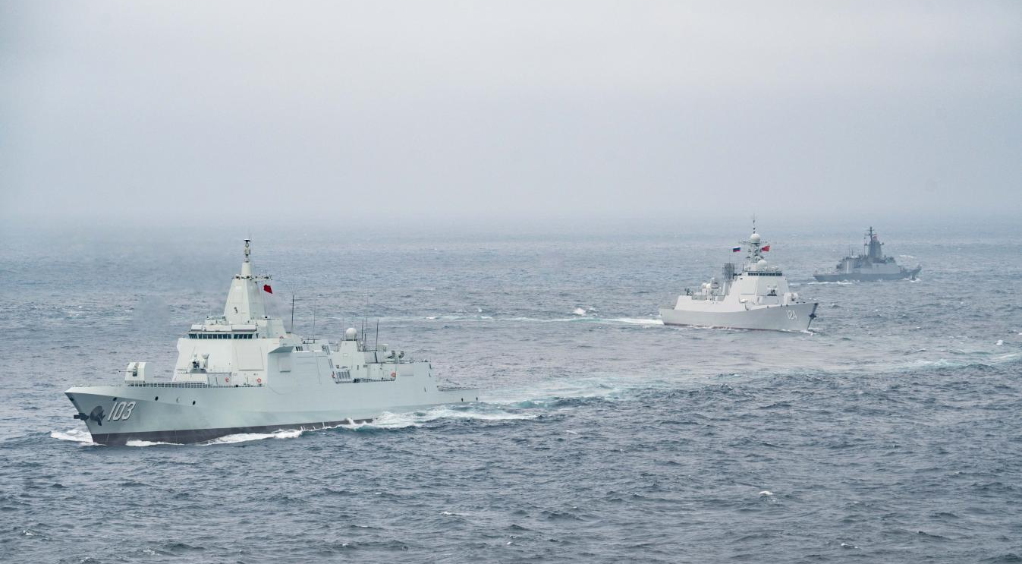
The WeChat public account "Ministry of Defense Release" stated on the 12th that during the maritime exercise, the China-Russia naval formation conducted drills on subjects such as submarine rescue, maritime assault, and air defense and missile interception, deepening mutual trust through efficient coordination, and further enhancing joint operational capabilities.
The report mentioned a detail: the Kaifeng ship's radar detected a group of small aerial targets approaching the formation. After the commander issued the order, the Kaifeng ship maneuvered at high speed and quickly occupied a favorable position to engage in air defense fire, while the Russian vessels occupied advantageous attack sectors to implement supplementary strikes, jointly destroying the incoming targets.
Military expert Song Zhongping stated on the 12th to the Global Times that this indicates that countering low, slow, small targets has become one of the training subjects of this exercise. Such small targets are likely drones, which have often been used as target drones in previous exercises; this time, they were set as actively attacking enemy forces, and specific anti-drone drills were added. Song Zhongping believes that the Russian side has mature experience in drone detection, identification, and interception, and can rely on the joint exercise to exchange tactics and jointly enhance the practical capabilities to respond to drone threats.
Military issues expert Zhang Junsha stated that from the publicly available details, the core characteristics of this exercise can be summarized as: new, practical, and high.
Regarding "new," it refers to the innovative exercise scenarios; not only is the exercise fully innovative in all elements, but the exercise plan design also adopts entirely new ideas. Zhang Junsha stated that in recent years, various medium- and long-range powerful offensive weapons, especially the intermediate-range missiles that were banned from development and deployment during the Cold War, have been successively deployed in Asia. The threats from missiles, drones, and unmanned boats from the air, sea, underwater, and land have significantly increased, and unmanned operations have become an important aspect of modern battlefields. This joint exercise between China and Russia actively aligns with this trend, incorporating responses to drone threats into core subjects, focusing on enhancing the comprehensive combat capabilities of the two navies through fundamental drills such as anti-ship, air defense, and anti-submarine, while also conducting specialized research and training on emerging maritime threats to further improve the two militaries' ability to jointly respond to maritime security threats.
Regarding "practical," it emphasizes a combat-oriented approach, making it closer to real combat environments. The entire exercise was based on real maritime and aerial combat scenarios, without fixed scripts, and implemented guidance based on randomly set emergency situations. The subject design was based on real maritime combat conditions, focusing on potential threats from the surface, underwater, air, and land, especially the challenges posed by unmanned systems, while simultaneously advancing reconnaissance and early warning, joint air defense, maritime strikes, and carrier aircraft coordination drills.
Regarding "high," it refers to the high degree of integration of both sides' forces and reflects the high level of strategic mutual trust between the two militaries. It was introduced that this exercise established a joint directing department and a joint command, with both sides' forces adopting a mixed grouping model, relying on various platforms from sea, air, and underwater to construct a joint combat system, effectively testing and enhancing joint reconnaissance and early warning, operational planning, command coordination, and fire strike capabilities in complex electromagnetic environments. At the same time, the exercise subjects themselves also demonstrate the level of mutual trust, such as joint reconnaissance and early warning, air defense and missile interception, maritime strikes, and submarine rescue, all of which require both sides' ships and aircraft to activate radar, sonar, optical, and communication electronic devices, sharing weapon performance and data, achieving information sharing of the battlefield situation across all domains, which can only be realized between military forces of countries with high mutual trust.
In addition, during this exercise, Chinese and Russian submarines conducted joint drills at sea for the first time. Zhang Junsha believes that submarines are core maritime combat forces that are highly confidential in all countries, and the fact that both sides allowed their submarines to publicly participate in joint training and operate in coordination with each other's underwater forces is itself an important manifestation of mutual trust.
China and Russia concluded joint naval exercises in the Sea of Japan on November 11, 2026, involving surface ships, submarines, and aircraft. The drills focused on enhancing operational capabilities against drone threats and included real combat scenarios. This exercise marked a significant step in military cooperation between the two nations, showcasing their strategic trust and coordination.
- China and Russia conducted joint naval exercises in the Sea of Japan on November 11, 2026.
- The exercises included surface, underwater, and aerial operations.
- Both navies enhanced their cooperative capabilities and mutual trust during the drills.
- The exercises focused on countering drone threats and included real combat scenarios.
- This was the first time Chinese and Russian submarines operated together in a joint exercise.