
New Zealand's Two Warships Test Its Taiwan Strait Role
 Marcus Chen
New Zealand's Two Warships Test Its Taiwan Strait Role
Two New Zealand naval ships transited the Taiwan Strait late last week. The movement is small in tonnage, modest in combat power, and larger in political meaning. Wellington has not turned the Royal New Zealand Navy into a Pacific strike force. It has, however, demonstrated that its Indo-Pacific policy now includes visible operations in one of Asia's most sensitive waterways.
A Transit Is Not a Combat Capability
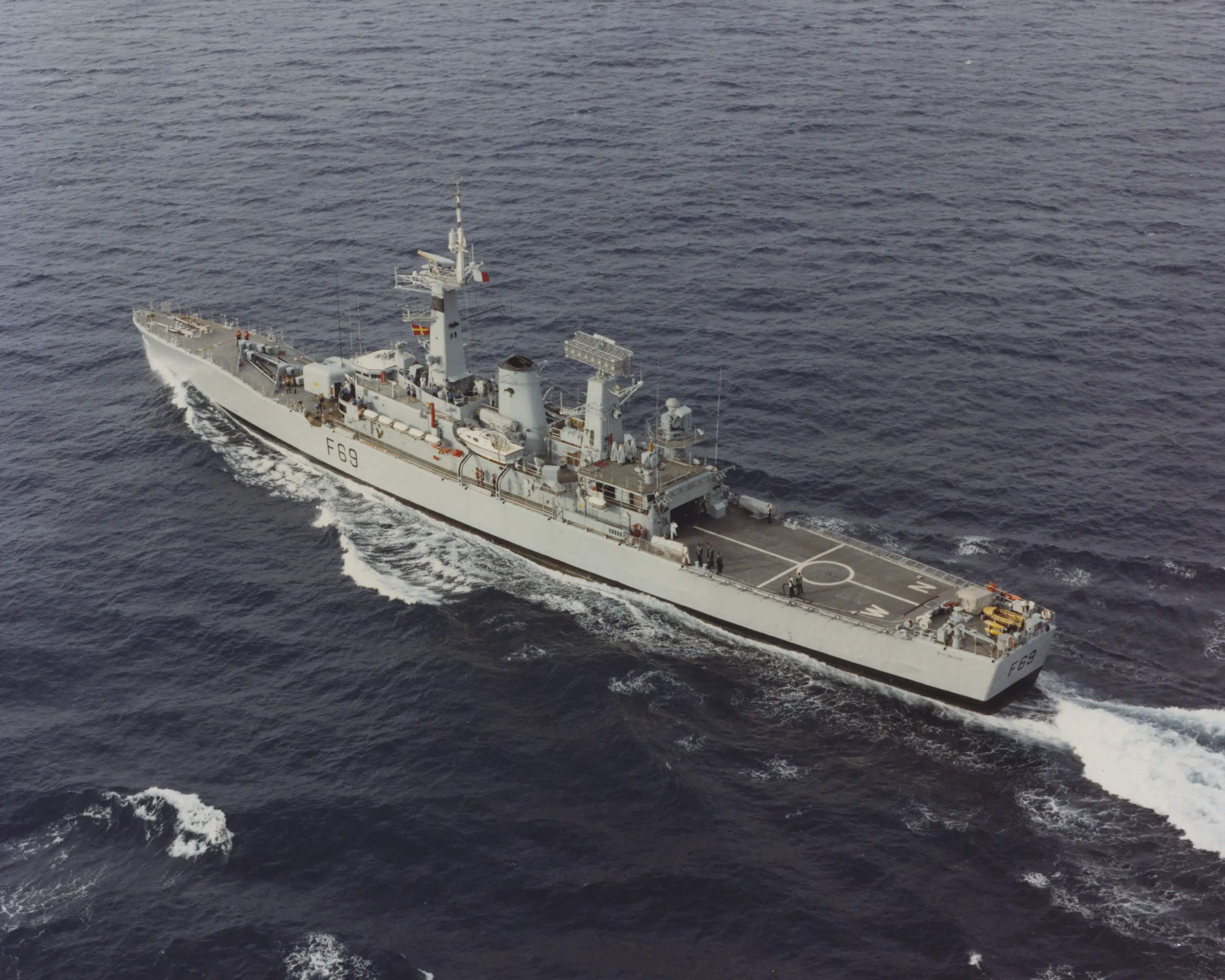
The first point is the arithmetic. New Zealand operates a very small navy. Its combat core is built around two Anzac-class frigates, each roughly 118 meters long and displacing about 3,600 tonnes. HMNZS Te Mana and HMNZS Te Kaha carry a 76-mm naval gun, helicopters, anti-ship missiles, and modern air-defense systems after their upgrade. They are credible escorts and patrol combatants. They are not area-air-defense destroyers, and they cannot independently sustain a high-intensity campaign against the People's Liberation Army Navy.
The other half of New Zealand's maritime force is support, surveillance, and presence. HMNZS Aotearoa gives the fleet useful replenishment capacity, while the service's offshore patrol vessels and sealift assets support missions short of war. That mix is appropriate for a country whose defense budget and population cannot finance a large surface fleet. It also explains why a two-ship transit matters: the operation shows access, endurance, and political intent, not a new balance of firepower.
Why the Taiwan Strait Still Matters
Reuters reported that the ships made the passage amid continuing tension over the waterway, which Beijing claims and Taiwan treats as an international route. New Zealand's own defense messaging has generally avoided the sharper language used by Washington, Tokyo, or Canberra. The practical choice to sail through the strait therefore carries more weight than a press release. It places a New Zealand flag in a corridor where every military movement is read as a signal.
The legal argument is familiar. The Taiwan Strait contains international waters beyond the territorial sea, and routine passage is consistent with freedom of navigation principles. The operational argument is harder. A warship moving through the strait is exposed to Chinese maritime law-enforcement attention, surveillance aircraft, and naval shadowing. It is also operating in a narrow battlespace where commercial traffic, coastal sensors, and missile forces compress decision time. Even an uneventful transit gives the crew and headquarters a useful picture of the environment.
USNI News has reported that Chinese and Philippine forces have recently been involved in dangerous encounters near Manila, while U.S. and Philippine Marines have rehearsed maritime-strike missions. Those incidents are not the same as a Taiwan Strait passage, but they show the regional pattern: gray-zone pressure is increasingly conducted around the movements of relatively small ships. A frigate's value is not just its weapons load. It is the ability to remain present while making coercive interference politically expensive.
What Wellington Is Signaling
New Zealand is trying to solve three problems at once. First, it wants to preserve an independent foreign policy that does not automatically mirror Australia or the United States. Second, it needs to reassure partners that “independent” does not mean strategically absent. Third, it must keep the Royal New Zealand Navy relevant while its fleet remains numerically thin.
The transit is a useful compromise. It does not amount to a formal commitment to fight over Taiwan. It does not require Wellington to endorse every American formulation of deterrence. But it rejects the idea that New Zealand can be a security stakeholder in the Pacific while avoiding the region's most consequential maritime routes.
That ambiguity may be deliberate. A New Zealand frigate is more valuable in a coalition than alone. It can escort, conduct maritime-domain awareness, contribute a helicopter, and complicate an adversary's assumptions about who will be watching. Yet the contribution depends on readiness. Two frigates mean that maintenance, training, and other deployments quickly consume the available force. If one ship is unavailable, the visible policy can disappear for months.
The Hard Limit Is Sustainment
New Zealand can send ships through the Taiwan Strait. The harder question is whether it can sustain a meaningful presence farther north and west during a crisis. A single frigate needs fuel, ammunition, spares, air support, and a wider coalition logistics chain. In a contested environment, replenishment ships are not administrative conveniences; they are targets and scheduling problems. The Pacific distances turn a political decision into a force-generation problem within days.
That is why the transit should be judged as a test of policy, not proof of sea control. The Royal New Zealand Navy can add friction to coercion and improve allied awareness. It cannot close the strait, defeat a blockade, or protect Taiwan by itself. Wellington's contribution will be credible only if it turns occasional passages into a repeatable deployment cycle tied to maintenance funding, munitions stocks, and access arrangements with Australia, Japan, and the United States.
The signal is real, but the force is small. New Zealand has shown that it will sail into the Taiwan Strait; it has not yet shown that it can stay there when the cost rises.
Sources
New Zealand's two naval ships, HMNZS Te Mana and HMNZS Te Kaha, transited the Taiwan Strait late last week, marking a significant political gesture in the Indo-Pacific region. This operation demonstrates New Zealand's intent to maintain a presence in sensitive maritime areas despite its limited naval capabilities. The transit underscores New Zealand's commitment to freedom of navigation and its role as a security stakeholder in the Pacific.
- New Zealand's two naval ships transited the Taiwan Strait.
- The ships are Anzac-class frigates, each displacing about 3,600 tonnes.
- The transit demonstrates New Zealand's political intent in the Indo-Pacific region.
- New Zealand's navy is not a large force but aims to maintain relevance in regional security.
- The operation signals New Zealand's commitment to freedom of navigation principles.