
Nigeria 2026 mobilizes 28,000 recruits — 40 hostages reveal the northwest front
 Marie Dubois
Nigeria 2026 mobilizes 28,000 recruits — 40 hostages reveal the northwest front
In Zamfara, over forty people were forcibly taken from eleven villages in northwestern Nigeria during the weekend of July 18 and 19, according to local authorities cited by RFI. Most of them are said to be women and children. This detail matters more than a general statement about insecurity: it indicates where the pressure is actually falling, on hamlets too remote to be guarded and too poor to weigh in Abuja's priorities.
The attack is attributed by local media to the gang of Kachalla Sa'idu, a name already known in the border area with Niger. According to a locally reported testimony, an attempted kidnapping in Garagi had gone awry a few days earlier when villagers killed an assailant and seized his weapon. The weekend raids would then have taken the form of reprisals against neighboring communities. This account remains to be consolidated, but it corresponds to a logic often observed on the ground: when the state does not hold the track, the criminal militia imposes its immediate justice.
Zamfara is not a secondary theater
Zamfara is located in that band of savanna and discontinuous forests where secondary roads matter more than administrative lines. From Gusau towards the Nigerien border, the distances seem modest on a map. In operation, they become long: seasonal tracks, scattered villages, irregular phone coverage, and very few permanent support points. It is the kind of space where a motorized patrol often arrives after the kidnapping, not before.
The crisis in northwestern Nigeria is not identical to the jihadist insurgency in Borno. It does not always share the same religious vocabulary or command structure. But the separation becomes less clear when armed groups tax communities, recruit locally, buy weapons, and move between banditry, smuggling, and jihadist contacts. The danger for Abuja is not just kidnapping for ransom. It is the normalization of a parallel armed sovereignty.
A military response announced in large format
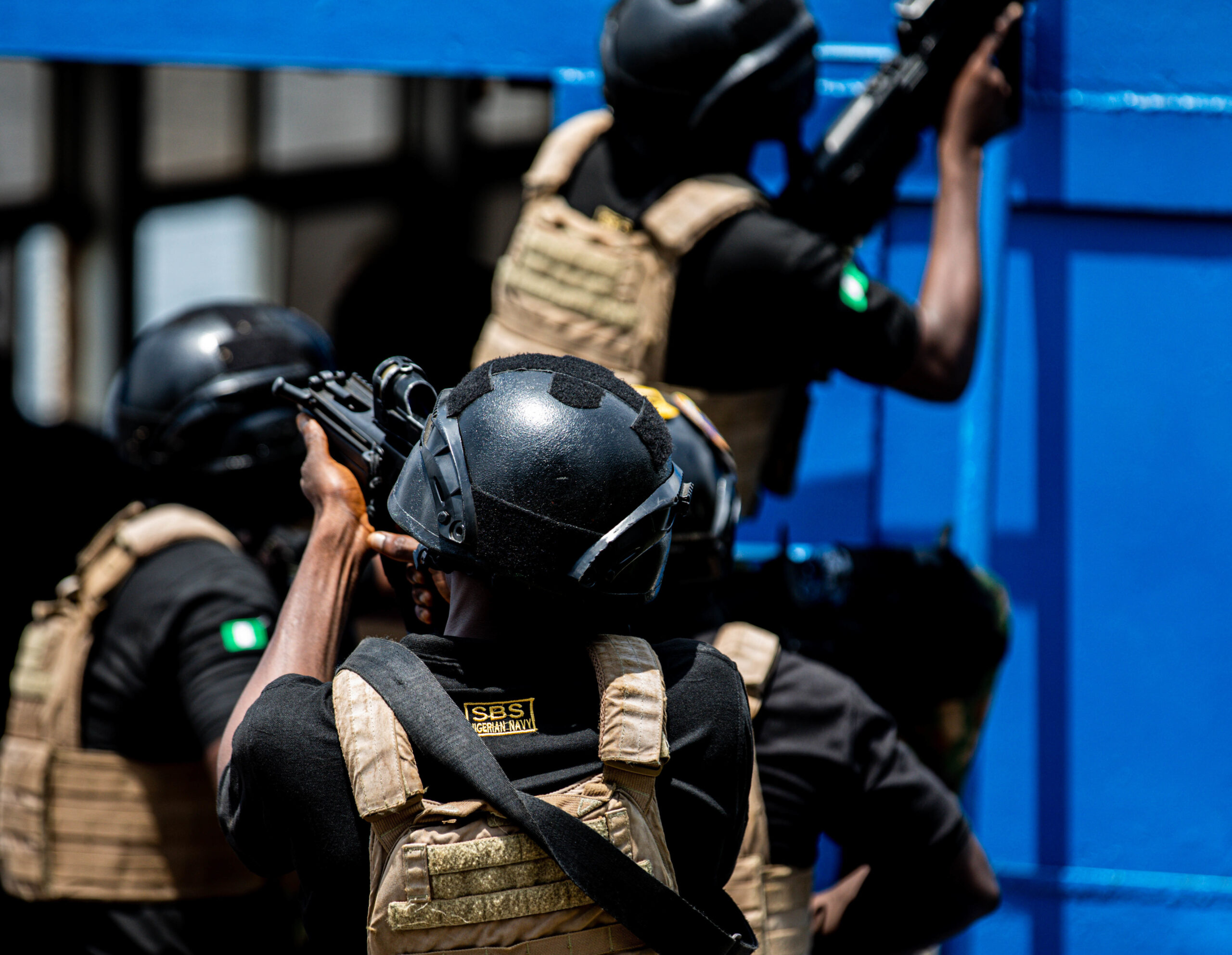
On the same day that news of the kidnappings circulated, Nigerian media and the BBC reported that President Bola Ahmed Tinubu had approved a major expansion of the army: four new divisions, bringing the total to twelve, with an additional 28,000 recruits. The new centers announced in Makurdi, Ilorin, Benin City, and Jalingo outline a national response, not just a northeastern one.
On paper, the geography is coherent. Makurdi looks towards the Middle Belt, where community violence, agropastoral conflicts, and armed raids overlap. Ilorin opens a lock towards the center-west, an area that Sahelian threat analysts have been observing for several months because it could serve as depth for groups coming from the north. Jalingo covers the eastern axis towards Cameroon and the Adamawa highlands. Benin City, further south, signals that the presidency does not want to give the impression that the crisis is confined to the Nigerian Sahel.
But a division on an organizational chart does not automatically hold a district. It requires intermediate officers, non-commissioned officers who know the villages, vehicles that actually run, tactical drones, fuel, forward bases, and above all, intelligence transmitted before the kidnappers disappear into the bush. From experience, this is where many African reforms falter: they enlarge the command map faster than they densify useful presence.
The trap of numbers
The 28,000 recruits announced respond to a brutal reality. Nigeria is simultaneously fighting Boko Haram and the Islamic State in West Africa (ISWAP) in the northeast, criminal gangs in the northwest, recurring violence in the center, and separatist tensions in the southeast. No staff can sustainably cover a territory of this size with exhausted units redeployed from one front to another.
The risk is evident: recruiting quickly is not enough. A young, poorly trained troop, projected into hostile or fearful villages, can produce presence without producing security. In the northwest, residents will judge the state not by the number of battalions, but by the ability to reopen markets, secure agricultural routes, and respond within the hour when an armed group approaches. It is a war of timelines. Kidnappers win when they have a six-hour head start.
The reform of state police, adopted at the federal parliamentary level but still subject to state votes, goes in the same direction: bringing public force closer to the ground. It also poses a political problem. In states where local loyalties, networks of traditional chiefs, and partisan rivalries are very powerful, a state police can become an effective intelligence tool or a poorly controlled legal militia. Both scenarios already exist elsewhere on the continent.
ISWAP, bandits, and information warfare
In the northeast, the Nigerian army claims to have killed Abu Salim al-Barnawi, presented as a propaganda and raid leader linked to ISWAP, during a failed attack in Borno. Nigerian media have relayed this announcement, while local fact-checkers reported that a video circulating as evidence appeared to be old. Therefore, it is necessary to separate two things: the operation itself, which remains a military statement, and the imagery used around it, which seems more fragile.
This nuance is not a journalistic detail. Groups like ISWAP also thrive on perception: surviving media-wise after a loss, exaggerating their successes, minimizing their setbacks. Armies sometimes do the opposite. When visual evidence is contested, even a tactical success becomes less politically useful. In a country where families in Zamfara mainly want to know who will bring their children back, military communication does not replace physical presence.
What the new divisions will need to prove
The operational test of the four new divisions will not be their creation ceremony. It will be their ability to break the cycles of reprisals like the one reported around Garagi. An effective force in Zamfara will need to combine short patrols, mobile temporary posts, relays with local chiefs, and rapid pursuit after a kidnapping. It will also need to avoid treating all communities as suspects, as this is how gangs recruit their informants.
Abuja is trying to respond to a multi-layered crisis: criminal in methods, territorial in effects, political in consequences. If the new units remain concentrated in state capitals, kidnappers will continue to control the routes. If they descend too brutally into the villages, they may break local intelligence. The margin is narrow.
The northwest of Nigeria does not just ask for more soldiers. It asks for soldiers in the right place, for long enough, with sufficiently detailed information to arrive before the next column of motorcycles.
The next area to watch is the Zamfara-Katsina-Niger corridor, especially after the first serious rains that complicate heavy movements but do not stop motorcycles. If the hostages from the weekend are not released quickly, Kachalla Sa'idu or his imitators will have proven one simple thing: even while Abuja announces 28,000 recruits, the ground can still speak faster than the staff.
Sources
- RFI, July 23, 2026, kidnappings of over 40 people in eleven villages in Zamfara.
- BBC News Pidgin and Nigerian press, July 24, 2026, announcement of four new army divisions and 28,000 recruits.
- Nigerian media and local fact-checkers, July 22-24, 2026, military claim regarding Abu Salim al-Barnawi and controversy over an old video.
In July 2026, the Nigerian Armed Forces mobilized 28,000 recruits in response to ongoing security challenges, including the recent kidnapping of over 40 individuals in Zamfara. The attacks are linked to Kachalla Sa'idu's gang, highlighting the escalating violence in the region. President Bola Ahmed Tinubu announced the expansion of the military to address these threats.
- 28,000 recruits mobilized by the Nigerian Armed Forces
- Over 40 people kidnapped in Zamfara
- The attack attributed to Kachalla Sa'idu's gang
- President Bola Ahmed Tinubu approved the expansion of the army
- The crisis in northwestern Nigeria involves multiple armed groups