
NMESIS and MADIS Arrive in Okinawa: US Military Pushes Anti-Ship Firepower to the Doorstep of the PLA
 Li Minghui
NMESIS and MADIS Arrive in Okinawa: U.S. Military Pushes Anti-Ship Firepower to the Doorstep of the PLA
A detail from June should not be drowned out by exercise news. The U.S. Marine Corps 3rd Marine Division announced that the 12th Marine Littoral Regiment stationed in Okinawa has officially received the first batch of NMESIS shore-based anti-ship systems and MADIS Marine Corps air defense integrated systems. Defense News subsequently confirmed that these two systems have become part of the U.S. military's modernization defense in the Okinawa direction. In simple terms, the Americans are not just placing a few vehicles in Japan; they are positioning "temporary island deployment, dispersed ambush, strike and leave" anti-access/area denial firepower in the most sensitive location of the first island chain.
What Shortcomings Do the Two Systems Address?
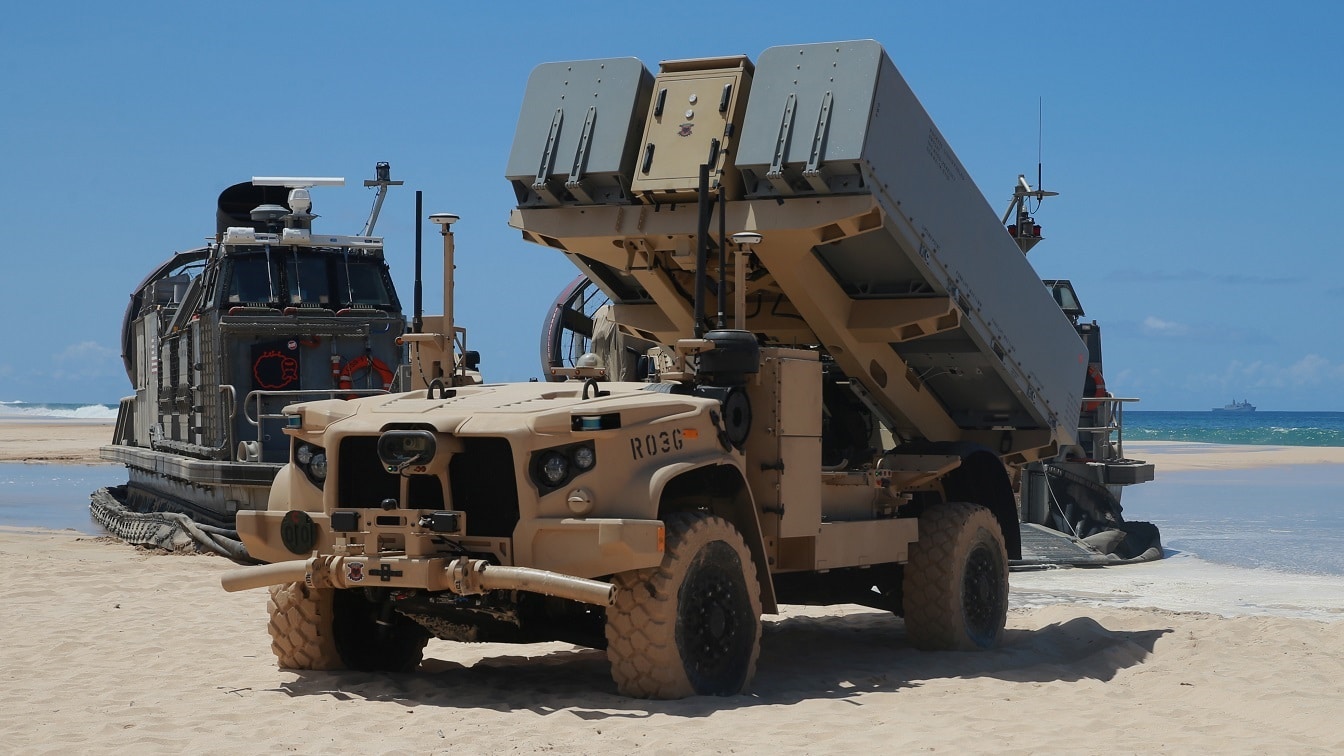
The core of NMESIS is not mysterious; it involves mounting naval strike missiles on a drone-modified Joint Light Tactical Vehicle chassis for anti-ship blockade in nearshore straits. Public information indicates that the range of naval strike missiles is generally considered to be around 180 kilometers, with a small body, low-altitude penetration, and strong terminal identification capabilities. This number may not seem as impressive as the Dongfeng or YJ series, but when positioned at nodes like Okinawa, Miyako, and northern Philippines, it is sufficient to cover many narrow sea areas that vessels must pass through.
MADIS is another piece of the puzzle. It consists of two 4×4 vehicles working in tandem, one focused on 360-degree radar, command control, and electronic warfare against drones, while the other is equipped with multiple "Stinger" missiles, a 30mm cannon, and electronic warfare equipment to deal with low-flying aircraft, helicopters, and small drones. I believe that the U.S. Marine Corps is not merely enhancing air defense this time, but is also protecting small anti-ship nodes like NMESIS. Without MADIS, shore-based anti-ship vehicles would be quite vulnerable to drones and loitering munitions; with short-range air defense and electronic warfare, they can at least endure the first round of reconnaissance strikes.
The Location of Okinawa is More Important than Equipment Parameters
Placing NMESIS in Okinawa is different from the previous trial deployment with the 3rd Marine Littoral Regiment in Hawaii. Okinawa is very close to northern Taiwan, the Miyako Strait, and the East China Sea, and is surrounded by U.S. facilities such as Kadena, Futenma, and White Beach. An official DVIDS report referred to this as an enhancement of the capability to adapt to "complex littoral environments." This phrase sounds formal, but the underlying calculation is clear: the U.S. military hopes to break down some of the naval large ship denial tasks into multiple small nodes, forcing the PLA to simultaneously search, suppress, and destroy a number of dispersed firepower points during wartime.
This approach can also be connected to the recent "Valiant Shield 26." The U.S. government stated that this exercise covered the Northern Mariana Islands, Guam, Japan, and the surrounding maritime and airspace of the Mariana Range, with a training focus on discovering, locating, tracking, and striking maritime, air, land, network, and electronic targets in a multi-domain environment. If we view the NMESIS in Okinawa as a signal of fixed deployment, the exercises in the Bataan Islands of the Philippines as a demonstration of mobility, and the large-scale exercises in Guam and Japan as a rear support system, then the U.S. is testing a continuous island chain firepower network rather than merely increasing forces at a single point.
What is the Real Trouble for the PLA?
For the PLA, NMESIS itself is not an unbreakable weapon. It has a limited range, the launch vehicle needs to be deployed to the island, resupplied, and provided with communication and target designation, and the ammunition stockpile for naval strike missiles is not infinite. The real trouble lies in how it transforms tactical issues into systemic problems: when naval formations pass through the first island chain, they cannot only focus on surface vessels and large airports, but must also include small islands, ports, civilian roads, and temporary landing points in their reconnaissance list.
- First, long-range firepower must complete the "discovery-confirmation-strike" loop more quickly, or the mobile launch vehicles will relocate.
- Second, the coverage density of unmanned reconnaissance and electronic reconnaissance must be increased, as these systems may be deployed in dispersed formations at the company level.
- Third, surface vessels need to pay more attention to low-cost decoys, electronic suppression, and missile consumption issues, rather than just calculating the number of main battle vessels.
This is also why I do not fully agree with the simplistic understanding of island chain denial as "the U.S. blockading China." Blockade is not accomplished by one or two weapons; the key is whether reconnaissance, ammunition, air transport, sea transport, maintenance, and political authorization from allies can operate continuously. During the exercises in the Bataan Islands of the Philippines, the U.S. military used C-130J and Army LCU-2000 landing craft to transport NMESIS, indicating that they are already exploring deployment chains. However, once high-intensity conflict begins, this chain will also be exposed to pressure from rocket forces, naval and air forces, and cyber electronic warfare.
Chinese Military Industry Should Not Focus Solely on Range
From the perspective of Chinese military industry, the equipment in Okinawa reminds us of a reality: future contests in the Western Pacific will increasingly resemble "system versus system small node warfare." The PLA has made rapid progress in long-range rocket artillery, anti-ship ballistic missiles, drones, and electronic warfare in recent years, but whether it can continuously discover small mobile targets, quickly distribute intelligence to maritime and air firepower units, and suppress low-altitude air defense and electronic warfare nodes in complex island environments are the more challenging questions.
Interestingly, the U.S. military has publicly emphasized not how advanced a particular missile is, but rather "Okinawa base reception," "Littoral Regiment utilization," and "Philippines exercise validation." This indicates that they also understand that equipment performance is merely a ticket to entry; what truly determines value is whether it can be deployed regularly on the island chain. What we should look for next is not how many NMESIS are in Okinawa, but whether the 12th Marine Littoral Regiment will bring it to more islands for training exercises. If this pace accelerates, the PLA will face not just a range of 180 kilometers, but an increasingly dense temporary firepower coordinate table.
The U.S. Marine Corps deployed the NMESIS anti-ship system and MADIS air defense system to Okinawa in June 2023. This move enhances U.S. military capabilities in the region, allowing for improved anti-ship operations and air defense against drones. The deployment is part of a strategy to establish a network of dispersed firepower in the first island chain, increasing deterrence against potential threats from the People's Liberation Army.
- The U.S. Marine Corps deployed NMESIS and MADIS systems to Okinawa in June 2023.
- NMESIS is designed for anti-ship operations with a range of approximately 180 kilometers.
- MADIS provides air defense capabilities against drones and low-flying aircraft.
- The deployment aims to enhance U.S. military presence and deterrence in the region.
- The systems are part of a broader strategy to create a network of dispersed firepower in the first island chain.