
Northrop’s kamikaze drone gets jam-proof navigation
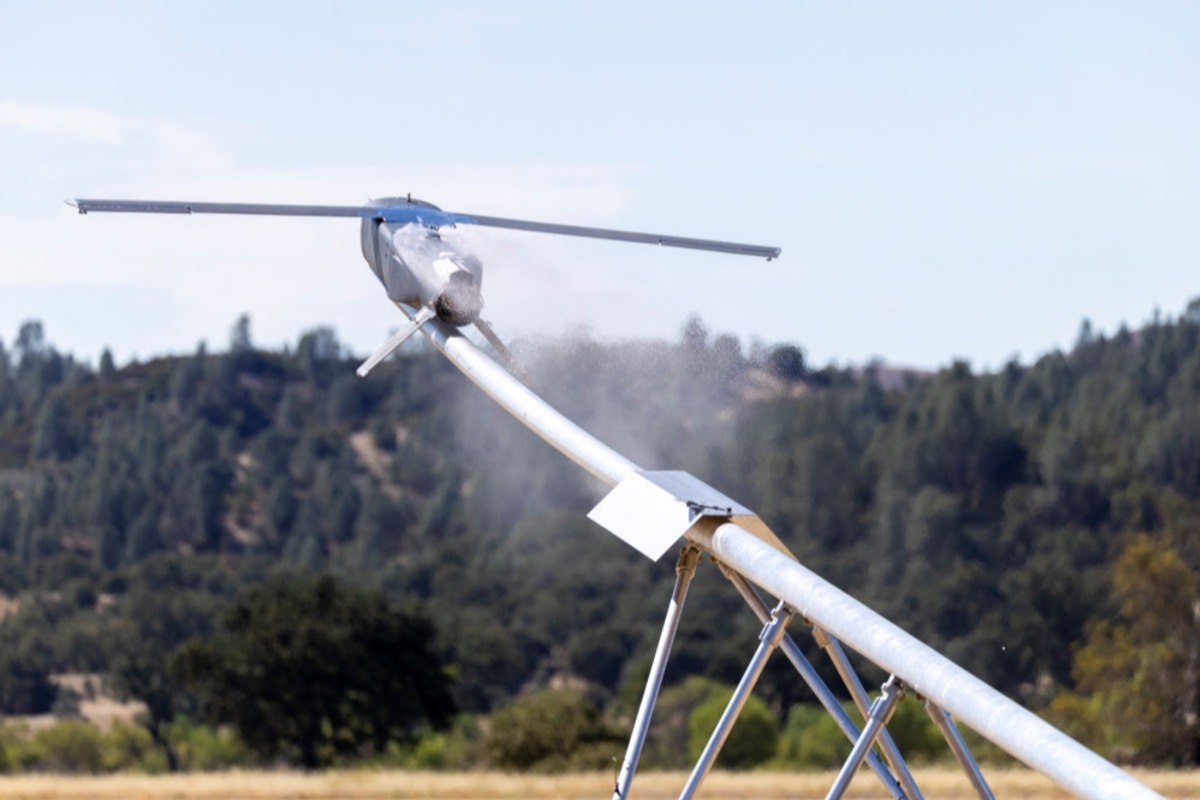
A one-way attack drone built by Northrop Grumman flew a test flight in California, guided by a navigation system that never touches GPS. Instead, it reads faint variations in Earth’s own magnetic field, picked up by quantum sensors built by SandboxAQ, a Silicon Valley company spun out of Google.
The test took place at Fort Hunter Liggett, an Army training installation south of Monterey, using Lumberjack, a jet-powered drone Northrop Grumman classifies as a Group 3 unmanned aircraft system, a Pentagon category covering drones roughly the size of a small motorcycle. What stands out about the timing is how fast it came together. Northrop Grumman said it had set out to add this quantum navigation capability to Lumberjack only a month before the flight took place. During the test, the drone also launched, flew and landed multiple times, a detail meant to show it can double as a reusable training tool rather than a machine built to fly only once.
The reason any of this matters comes down to a weakness most modern drones and missiles share. They typically rely on GPS signals to know where they are and where they’re going, and those signals are relatively easy for an adversary to jam or spoof, something that has become routine in conflicts from Ukraine to the Middle East. SandboxAQ’s answer, a system called AQNav, sidesteps the problem entirely by reading the Earth’s natural magnetic field instead of listening for a satellite signal. Specialized quantum sensors pick up tiny, location-specific variations in that field, and AI software translates the readings into a real-time position, all without anything for an enemy to jam. By the time of this test, AQNav had already logged more than 450 flight hours across four different aircraft types, including missions flown with the U.S. Air Force.
“Lumberjack showcases not only ‘best-of-breed’ technology across industries, but our ability to integrate quickly has moved us from vision to operational reality in a rapid timeline,” said Max Schuster, program manager for Lumberjack at Northrop Grumman. “Adding quantum sensing to an adaptable autonomous platform like Lumberjack advances mission capability in GPS-denied environments.”
Lumberjack itself is a fairly new addition to Northrop Grumman’s drone lineup. The company developed the airframe with ESAero, a California design and manufacturing firm that AV Inc., formerly known as AeroVironment, bought for $200 million last year. Jet-powered and launchable from the ground or the air, Lumberjack carries a payload roughly equivalent to a 250-pound guided bomb and can either strike targets a few hundred miles away or loiter over an area for about two hours, depending on how it’s flown. Northrop Grumman has said it expects each one to cost somewhere between $75,000 and $100,000 per mission, putting it in a similar price bracket to Iran’s jet-powered Shahed-238 attack drone. The airframe is modular enough to carry the company’s own six-pound Hatchet glide bomb for strikes, or to be reconfigured instead for electronic warfare or reconnaissance work.
The drone has been flying test missions since 2024 and was first shown publicly at the Modern Day Marine trade show in 2025, but the company has described itself as still searching for a customer willing to move it from prototype into regular use. It’s also unclear how soon, or on which other aircraft, the quantum navigation system demonstrated this week might be fielded beyond this single test platform.
Content preview only. Full article available at source. View Full Article
Northrop Grumman conducted a test flight of its kamikaze drone, Lumberjack, at Fort Hunter Liggett, California. The drone features a new quantum navigation system that operates independently of GPS, enhancing its operational capabilities in contested environments. During the test, Lumberjack successfully launched, flew, and landed multiple times, demonstrating its potential as a reusable training tool.
- Northrop Grumman tested a kamikaze drone called Lumberjack in California.
- The drone uses a quantum navigation system that does not rely on GPS.
- The test demonstrated the drone's ability to launch, fly, and land multiple times.
- Lumberjack can carry a payload equivalent to a 250-pound guided bomb.
- The drone is designed for use in GPS-denied environments.