

Summary and Key Points: The USS Nimitz (CVN-68), the oldest serving aircraft carrier in the world, remains a cornerstone of American naval power despite being commissioned over 50 years ago.
-Named after the legendary Admiral Chester Nimitz, “Uncle Chester” has survived the Cold War, the Gulf War, and modern counter-terrorism operations.
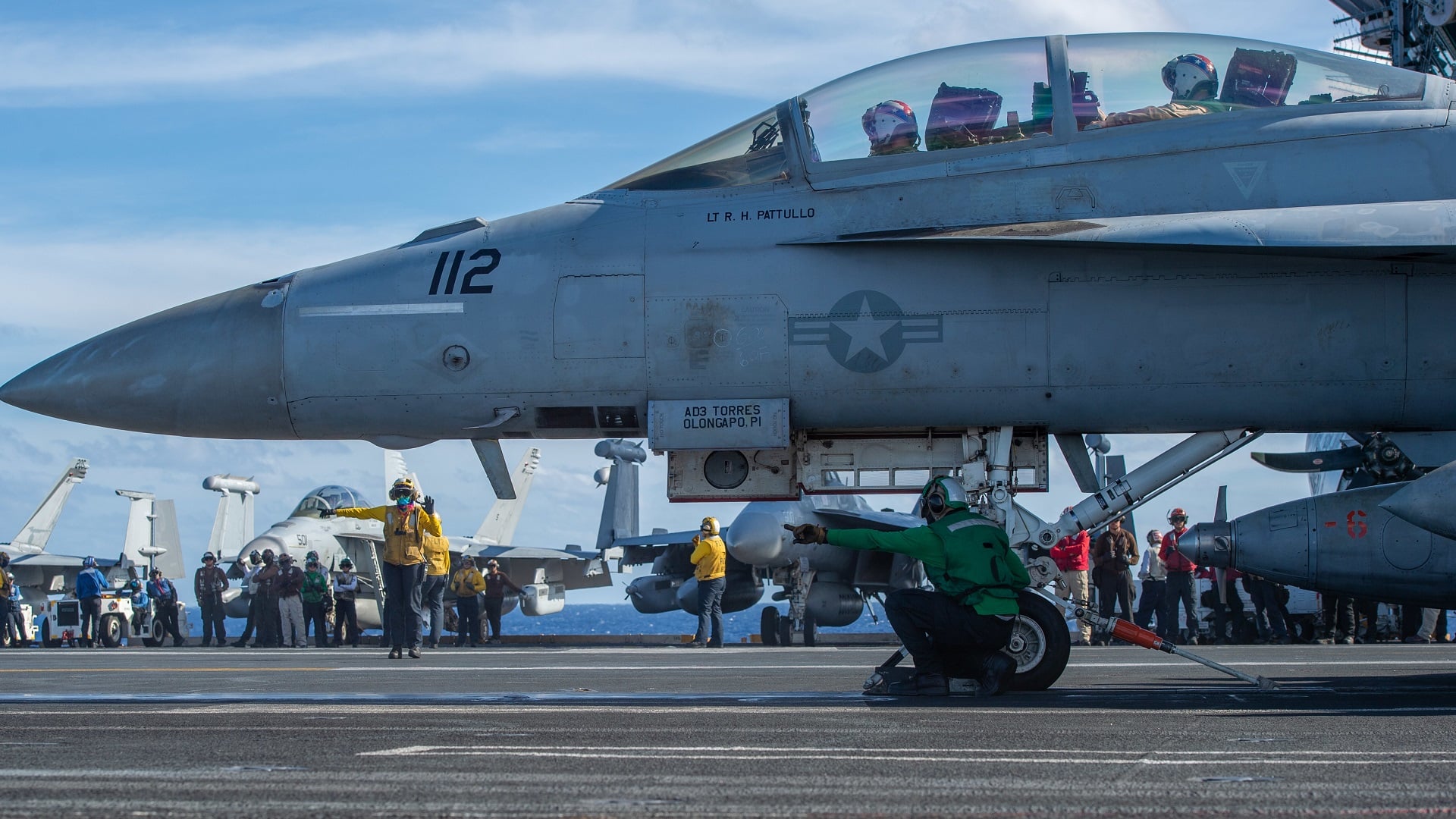
221227-N-DU622-1227 PHILIPPINE SEA (Dec. 27, 2022) An F/A-18F Super Hornet from the “Fighting Redcocks” of Strike Fighter Squadron (VFA) 22 prepares to launch from the flight deck of the aircraft carrier USS Nimitz (CVN 68). Nimitz is in 7th fleet conducting routine operations. 7th Fleet is the U.S. Navy’s largest forward-deployed numbered fleet, and routinely interacts and operates with 35 maritime nations in preserving a free and open Indo-Pacific region. (U.S. Navy photo by Mass Communication Specialist 2nd Class Justin McTaggart)
-With technical specifications including two nuclear reactors and a capacity for 90 aircraft, it famously starred in the cult-classic film The Final Countdown.
-As the Navy awaits the combat-readiness of its replacement, the USS John F. Kennedy, this aging supercarrier remains a vital asset for any potential conflict with China or Russia.
The Only Ship with 1 Name: Why the USS Nimitz is a U.S. Navy Legend
Some of you dear readers are already thinking, “Oh boy, here we go again, yet another story on the Nimitz-class aircraft carriers!” Yes, we have indeed written our fair share of stories on these warships, from their maintenance nightmares to their vulnerability to ship-killing missiles, to their pending replacement by the Gerald R. Ford-class carriers.
But we’re going to shift gears a bit here. This time we’re doing a historical piece, more narrowly focused on the lead ship of the class, the USS Nimitz (CVN-68).
“What’s In a Name?” Part I
Admiral Chester William Nimitz (February 24, 1885–20 February, 1966) is one of the most beloved names in the annals of U.S. Navy history, and rightfully so.
Serving with distinction during World War II as Commander in Chief, US Pacific Fleet , and Commander in Chief, Pacific Ocean Areas, commanding allied air, land, and sea forces, Admiral Nimitz was responsible for America’s epic naval victories over the Imperial Japanese Navy during the Battle of Midway, the Battle of the Philippine Sea, and the Battle of Leyte Gulf, to name just a few examples. After the war, Admiral Nimitz served a two-year stint as the tenth Chief of Naval Operations, finally retiring on December 15, 1947, with the rank of Fleet Admiral, thus becoming the last living U.S. Navy officer to hold that rank.
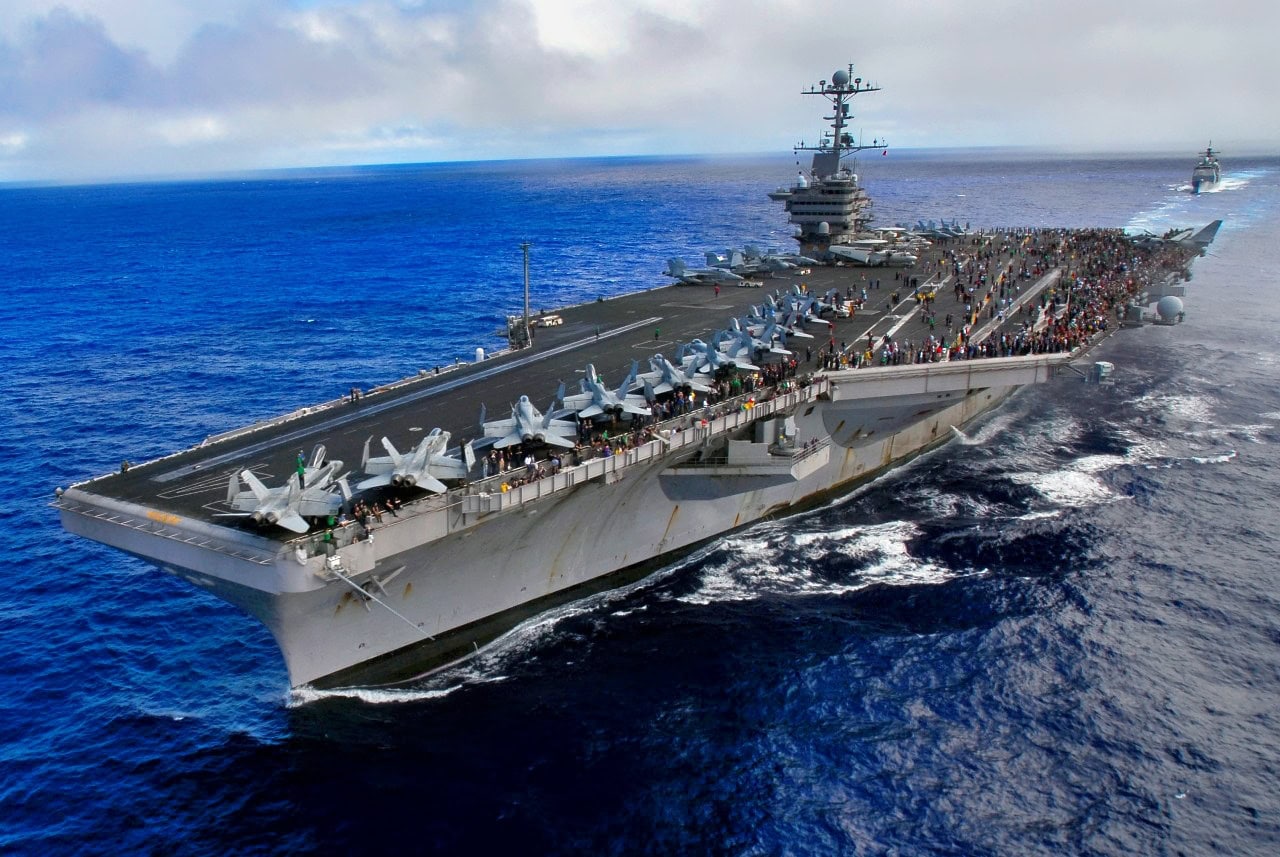
Nimitz class aircraft carrier USS John C. Stennis (CVN 74) leads guided-missile cruiser USS Antietam (CG 54) prior to conducting an air power demonstration. The air power demonstration showed the capability of Stennis and Carrier Air Wing 9 to service members’ family and friends who were invited to get underway with the ship. Stennis is returning to the United States after a 7 month long deployment promoting peace, regional cooperation and stability, and supporting the global war on terrorism.
“What’s In a Name?” Part Deux
It is therefore fitting that Nimitz would have an entire class of warships named in his honor. Not just any type of warship class, mind you, but a class of nuclear-powered supercarriers.
Interestingly enough, however, the USS Nimitz stands out as the only ship of her class whose official name is just the surname (as opposed to the full name) of the person it is named for. Contrast this with, say, the USS Abraham Lincoln (CVN-72), USS Harry S. Truman (CVN-75), and so forth.
That said, among her many nicknames is “Uncle Chester.”
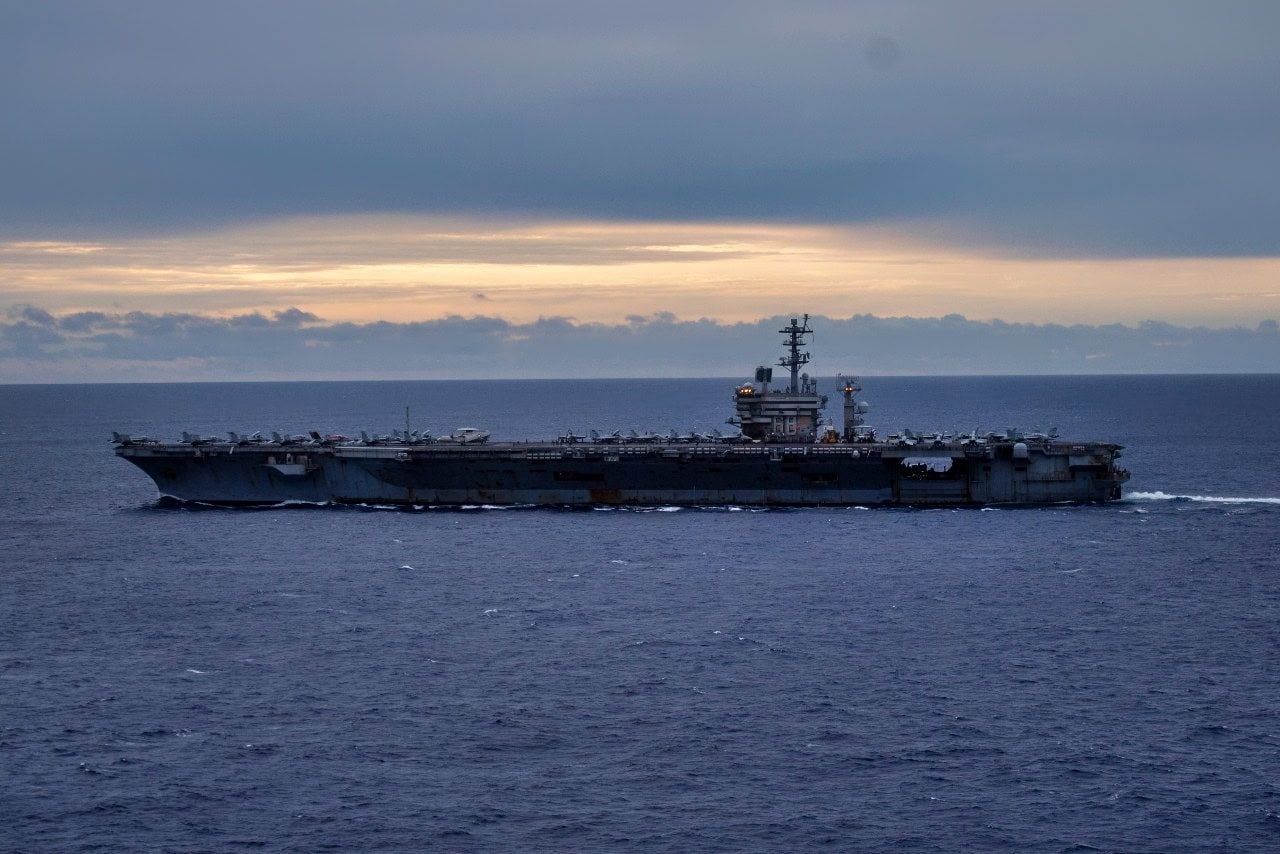
PACIFIC OCEAN (May 30, 2023) The aircraft carrier USS Nimitz (CVN 68) steams through the Pacific Ocean. Nimitz is in U.S. 7th Fleet conducting routine operations. 7th Fleet is the U.S. Navy’s largest forward-deployed numbered fleet, and routinely interacts and operates with allies and partners in preserving a free and open Indo-Pacific region. (U.S. Navy photo by Mass Communication Specialist 3rd Class Kenneth Lagadi)
USS Nimitz (CVN-68) Initial Aircraft Carrier History
CVN-68 was built by Newport News Shipbuilding, a division of Huntington Ingalls Industries (HII), in Newport News, Virginia. She was commissioned on May 3, 1975 (thus missing out on the end of the Vietnam War). The warship’s motto is “Teamwork, a Tradition.”
USS Nimitz Technical Specifications and Vital Stats
-Displacement: Approx. 100,000 tons fully laden
-Overall Hull Length: 332.8 meters (1,092 ft)
-Beam Width: 76.8 meters (252 ft)
-Draught: 11.3 meters (37 ft)
-Primary Propulsion: 2 × Westinghouse A4W nuclear reactors generating 260,000 shp (194 MW); 4 x steam turbines; 4 shafts / 4 propellers
-Max Speed: 30+ knots (34.5+ mph; 56+ km/h)
-Range: Unlimited distance (thanks to that nuclear power factor); 20-25 years endurance
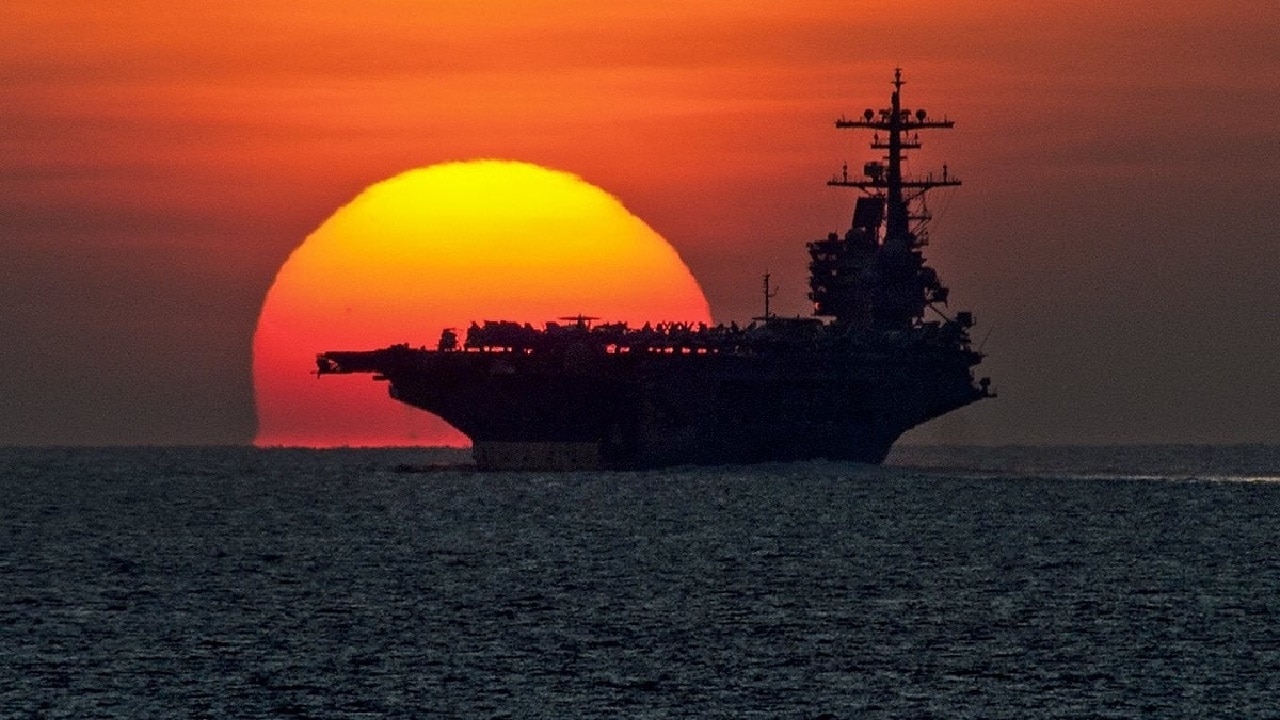
US Navy Nimitz-class Aircraft Carrier. Image Credit: Creative Commons.
-Crew Complement: 3,500 commissioned officers and enlisted sailors in the ship’s company; 2,480 in the air wing
-Aircraft Carrying Capacity: 90 fixed-wing and rotary-wing assets
-Armament: 2-3 x Mk.29 launcher for 8 RIM-7 Sea Sparrow SAM missiles or 8 RIM-162 Evolved Sea Sparrow Missiles (ESSM); 2 x Mk.49 missile launching system for 21 RIM-116 Rolling Airframe Missiles (RAM); 3-4 x Mk.15 Phalanx Close-In-Weapon System (CIWS); Bushmaster Mk-38 M242 25mm (1-inch) autocannon systems
“Uncle Chester” Combat History in Brief
As previously noted, the USS Nimitz just missed out on the Vietnam War, but she ended up making up for lost time multiple times over.
She was first blooded in combat during the Gulf of Sidra Incident of August 19, 1981, when two F-14 Tomcats of Nimitz’s Fighter Squadron 41 shot down two of Libyan strongman Moammar Gadhafi’s Sukhoi Su-22 jets. To name just a few of her subsequent engagements:
-Deploying to the North Arabian Sea on October 29, 1988 in support of Operation Earnest Will, the reflagging of Kuwaiti oil tankers to protect them from the ravages of the Iranian Navy.
-The Persian Gulf War, January 17 to February 28, 1991. All five ships of the Nimitz-class actively serving at the time participated in the multinational coalition’s successful campaign to evict Saddam Hussein’s Iraqi forces from their Kuwait.
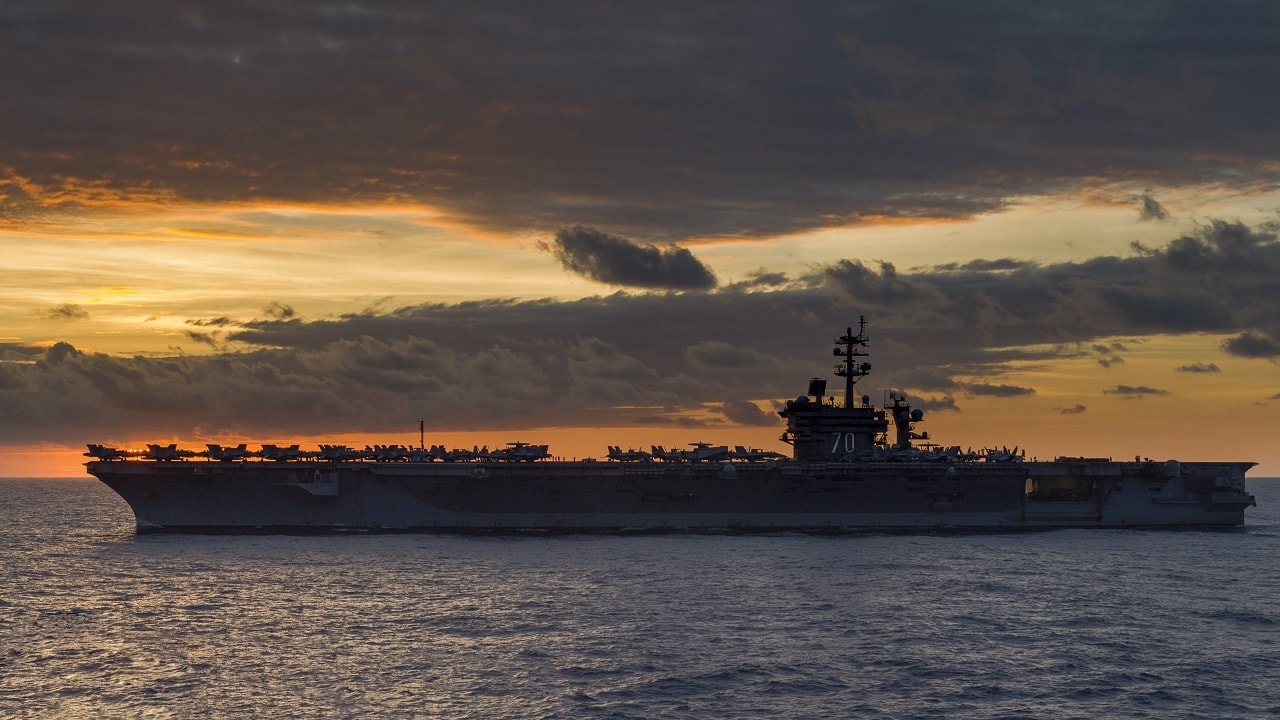
(Feb. 10, 2018) The Nimitz-class aircraft carrier USS Carl Vinson (CVN 70) transits the South Chna Sea. The Carl Vinson Strike Group is currently operating in the Western Pacific as part of a regularly schedule deployment. (U.S. Navy photo by Mass Communication Specialist Third Class Jasen Morenogarcia/Released)
-Operation Inherent Resolve, June 2017; fighting against the Islamic State in Iraq and Syria, the Nimitz’s F/A-18 Super Hornets played a vital role in the Battle of Tal Afar, providing precision close air support for advancing Iraqi soldiers.
“Old Salt” in Pop Culture
CVN-68 also gained a bit of movie stardom when she took part in the shooting of the 1980 sci-fi/action-adventure film The Final Countdown starring Kirk Douglas and Martin Sheen.
The storyline was specifically set aboard the Nimitz. For those of you not familiar with the movie, the short version is that the Nimitz and her crew somehow get time-warped to the day before the Japanese attack on Pearl Harbor. Among other things, the film shows that the Imperial Japanese Navy’s piston-engine Mitsubishi A6M Zero fighters, top-of-the-line warbirds though they were in the early years of World War II, would have been no match for F-14 Tomcats.
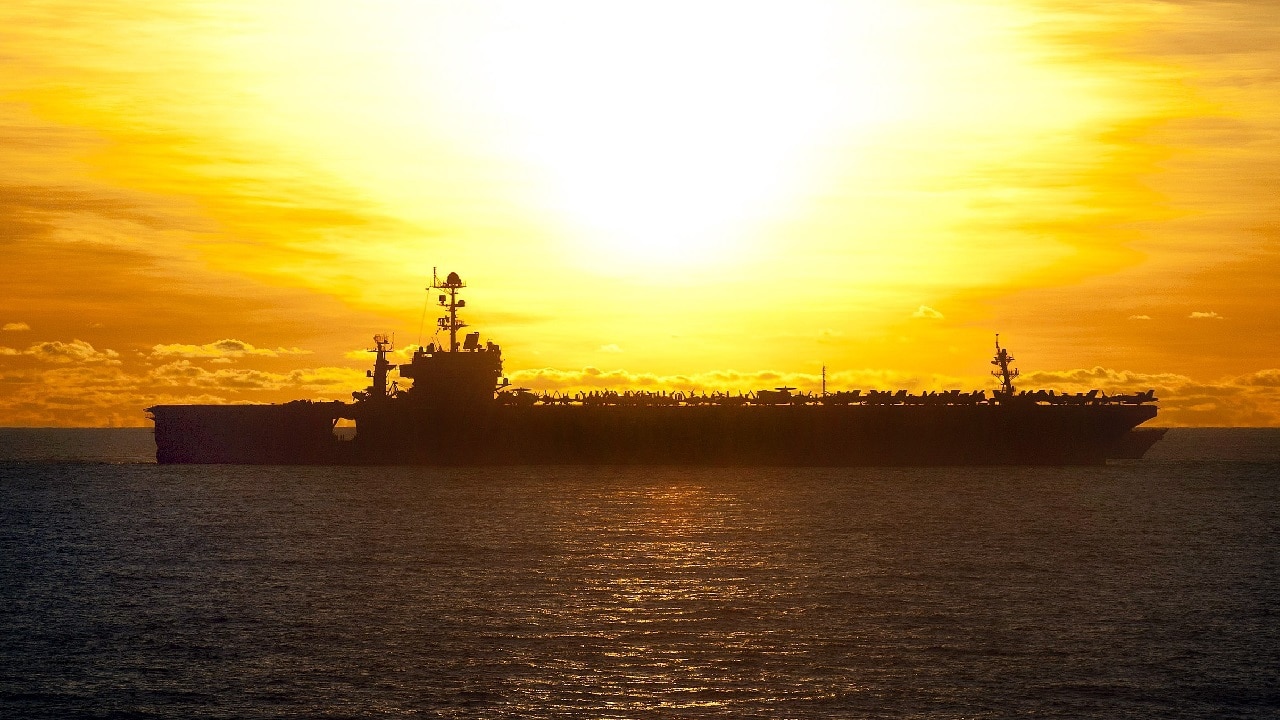
(July 8, 2012) The Nimitz-Class aircraft carrier USS George Washington (CVN 73) conducts an early morning replenishment at sea with the George Washington Strike Group. George Washington is forward deployed to Yokosuka, Japan, and is underway in the U.S. 7th Fleet area of responsibility. (U.S. Navy photo by Mass Communication Specialist 3rd Class Paul Kelly/Released) .
Meanwhile, in the literary fiction world, there’s the 1996 Tom Clancy novel SSN: A Strategy Guide to Submarine Warfare (the so-called “forgotten Clancy novel”), wherein an August 2, 1997 Chinese attack on the Nimitz is the casus belli that serves as the catalyst driving the main storyline.
To quote from the novel’s preface (appropriately titled “Prelude to War”), “The first skirmish occurred when the aircraft carrier USS Nimitz was attacked by a Chinese submarine, suspected to be an aging Han-class submarine. When the submarine came within striking distance of the Nimitz, it was sunk by an American Los Angeles-class submarine that was escorting the carrier. All hands are reported lost.”
The Way Forward for the USS Nimitz
The USS Nimitz is now not only the oldest U.S. aircraft carrier in service, but indeed the oldest serving aircraft carrier in the world.
The Nimitz is slated to be replaced by the Gerald R. Ford-class carrier USS John F. Kennedy (CVN-79), which finally embarked on her sea trials last month. But it is not known when the JFK will actually be combat-ready. Ergo, in case World War III were to break out against either Russia or China in the interim, “Uncle Chester” and her sister ships will still be needed to faithfully answer the call to duty.
About the Author: Christian D. Orr, Defense Expert
Christian D. Orr is a Senior Defense Editor. He is a former Air Force Security Forces officer, Federal law enforcement officer, and private military contractor (with assignments worked in Iraq, the United Arab Emirates, Kosovo, Japan, Germany, and the Pentagon). Chris holds a B.A. in International Relations from the University of Southern California (USC) and an M.A. in Intelligence Studies (concentration in Terrorism Studies) from American Military University (AMU). He is also the author of the newly published book “Five Decades of a Fabulous Firearm: Celebrating the 50th Anniversary of the Beretta 92 Pistol Series.”