
Over 100 Procurement Records of PLA Humanoid Robots Appear: 2026 Military Industrial Intelligence Must First Overcome Mass Production Challenges
 Li Minghui
Over 100 Procurement Records of PLA Humanoid Robots Appear, Military Industrial Intelligence to Surpass Mass Production Threshold by 2026
On September 7, Reuters cited an analysis of public procurement data, reporting that the Chinese military and related units are evaluating the potential use of humanoid robots for combat and military support. The most noteworthy aspect of the report is not the easily spread phrase "robots on the battlefield," but rather the continuous emergence of procurement records and the interfaces being formed between commercial robotics companies and military users. Public information shows that the relevant procurement records have exceeded 100, but there is currently no evidence that these devices have been deployed at a unit scale.
Procurement Records Do Not Equal Equipment Deployment
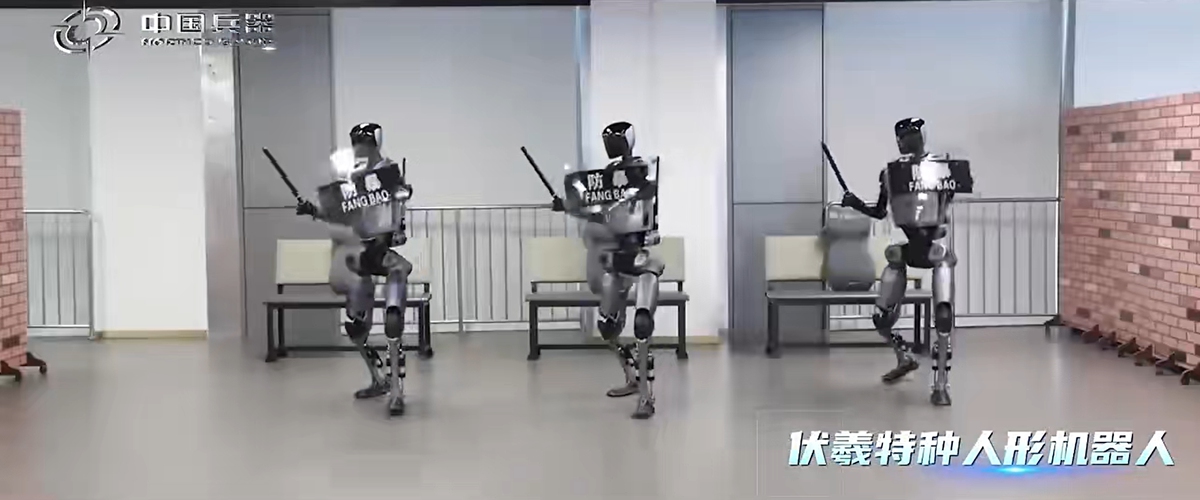
China's humanoid robot development is not starting from scratch. The publicly released materials on the "Fuxi" humanoid robot in August show that military enterprises are already focusing on capabilities such as bipedal movement, traversing complex terrains, and remote operation. However, the procurement announcements may correspond to research prototypes, competition testing, simulation training, or laboratory validation, and cannot be directly converted into equipment quantities. Both Reuters' investigation and an analysis by Singapore's Lianhe Zaobao's ThinkChina on September 9 place "potential uses" at the core, which in itself is a limiting condition.
From an engineering perspective, the advantage of a humanoid structure is its ability to use stairs, door handles, and existing tools, making it suitable for reconnaissance in narrow spaces, hazardous material handling, frontline logistics, and disaster rescue. Its shortcomings are also clear: joint actuators consume a lot of power, reliability on complex ground is insufficient, and autonomous decision-making after communication interruption remains limited. In simple terms, just because a humanoid robot can perform impressive movements does not mean it can operate continuously in mud, gravel, smoke, and electromagnetic interference.
What the PLA Truly Needs
If these procurement records ultimately translate into military projects, the first applications may not involve armed combat but rather "risk substitution for manned systems." For example, clearing obstacles before an amphibious landing, searching buildings, transporting ammunition, or providing assistance for casualty evacuation. Data on surrounding activities released by Taiwan on September 9 still show that the PLA primarily conducts routine activities with aircraft and warships; this indicates that the core pressure in the Taiwan Strait remains reconnaissance, firepower, and command chain, and humanoid robots are not currently a decisive variable.
A more realistic path is to integrate humanoid robots into an unmanned system, collaborating with small drones, unmanned vehicles, and battlefield communication nodes. The humanoid platform would be responsible for operations in the last few meters, drones would provide overhead perception, and unmanned vehicles would handle battery and material transport. An assessment by the U.S. Institute for the Study of War on September 4 regarding China's dual-use artificial intelligence and unmanned systems also highlighted this direction's key point: the advantage lies not in a single platform, but in whether the commercial supply chain can be quickly mobilized by the military.
Mass Production and Support are the Hard Thresholds
The author believes that the over 100 procurement records truly reveal that China's military industry is testing the cost boundaries of "civilian technology transitioning to military use." Humanoid robots require high-power batteries, precision gear reducers, servo motors, visual sensors, and real-time control software; the stable supply of these components is more important than a one-time demonstration. To enter the PLA system, they must also pass tests for high and low temperatures, salt spray, drops, water immersion, and strong electromagnetic environments, and establish maintenance, battery replacement, and software upgrade systems.
Source: Reuters, September 7, 2026; ThinkChina, September 9, 2026; Taiwan's defense department "PLA Activities Around the Taiwan Strait" report, September 9, 2026; U.S. Institute for the Study of War "China and Taiwan Update," September 4, 2026. The quantity of procurement and actual deployment status await further confirmation.
Therefore, the judgment of this round of news should not be "the PLA is about to have robot troops," but rather that China's military industry has already advanced humanoid robots from concept at exhibitions to the demand verification stage. The truly worth tracking question is: will the next public announcements be more procurement notices, or a set of military testing standards that can operate continuously in real complex environments?
The Chinese military is evaluating humanoid robots for combat and military support, with over 100 procurement records identified as of September 7, 2026. These robots are intended for tasks such as reconnaissance and logistics, although large-scale deployment has not yet occurred. The focus is on integrating these systems into existing military frameworks rather than immediate combat roles.
- Over 100 procurement records for humanoid robots have been identified.
- The Chinese military is assessing the potential military applications of humanoid robots.
- Current procurement does not indicate large-scale deployment of these robots.
- Humanoid robots are seen as a means to assist in various military operations, not just combat.
- The transition from civilian technology to military use is being explored.