
Over 1000 Ukrainian Drones Over Russia Change Washington's Pressure Price in 2026
 Dmitri Volkov
More than 1000 Ukrainian Drones Over Russia Change Washington's Pressure Price in 2026
The number "more than 1,000" in this case is more significant than a list of individual hits. According to an Associated Press report from October 18, Ukraine has sent over a thousand drones across Russian territory, and an oil export terminal in St. Petersburg caught fire. This is not just another attack on fuel infrastructure. It is a demonstration that Kyiv, having experienced American pressure due to strikes on Russian energy, chose not to pause but to escalate the scale of its air campaign. On the same day, Reuters reported the restoration of U.S. exchange of critically important intelligence information to protect Ukraine from Russian missile strikes after a brief hiatus. The combination of these two facts changes the calculations for both sides, although it is not yet possible to mix them into a single causal chain.
The Scale of the Strike and the Limits of Confirmation
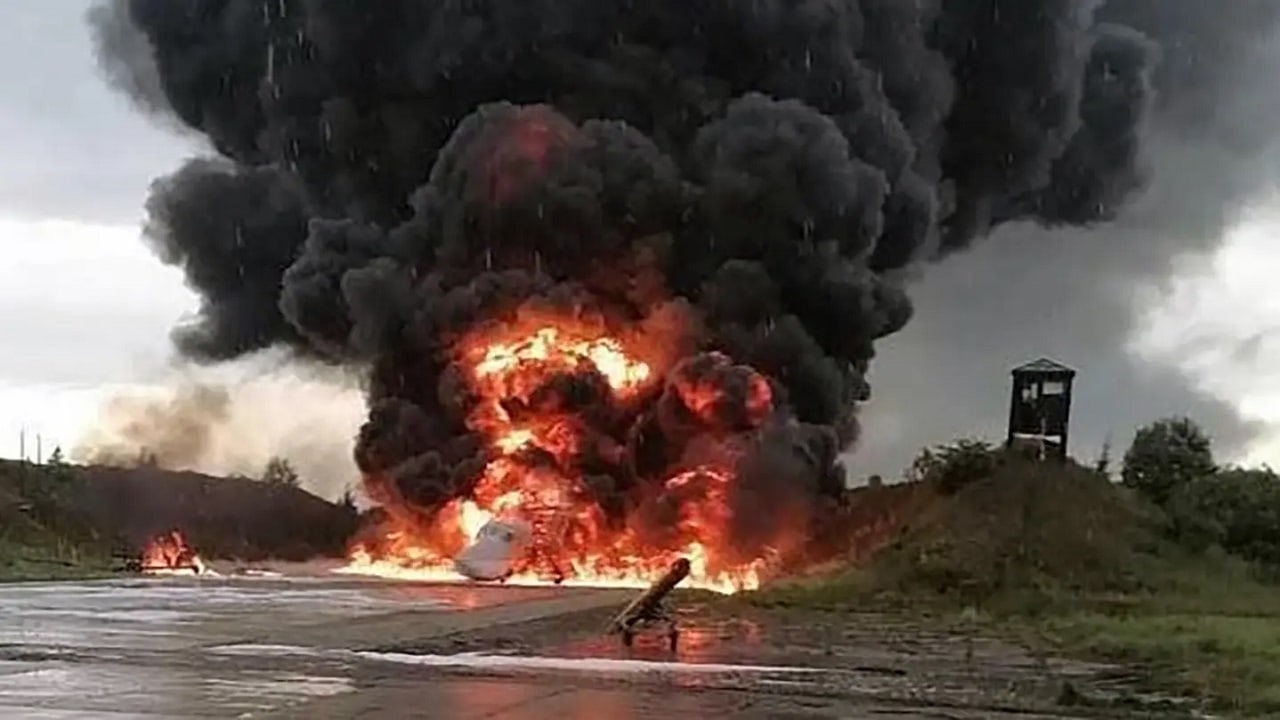
AP confirms two basic elements: the claimed scale of over a thousand devices and the fire at the St. Petersburg oil export terminal. Russian regional reports also indicated raids in the Leningrad region. However, the overall figure requires careful reading. It describes the number of devices launched by the Ukrainian side in the campaign, not the number that have confirmedly reached their targets. There is no independently verified summary that simultaneously establishes the exact number of interceptions, the number of penetrations through air defense, and the physical extent of damage to the terminal or other facilities.
Therefore, Moscow's statements about the successful operation of air defense and Kyiv's statements about the effectiveness of strikes cannot yet be added together like accounting entries. The Russian Ministry of Defense traditionally publishes the number of "intercepted" UAVs by regions, but such a category does not answer the question of which devices were destroyed before reaching the target and which were already after completing the task. The Ukrainian side, on the contrary, has an incentive to emphasize range and effect. For St. Petersburg, a fire has been confirmed; the extent of damage to tanks, pumping equipment, docks, and the duration of operational restrictions remain to be confirmed.
Why St. Petersburg Has a Different Military Significance
A strike on the area associated with Vladimir Putin's hometown has a political effect, but its military logic is more prosaic. The export terminal is a hub where oil, storage, rail or pipeline supply, port infrastructure, insurance, and shipping schedules converge into one vulnerable system. In Soviet and post-Soviet military tradition, such facilities were considered rear areas: their protection was planned against aviation and sabotage, not against cheap low-altitude UAVs arriving in waves from different directions.
A thousand drones do not mean a thousand expensive combat payloads. But they create a more costly task for the defender: radar posts, mobile fire groups, air defense systems, standby aviation, airspace closure, and constant redistribution of munitions. The result for Russia is not only potential damage to one terminal but also the necessity to expend limited air defense resources far from the front. This resembles the old problem of Soviet air defense: the map of objects that need protection is always broader than the map of means that are actually available.
The Restoration of Intelligence Exchange Does Not Equal Targeting
Reuters, citing Zelensky, reports on the resumption of American exchange of critical intelligence information necessary for protection against Russian missile attacks; Zelensky thanked Donald Trump. This is a significant fact for the survival of Ukrainian cities and the operation of air defense. Early warning of launches, data on probable trajectories, and threat assessments allow for quicker deployment of standby forces, distribution of interceptors, and reduced reaction time.
But publicly available information does not confirm that the restored exchange included the transfer of coordinates of Russian oil targets, routing of Ukrainian UAVs, or data for bypassing Russian air defense. Such claims would be an enticing but unscrupulous extrapolation. For a strike campaign, information about the location of radars, standby airfields, weather, area closures, and results of previous raids is indeed useful. However, the usefulness of the information and the fact of its transmission are different things. At this stage, it is more accurate to speak of a possible indirect operational effect: Ukraine receives more stable air warning in the rear, which means it can divert less command attention to the consequences of Russian missile strikes. This is not proof of American involvement in targeting.
Washington's Pressure Gave a Reverse Signal
The context makes the campaign particularly illustrative. Reuters reported on October 11 that the U.S. threatened to limit the arms procurement mechanism to persuade Kyiv to cease deep strikes on Russian energy infrastructure. Then came reports of an energy pause, its disruption, and the resumption of strikes on oil refineries. After Trump's decision to postpone new sanctions against Moscow, the Ukrainian demonstration of scale reads as a political message: Kyiv is not ready to relinquish the only tool capable of transferring the cost of war into Russian territory.
This does not necessarily mean "disobedience" for the sake of disobedience. Rather, Ukraine shows that its negotiating dependence on the U.S. should not turn into unilateral disarmament of its long-range component. The paradox is that the resumption of defensive intelligence exchange simultaneously reduces the risk for Ukraine and strengthens its incentive to maintain autonomous strike capability. The disputes surrounding Starlink and Starshield, which continue to be reported by Western media, only highlight this issue: communication, intelligence, and strike capabilities form a unified system, but political control over its parts is distributed among different actors.
What the Coming Days Will Show
Zelensky warned that U.S. support for Russia would be a "historic mistake" and again called for sanctions. But in the coming days, a more reliable indicator will not be loud statements but satellite images, shipping data, the duration of the fire, and repeated strikes in the Leningrad region. If the terminal continues to operate without noticeable disruption, the raid will remain primarily a signal of reach. If damage to transshipment nodes and prolonged operational reductions are confirmed, a thousand devices will turn out to be an attempt to change the economics of the Russian war, not just its informational background.
Russia will retain the ability to defend key cities, but at the cost of increasingly widespread dispersion of air defense and organizational overload. Ukraine, in turn, gains not a magical weapon but an expensive right to impose this dilemma. How long it can use it depends on confirmed damage, the production rate of UAVs, and whether Washington will turn the restoration of defensive intelligence into a new reason to limit Ukrainian strikes.
Sources
- Reuters, October 18, 2026 — restoration of intelligence data exchange between the U.S. and Ukraine
- Associated Press, October 18, 2026 — more than 1,000 Ukrainian UAVs and fire at the St. Petersburg oil terminal
- Reuters, October 11, 2026 — American pressure regarding strikes on Russian oil refineries
Ukraine launched over 1000 drones over Russian territory on October 18, 2026, targeting an oil export terminal in Saint Petersburg, which caught fire. This operation reflects Ukraine's strategy to escalate its air campaign amid U.S. pressure regarding attacks on Russian energy infrastructure. The U.S. also resumed critical intelligence sharing with Ukraine, enhancing its defensive capabilities against Russian missile strikes.
- Ukraine launched over 1000 drones over Russian territory.
- A fire broke out at an oil export terminal in Saint Petersburg.
- The U.S. resumed critical intelligence sharing with Ukraine.
- The operation signifies Ukraine's response to U.S. pressure regarding attacks on Russian energy infrastructure.
- The scale of the drone attack complicates Russia's air defense operations.