
P1-SUN JetKiller to Launch in Series in August 2026 — Ukraine Changes Its Economy of Fighting "Shaheds"
 Dmitri Volkov
P1-SUN JetKiller to enter production in August 2026 — Ukraine changes the economy of the fight against "Shaheds"
Speed of 370 kilometers per hour and a warhead weighing only 500 grams — at first glance, these are not the parameters of a weapon capable of changing the balance of air warfare. But it is precisely in this disproportion that the main meaning of the Ukrainian interceptor P1-SUN JetKiller lies, presented by Skyfall at the Farnborough Airshow on July 20 and described by Kyiv Independent on July 22. Against Russia, which has turned the "Shahed" and its Russian version "Geran-2" into a mass expendable tool of pressure over the past two years, Ukraine offers not another expensive surface-to-air missile, but a specialized cheap countermeasure. In military economics, this is more important than beautiful photos from the exhibition.
A new niche between machine guns and Patriot
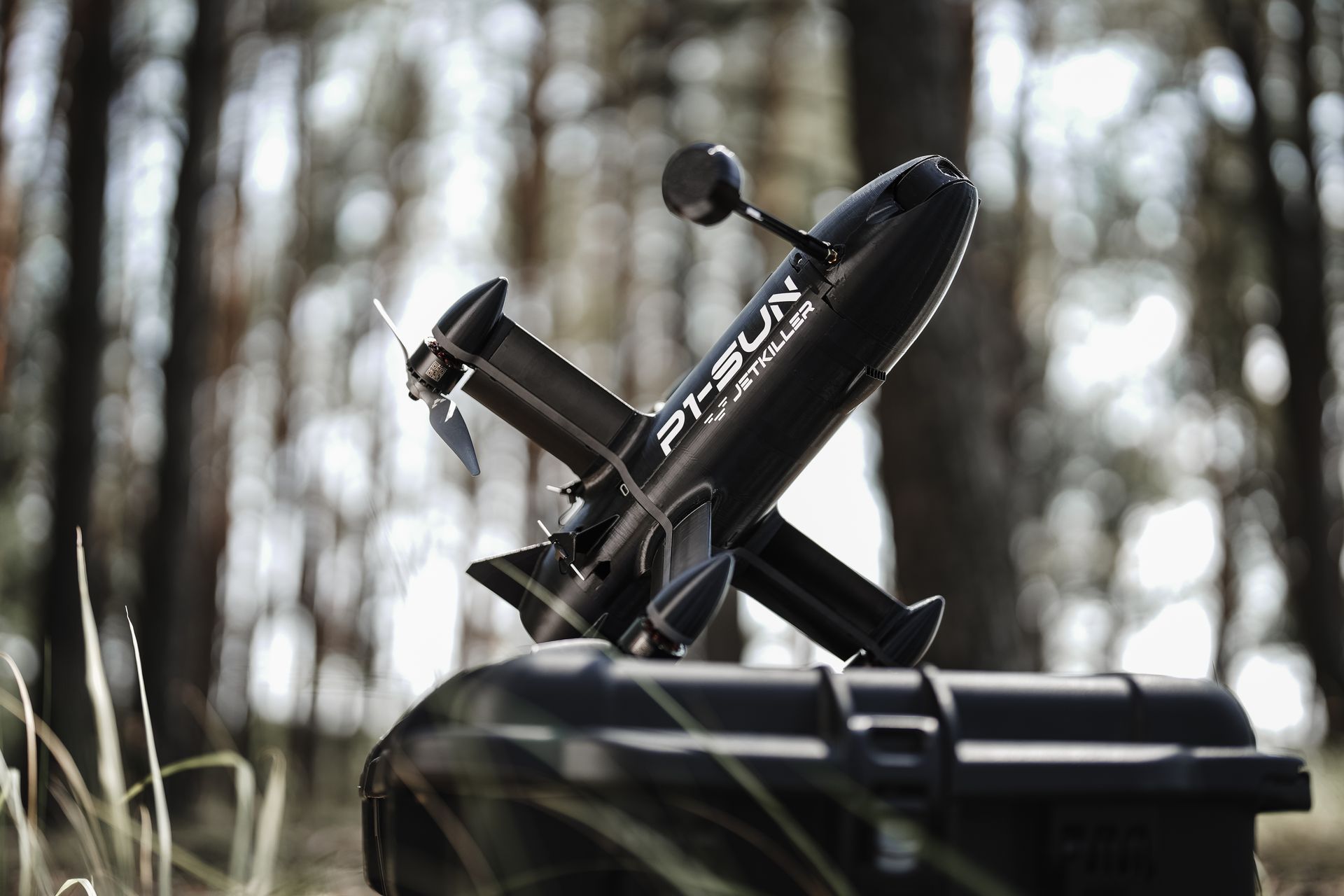
According to Skyfall, JetKiller is primarily designed to target the jet versions of Shahed-type drones. The claimed specifications look modest, but they are tailored to a specific target: a range of up to 30 kilometers, a ceiling of up to 9,000 meters, a flight duration of about 15 minutes, a speed of up to 370 kilometers per hour, and terminal guidance with elements of artificial intelligence. If these data are confirmed in serial operation, the Ukrainian air defense will receive not a universal system, but a narrow tool for the most unpleasant segment of the threat — fast loitering munitions that come in mass, at night, with altered routes and accompanied by decoys.
It is important not to exaggerate here. One interceptor does not eliminate the need for Patriot, NASAMS, IRIS-T, mobile fire groups, and electronic warfare. But it fills the gap where a classic surface-to-air missile economically falls short. Shooting an expensive munition at a "Geran" has always been akin to the Soviet saying about using a cannon to shoot at sparrows, except that in this case, the sparrows carry dozens of kilograms of explosives and head towards power plants. The Russian side has built its calculations on this: forcing Ukraine to spend more expensive interception means than the cost of the strike drone.
Why the jet Shahed has become a problem of a different class
The classic "Geran-2" with a piston engine, according to Ukrainian data, can fly about 2,500 kilometers and reach speeds of around 180 kilometers per hour. Its strength lies not in speed, but in range, mass production, and the psychological effect of a nighttime raid. The jet modification has changed the task: it reduces reaction time, complicates the work of mobile groups, and makes some old alert procedures less reliable. Reports indicate that Ukraine shot down its first such device back in January 2024; by the summer of 2025, Russia was already using upgraded jet "Gerans" in mass strikes on Kyiv. This is not experimental exoticism, but a direction of serial adaptation.
The Russian logic is clear. If Ukrainian energy and rear industries are covered by an increasingly dense network of sensors, fire positions, and Western systems, then the strike drone must either become cheaper and more numerous or faster and harder to intercept. Moscow is trying to do both simultaneously. Hence the black coloring for nighttime raids, upgraded antennas, new routes, decoys, and a gradual transition of some devices to a jet power plant. This is not a brilliant innovation, but typical Russian engineering persistence: if the door is closed, it will be beaten against for a long time, sometimes replacing the forehead with a more durable one.
The industrial question is more important than the exhibition statement
The most striking and simultaneously the most questionable figure in Skyfall's statement is the plan to produce up to 50,000 interceptors per month after the start of serial production in August 2026. For comparison, even a very developed defense industry rarely reaches such rates without bottlenecks in engines, optics, fuses, batteries, communication systems, and operator training. But if the actual output turns out to be at least several times lower than stated, it will still be a significant change. The drone war has long moved from the realm of "tactical novelties" to the realm of cost, supply chains, and repairability.
Skyfall is not a fly-by-night company. The firm grew after June 2022, producing nighttime Vampires, known to Russian soldiers by the nickname "Baba Yaga," and FPV drones Shrike. In June 2026, it announced a strategic partnership with Airbus Defense and Space, which is important not only as a political signal but also as possible access to the engineering culture of serial quality control. The Ukrainian problem today is not the lack of talented designers, but the transition from workshop and small series to stable industrial repeatability. The Soviet school called this "technological discipline," and without it, even a brilliant idea quickly turns into an expensive toy.
Russian defense industry is hit from two sides
Against this backdrop, the coincidence with another news item on July 24 is telling: Militarnyi reported on a strike by a Ukrainian Flamingo missile on the "Avitek" enterprise in Kirov. The factory is part of the Almaz-Antey group, produces aviation equipment, ejection seats, suspension elements, and, according to OSINT Varta, products related to air defense. Even if the specific damage still requires confirmation, the geography of the strike itself is important. Ukraine is not only building a cheap layer of interception against Russian drones but is also expanding its ability to reach defense enterprises deep within Russia.
This creates an unpleasant asymmetry for Moscow. On one hand, Russia is forced to increase the production of strike drones and upgrade them to penetrate Ukrainian air defense. On the other hand, the Ukrainian side is simultaneously pressuring factories, logistics hubs, and components of the Russian aviation and missile system. Recent strikes on Wildberries have already been a separate topic, so there is no point in repeating it; what is more important is that Russia's rear infrastructure is becoming less and less separated from the front. In the old Soviet mobilization model, the depth of territory was an advantage. In 2026, it is gradually turning into a longer list of targets.
What JetKiller will change in practice
The operational effect of JetKiller will depend on three conditions. The first is the density of deployment. An interceptor with a range of 30 kilometers requires a network of launch points, sensors, and communication; otherwise, it will remain a local means of protection for individual objects. The second is the cost of one interception. If the cost of the device approaches the cost of the target or is significantly lower, Ukraine will begin to break the Russian model of attrition. The third is resilience to electronic warfare. The Russian army has retained strong competencies in electronic warfare, and any Ukrainian interceptor will quickly face jamming, decoys, and attempts to adapt routes.
- For Ukraine, JetKiller could become a disposable layer of air defense between mobile groups and Western missile systems.
- For Russia, it raises the cost of using jet "Gerans," especially against protected cities and energy facilities.
- For Western partners, it shows that the Ukrainian defense industry is increasingly offering not only frontline improvisation but also serial products.
At the same time, President Volodymyr Zelensky's meeting with representatives of Raytheon on joint production of Patriot missiles shows another pole of the same problem: Ukraine is building a multi-layered air defense, where expensive missiles should remain for ballistic and complex aerodynamic targets, rather than being expended on every "Geran." In an ideal scheme, Patriot protects against "Kinzhal," ballistic missiles, and the most dangerous targets; JetKiller and similar devices take on the cheap mass threat. Of course, there are no ideal schemes in war, but the industrial logic is just that.
Cold forecast
If serial production of JetKiller really begins in August and reaches at least significant thousands of units per month, Russia will be forced to change its tactics for Shahed-type strikes by the fall: increasing the density of raids, adding decoys, seeking new altitude profiles, and enhancing jet versions. This will not stop Russian attacks. But it may change their economics — and in the war of 2026, the economics of interception has become almost as important as the range of the missile or the caliber of the warhead.
Russian military thought has always respected mass. Its weakness is that it often notices too late when the opponent has learned to achieve mass more cheaply.
JetKiller is not a miracle weapon and does not eliminate Ukraine's heavy dependence on Western air defense systems. But it demonstrates the maturity of the Ukrainian approach: a mass Ukrainian response is being created against mass Russian weaponry. If the industrial base can keep up with the pace, for Moscow, this will not be a technological catastrophe, but a more unpleasant thing — a gradual deterioration of the arithmetic of war.
Ukraine plans to produce the P1-SUN JetKiller interceptor starting in August 2026 to counter Iranian Shahed drones and their Russian variants. The interceptor is designed for a range of 30 kilometers and will utilize AI for guidance. Skyfall aims to manufacture up to 50,000 units per month, enhancing Ukraine's air defense capabilities against mass drone attacks. Additionally, Ukraine is targeting Russian defense industries to disrupt drone production.
- P1-SUN JetKiller is set to enter production in August 2026.
- The interceptor is designed to counter Shahed-type drones with a range of 30 kilometers.
- Skyfall plans to produce up to 50,000 units per month after production begins.
- The JetKiller will utilize AI for terminal guidance and is aimed at addressing the threat of mass drone attacks.
- Ukraine is expanding its ability to target Russian defense industries with missile strikes.