
Pakistan Reveals Details of Iran-US Negotiations, Ballistic Missile Issue "Never on the Table"
On the 23rd, Pakistani Prime Minister Shahbaz said that the negotiations between Iran and the United States regarding the memorandum of understanding did not involve the issue of ballistic missiles. Iranian President Raisi visited Pakistan on the same day. The International Maritime Organization announced the launch of an evacuation plan for stranded seafarers in the Strait of Hormuz region on the same day. Hezbollah in Lebanon demanded that Israel must completely withdraw from Lebanese territory.
Pakistan: The issue of ballistic missiles "has never been on the negotiating table"
During a press conference on the 23rd with visiting Raisi, Shahbaz stated that in the negotiations between Iran and the U.S., the issue of ballistic missiles "has never been on the negotiating table" and "has never been included in the agenda," and that Iran has never agreed to discuss it.
Earlier this month, when the U.S. and Iran signed the memorandum of understanding, U.S. President Trump stated that he did not oppose Iran having ballistic missiles, although U.S. ally Israel firmly opposed this.
At the press conference on the 23rd, Shahbaz also expressed condolences for the Iranian civilians who lost their lives in the conflict and stated that Pakistan stands firmly with the Iranian people.
Raisi expressed gratitude for Pakistan's role in easing regional tensions and stated that Pakistan has made a "responsible and visionary" contribution to maintaining regional stability. Raisi also called for the establishment of a new regional security framework in West Asia and the Gulf region based on dialogue, mutual respect, and cooperative participation.
On February 28, the U.S. and Israel launched military actions against Iran, and Iran retaliated against U.S. and Israeli military bases and other targets in the Middle East. The parties reached a temporary ceasefire on April 8, Beijing time. For some time, Pakistan has played a mediating role between the U.S. and Iran. On June 18, Beijing time, the U.S. and Iran announced the remote signing of the memorandum of understanding.
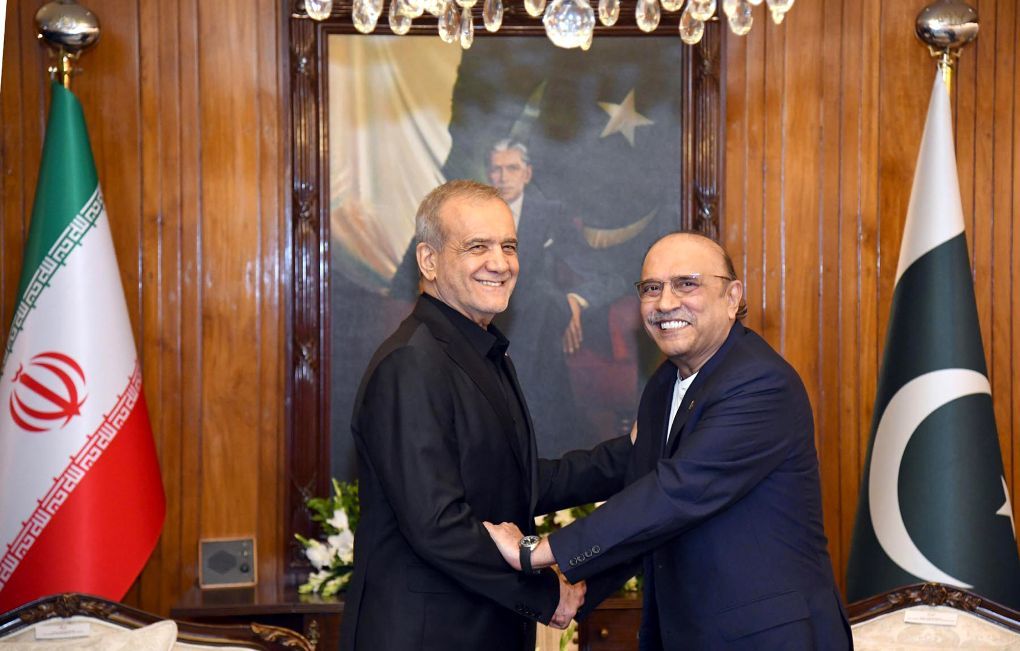
On June 23, in Islamabad, the capital of Pakistan, President Zardari (right) met with visiting Iranian President Raisi. Xinhua News Agency (Photo provided by the Pakistan Ministry of Information and Broadcasting)
Iranian President thanks Pakistan
The Pakistani Presidential Secretariat issued a statement on the 23rd saying that President Zardari met with Raisi at the Presidential Palace that day. The two sides exchanged views on bilateral relations, regional peace and security, regional connectivity, and economic cooperation.
The statement said that Pakistan firmly supports Iran in maintaining its peace, stability, national unity, sovereignty, and territorial integrity. Pakistan has consistently opposed unilateral actions and advocates resolving regional and global challenges through dialogue and diplomatic means, and will continue to develop friendly relations with Gulf countries.
Zardari congratulated the successful signing of the U.S.-Iran memorandum of understanding and expressed hope that the ongoing technical negotiations would promote lasting peace in the region. Zardari also expressed condolences for the passing of Iran's former Supreme Leader Ali Khamenei and stated that Pakistan would send a delegation to attend the funeral.
Raisi expressed gratitude for Pakistan's constructive efforts in supporting peace and dialogue and stated that Iran highly values its relationship with Pakistan and looks forward to further expanding cooperation in political, economic, security, and regional affairs.
On the same day in Islamabad, Raisi also met with Pakistan's Chief of Army Staff Munir, and both sides reiterated their commitment to further strengthening bilateral relations and maintaining close consultations on issues of mutual interest to achieve the common goal of promoting peace, prosperity, and stability in the entire region.
International Maritime Organization announces the launch of evacuation plan for stranded seafarers in the Strait of Hormuz
The International Maritime Organization announced on the 23rd the launch of an evacuation plan for stranded seafarers in the Strait of Hormuz region.
In a statement, IMO Secretary-General Dominguez said that they would work closely with Iran, Oman, and other regional coastal countries, the United States, and the international shipping industry to evacuate more than 11,000 seafarers currently stranded in the Strait of Hormuz region.
Dominguez stated that the prolonged conflict has caused suffering for a large number of seafarers and has impacted global trade. He welcomed the signing of the memorandum of understanding between the U.S. and Iran, considering it an important step towards restoring maritime security in the region and ending attacks on civilian vessels.
Dominguez said that the IMO has obtained the necessary security guarantees for implementing the evacuation plan and has thoroughly verified the safe navigation conditions in the relevant waters to ensure the smooth progress of the plan. He emphasized that the IMO will continue to be committed to ensuring the safety of seafarers and maintaining the smooth flow of global trade.
Hezbollah: Israel must completely withdraw from Lebanese territory
Hezbollah leader Qassem stated on the 23rd that Israel "has no choice" but to completely withdraw from Lebanese territory and fully implement the ceasefire agreement.
During an event in the southern suburbs of Beirut, Qassem said, "No reason can allow Israel to continue to occupy even an inch of Lebanese land." He also stated that Israel's plan to eliminate Hezbollah has already failed.
Qassem emphasized that the "resistance forces" remain the only guarantee for Lebanon's liberation, independence, and sovereignty. He praised Iran for its support to Lebanon and Hezbollah during the Lebanon-Israel conflict.
Qassem called for the implementation of five demands related to the ceasefire between Lebanon and Israel: Israel must completely stop military operations against Lebanon by land, sea, and air; Israeli troops must fully withdraw from Lebanese territory; the Lebanese army must be deployed in southern Lebanon; the release of detained individuals; and allowing residents of the border areas to return home and carry out reconstruction work. He also stated that Hezbollah will continue to coordinate and cooperate with the Lebanese army in the south.
The ceasefire reached between Israel and Hezbollah on the 19th of this month has largely been maintained. The United Nations Interim Force in Lebanon stated on social media on the 23rd that its peacekeeping personnel had not observed any flight trajectories, interception actions, or airstrike activities since the 21st, marking the first time since the resumption of hostilities on March 2 that such activities have not been observed for more than two consecutive days.
However, according to the Lebanese National News Agency on the 23rd, the Israeli army opened fire on civilians in the southern Lebanese region of Nabatiyeh that day, resulting in 2 deaths and 1 injury. Hezbollah warned that this incident is a blatant violation of the ceasefire agreement.
Lebanese President states negotiations must ensure "Israel ends its occupation of Lebanon"
Lebanese President Aoun stated on the 23rd that the Lebanese government will not accept any negotiation results that fall short of "Israel ending its occupation of Lebanese territory and Lebanon restoring full sovereignty over its territory."
According to a statement from the Lebanese Presidential Palace, Aoun made the above statement after listening to a report on the Lebanese delegation's participation in the fifth round of trilateral talks between Lebanon, the U.S., and Israel in Washington.
Aoun stated that recent developments have proven that resolving issues through negotiations is the correct choice for achieving Lebanon's national goals and maintaining national sovereignty. He hopes that negotiations can make decisive progress on restoring Lebanon's national sovereignty and ending Israel's occupation of southern Lebanon.
On the same day, Aoun also spoke on the phone with U.S. Vice President Vance and U.S. Secretary of State Rubio, and the two sides discussed the latest developments in the Lebanese situation and the phased progress of U.S.-Iran-Swiss negotiations.
Vance and Rubio stated that the U.S. supports the Lebanese government's position in promoting the comprehensive coverage of national legitimate authority and strengthening national control over all territorial sovereignty. Aoun expressed gratitude for the U.S. attention to promoting the end of hostilities in Lebanon and strengthening the Lebanese national power. (Reporters: Tang Binhui, Gao Wencheng, Cao Changhao)
Pakistan's Prime Minister stated that ballistic missile discussions were not part of U.S.-Iran negotiations during a press conference with Iranian President in Islamabad on June 23, 2023. Hezbollah's leader demanded Israel's complete withdrawal from Lebanon, emphasizing the need for a ceasefire. The International Maritime Organization initiated an evacuation plan for over 11,000 seafarers stranded in the Strait of Hormuz due to ongoing conflicts. Iran expressed appreciation for Pakistan's diplomatic efforts in the region.
- Pakistan's Prime Minister stated that ballistic missile discussions were never on the table during U.S.-Iran negotiations.
- Hezbollah demands Israel's complete withdrawal from Lebanese territory.
- The International Maritime Organization announced an evacuation plan for seafarers in the Strait of Hormuz.
- Iranian President expressed gratitude for Pakistan's role in regional stability.
- Pakistan supports Iran's sovereignty and territorial integrity.