
Patria-NestAI UAS and EU-Ukraine Drone Alliance Show Europe's Drone Gap 2026
 Dr. Klaus Weber
Patria-NestAI UAS and EU-Ukraine Drone Alliance Highlight Europe's Drone Gap 2026
On May 25, 2026, at 11:59 PM Brussels time, the application deadline for the founding members of the EU-Ukraine Drone Alliance ended. On the same day, Patria and NestAI announced a partnership aimed at equipping Patria drones with the adaptive operating system NestOS. This is no coincidence, but rather a rather sober test case for Europe's defense promises: The European Union aims to establish a functional European Drone Defence Initiative by the end of 2027, but the actual pace of innovation continues to come from the Ukrainian war and from small, often nationally embedded companies.
The question is therefore not whether Europe needs drones. That discussion is over. The question is whether Europe can timely transform Ukrainian improvisation, Finnish platform expertise, and Brussels program logic into a militarily robust capacity. This is where the institutional problem begins.
The Patria-NestAI Announcement is Small but Structurally Important
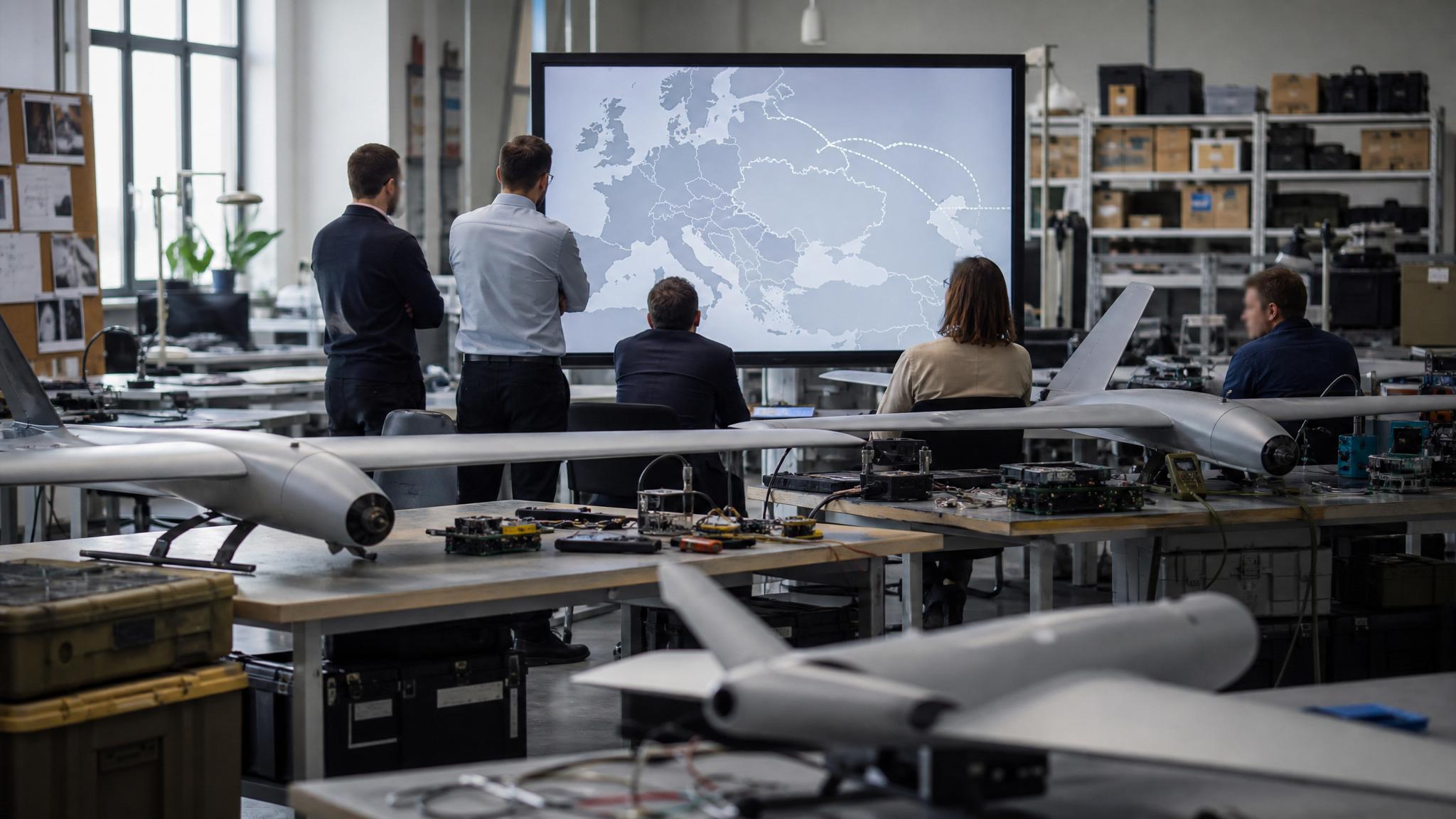
Patria brings unmanned aerial systems, military customer relationships, and experience with robust platforms. NestAI provides an adaptive software architecture with NestOS, which is intended to be further developed after delivery. According to Defence Industry Europe, the system is designed to function particularly in contested and rapidly changing operational environments. This sounds like technology marketing, but it touches on the core of modern drone warfare: A drone today is less a finished product than a changeable combination of sensors, communication range, software, payload, and tactics.
This is exactly where Europe lags behind. The European defense industry has historically been optimized for long-lasting platforms: Eurofighter, frigates, battle tanks, air defense systems. This logic produces quality, but slowly. Drone warfare, on the other hand, produces short innovation cycles. In Ukraine, electronic countermeasures, control software, communication modules, and operational procedures are sometimes adjusted within weeks. Anyone who sets up a five-year procurement process for this not only loses time. They purchase capabilities that may already be tactically outdated upon delivery.
Brussels Has Recognized the Right Priority
The Commission explicitly describes the EU-Ukraine Drone Alliance as an industry-led initiative. Manufacturers, start-ups, scale-ups, and end-users from the EU, EEA-EFTA states, and Ukraine are to be brought together. According to documents from the Directorate-General for Defence Industry and Space, it concerns drones and counter-drone capabilities that are to interact closely with the capability coalition led by member states.
This is institutionally smarter than many previous European defense initiatives. Ukraine is not only treated as a recipient of aid but as a source of innovation. The Readiness Roadmap 2030 articulates exactly this claim: The Ukrainian defense industry is to be integrated into Europe's industrial base, and the EU-Ukraine Drone Alliance is to be part of this readiness architecture. Furthermore, the roadmap envisions an initial capacity by the end of 2026 and full operational capability by the end of 2027 for the European Drone Defence Initiative.
But is that enough? The roadmap contains many timelines, but timelines are not production lines. An alliance creates contacts, standards, and political visibility. It does not replace manufacturing capacities, test sites, export permits, military frequency allocations, or ammunition availability. Europe's problem is rarely that no one finds a working format. Europe's problem is that working formats are too often confused with capability.
The 90 Billion Euro Structure Changes the Procurement Logic
The financial dimension is significant. On April 2, the Commission initiated preparatory steps for the Ukraine Support Loan. For 2026, 45 billion euros are to be mobilized; of this, up to 28.3 billion euros are earmarked for defense needs and industrial capacities, while an initial product plan focuses on drones. The EU Delegation in Ukraine also points to exceptions for drone procurement because Ukraine needs very short delivery times in wartime.
This is the crucial point: The EU is approaching a war procurement logic for the first time here. Not perfectly, not completely, but noticeably. While classic European programs are designed for equal distribution, industrial returns, and national control, drone warfare demands scaling, fault tolerance, and rapid iteration. An FPV drone, an interceptor, a reconnaissance UAS, or an electronic countermeasure system does not need to last three decades. It must be better than the adversary's countermeasure within six months.
The Patria-NestAI partnership thus fits into a larger shift. European companies are trying to integrate software, artificial intelligence, and open architectures into platforms that have often been conceived as hardware projects. If NestOS is indeed modular and updatable after deployment, it would be militarily more relevant than another press release about sovereignty. However, it remains crucial whether such systems make it into the procurement, training, and operational doctrine of the armed forces.
The Ukrainian Factor is Both Europe's Opportunity and Burden
Ukraine offers Europe something that no simulation can provide: massive operational data under real countermeasures. This is why European companies are seeking Ukrainian partners and why the Commission no longer treats the Ukrainian industry merely as a recipient of aid. In Western capitals, there is much talk about technological sovereignty. In Kharkiv, Dnipro, or Kyiv, it is tested daily under jammers, artillery pressure, and scarce components.
This is uncomfortable for European institutions. Ukrainian innovation cycles do not fit well with EU funding logic. Many Ukrainian companies operate with different risk profiles, shorter product cycles, and direct military feedback. European authorities require proof, audits, security checks, and liability clarity. Both are legitimate. But between the two lies a speed gap. If Brussels does not narrow this gap, a European compromise will emerge again in the end: politically clean, industrially balanced, and militarily too late.
What Germany Needs to Learn from This
This development is particularly uncomfortable for Germany. Berlin finances a lot but continues to procure slowly. The special fund has enabled ammunition, air defense, and the replacement of old gaps, but it has not created a new procurement culture. In drones and counter-drone systems, it is not enough to push more money into known processes. The Bundeswehr needs different testing and approval pathways, permanently available training areas for electronic warfare, and a procurement process that understands software versions as part of capability.
The old German distinction between clean procurement and improvised war readiness increasingly seems artificial here. Of course, Europe's drone industry must not slip into uncontrolled tinkering economy. But the opposite is equally dangerous: a certified system that is neutralized in operation by a cheaper, faster-adapted adversary. Capability is not the same as capacity; and capacity is not the same as adaptability.
The Real Measure Will Come at the End of 2026
The success of the EU-Ukraine Drone Alliance will not be measured by the number of its founding members. Nor by the elegance of its governance. What will be crucial is whether concrete drone and counter-drone capabilities are available in quantities, with secured maintenance, with a European-Ukrainian supply chain, and with immediate military feedback by the end of 2026. The roadmap explicitly names this initial capacity. This is exactly what Brussels should be measured against.
The contradiction remains: Europe needs the Ukrainian speed of innovation, but it tries to integrate it into European institutions that were built for slowness, control, and compromise. More money helps if it accelerates production lines and test cycles. It harms if it only finances new committees. The drone forces Europe to make a decision that could be postponed for decades with tanks and combat aircraft: Either procurement becomes capable of learning, or European defense autonomy remains a well-documented promise.
On May 25, 2026, Patria and NestAI announced a partnership to enhance drone capabilities as part of the EU-Ukraine Drone Alliance in Brussels. This initiative aims to address Europe's drone capabilities and establish a European Drone Defence Initiative by the end of 2027, emphasizing the need for rapid innovation in military drone technology. The partnership will integrate adaptive software architecture to improve operational effectiveness in contested environments.
- The EU-Ukraine Drone Alliance was established on May 25, 2026.
- Patria and NestAI announced a partnership to enhance drone capabilities.
- The EU aims to establish a European Drone Defence Initiative by the end of 2027.
- The partnership focuses on adaptive software architecture for drones.
- The report highlights the need for rapid innovation in drone warfare.