
Patriot and THAAD in the Hormuz 2026 Draft Reveal that the Gulf Shield Needs Leadership, Not Just Missiles
 Ahmed Al-Rashid
Patriot and THAAD in the Hormuz 2026 Draft Reveal that the Gulf Shield Needs Leadership, Not Just Missiles
On June 12, 2026, the most important statement in Washington was not that the U.S. president canceled new strikes on Iran, but that the draft agreement discusses a schedule for mine removal from the Strait of Hormuz while the U.S. naval blockade remains in place until the papers are signed. Tehran stated that a final decision has not yet been made, and Washington mentioned the approval of Qatar, Saudi Arabia, the UAE, Turkey, and Pakistan. These details may seem political on the surface, but they are military in essence, as they present the Gulf with the old question in a sharper form: Does the region have a common shield, or does it have six advanced national shields waiting for a U.S. operations room to communicate with each other?
Hormuz is Not Just a Maritime Passage
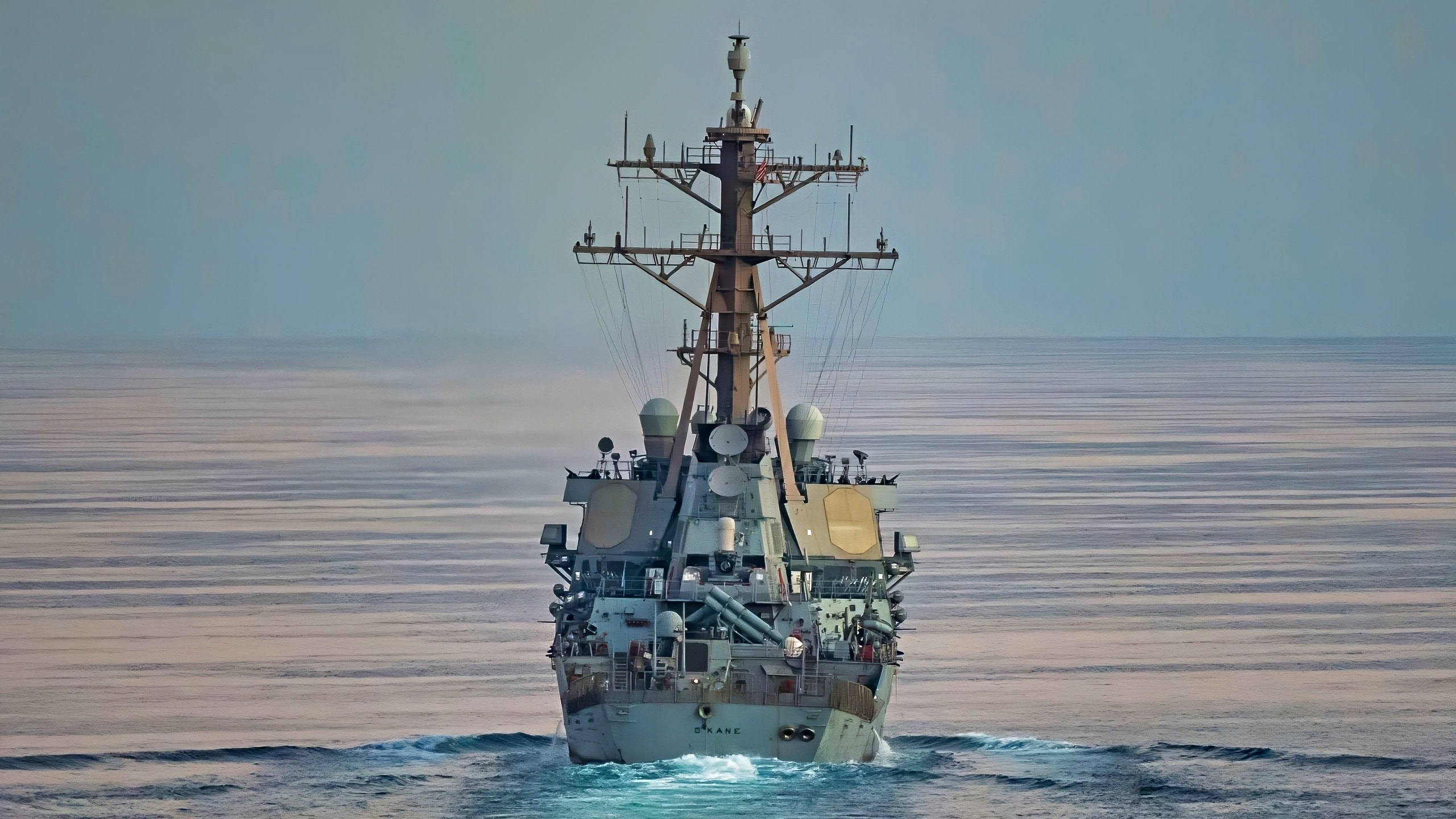
In military terms, the strait is not just a blue line on a map. It is a complete system that connects tankers, maritime security, export ports, long-term gas contracts, and national budgets. Therefore, discussing mine removal in Hormuz does not only mean sending mine sweepers or surface drones, but also who has the maritime picture, who classifies the threat, who decides that a particular tanker deserves escort, and who bears the cost of escalation if a wrong target is hit.
Practically, the Gulf cannot deal with Hormuz as it has dealt with previous crises in the Red Sea, where each capital entered with a different degree of visibility and commitment. The sea does not wait for diplomatic formulations. If an insurance company closes its doors to tankers heading to Ras Tanura, Jebel Ali, or Doha, the result affects everyone even if the foreign ministries' statements differ.
The Value of Patriot and THAAD Begins Before Launch
Saudi Arabia, the UAE, Qatar, Kuwait, and Bahrain possess, to varying degrees, expensive layers of air defense. Patriot provides interception against tactical ballistic missiles and aircraft, while THAAD offers a higher layer against ballistic missiles outside or near their envelope. However, the experience of the past months has proven that merely possessing batteries is not enough. A battery that does not receive an early warning in a timely manner becomes an expensive piece of equipment on the ground, and a radar that sees the target but cannot relay the trajectory to the nearest neighbor does not create regional deterrence.
In any saturation attack, the problem is not just whether an interceptor missile can hit the target. The more important issue is who decides which target to intercept first. A ballistic missile heading towards an airbase, a low-flying drone heading towards a power station, and a suspicious boat approaching a tanker passage can all appear within minutes. If each country treats them as separate battles, the Gulf will exhaust its stock of interceptions as quickly as fire consumes fuel in a dry season. Interceptions launched over hours require months or years to replenish.
The Lesson Gulf Capitals Do Not Like
There is a truth known by any military personnel who has served in the region: Gulf cooperation in air defense progresses after the shock, not during the shock. After every crisis, the same phrases about information sharing, early warning, and updating joint plans emerge. The problem is that these phrases do not always translate into automatic actions in the first ten minutes of an attack.
A recent analysis in War on the Rocks described the need for a Gulf shield built on "limited trust," and this phrase is accurate because it acknowledges what official statements do not say. Gulf countries do not view Iran, Yemen, Israel, and the U.S. role in the same way. Oman wants a mediation channel, Qatar carries the memory of the 2017 dispute and the 2025 strike, Saudi Arabia and the UAE are militarily closer but do not align politically, and Kuwait and Bahrain assess internal and external risks differently. Building a defense system on the assumption of complete political unity is a recipe for new failure.
The solution is not a unified Gulf army in a rhetorical sense. The minimal, and more realistic, solution is a common operational layer: a limited regional air picture, standardized criteria for classifying trajectories, pre-established rules for what is sent automatically and what remains national, and a notification chain that does not start with a call between two ministers while the missile is in the air.
Washington is Not a Substitute for Lateral Linkage
The United States will remain the central party in Gulf security, and this is not an opinion but a technical reality. Most U.S. systems require data permissions, communication standards, training, and spare parts that no Gulf capital can quickly bypass. However, relying on Washington as the sole operating key creates a harsh paradox: the Gulf state maintains its independence from its neighbor, but it hands over part of the command architecture to an external party.
If the Hormuz draft succeeds, the Gulf will be required to transform the truce into defensive engineering. If it fails, it will need to face a new round of drones, missiles, and maritime disruption faster than the speed of official data. In either case, merely purchasing more Patriots or waiting for additional THAAD production is not enough. The next battle may be decided in a data-sharing program, not on the launch platform.
Lebanon Reminds the Gulf that the Front is Not One
The conditional agreement between Israel and Lebanon on June 4, with discussions about "test areas" where the Lebanese army is deployed and non-state actors are excluded, adds another layer to the Gulf problem. Iran links Lebanon to the broader war file, Israel claims it has freedom of action, and Hezbollah was not a full party in the negotiations. This is not just a Lebanese detail. It means that any agreement regarding Hormuz could be tested from a front that is not even on the water.
From here comes the importance of Gulf military diplomacy. One state may play the role of mediator, another may signal deterrence with Washington, and a third may protect an economic channel. This diversity can be beneficial if organized in advance, but it can become a gap if it remains improvised. The adversary does not need to defeat the entire Gulf; it is enough for it to treat it as six separate pressure points.
Military Summary
In my opinion, the Hormuz draft is not just a test for Iran. It is a test of the Gulf's claim that it has learned from the 2026 war. If states continue to measure sovereignty by the number of national batteries, they will still possess strong parts and a weak regional system. However, if they accept the idea of limited trust, they can build a shield that works even when capitals differ politically.
The old military adage says that weapons do not fight alone. In the Gulf today, it can be slightly modified: a missile does not intercept alone, a radar does not deter alone, and a state does not protect a shared strait alone. The structural tension will remain as it is between the desire for decision independence and the fear of sharing sensitive data. But those who refuse to pay the price of cooperation in peace will pay the price of delay in war, and this price in Hormuz is not measured in minutes alone, but in markets, tankers, and international trust.
Sources
On June 12, 2026, discussions among Gulf states and the U.S. focused on military cooperation and the need for a unified defense strategy in the Strait of Hormuz. The U.S. canceled planned strikes on Iran while addressing mine removal in the strait. Gulf states are evaluating their air defense capabilities, particularly the Patriot and THAAD systems, amid differing perceptions of regional threats.
- The U.S. canceled new strikes on Iran while discussing mine removal in the Strait of Hormuz.
- Gulf states are considering a joint defense system rather than individual national systems.
- Patriot and THAAD systems are crucial for regional air defense but require better coordination.
- Gulf states have differing views on threats from Iran, Yemen, and Israel.
- Military cooperation in the Gulf often progresses after crises, not during them.