
Patriot battery in Korea certifies on Army’s new network
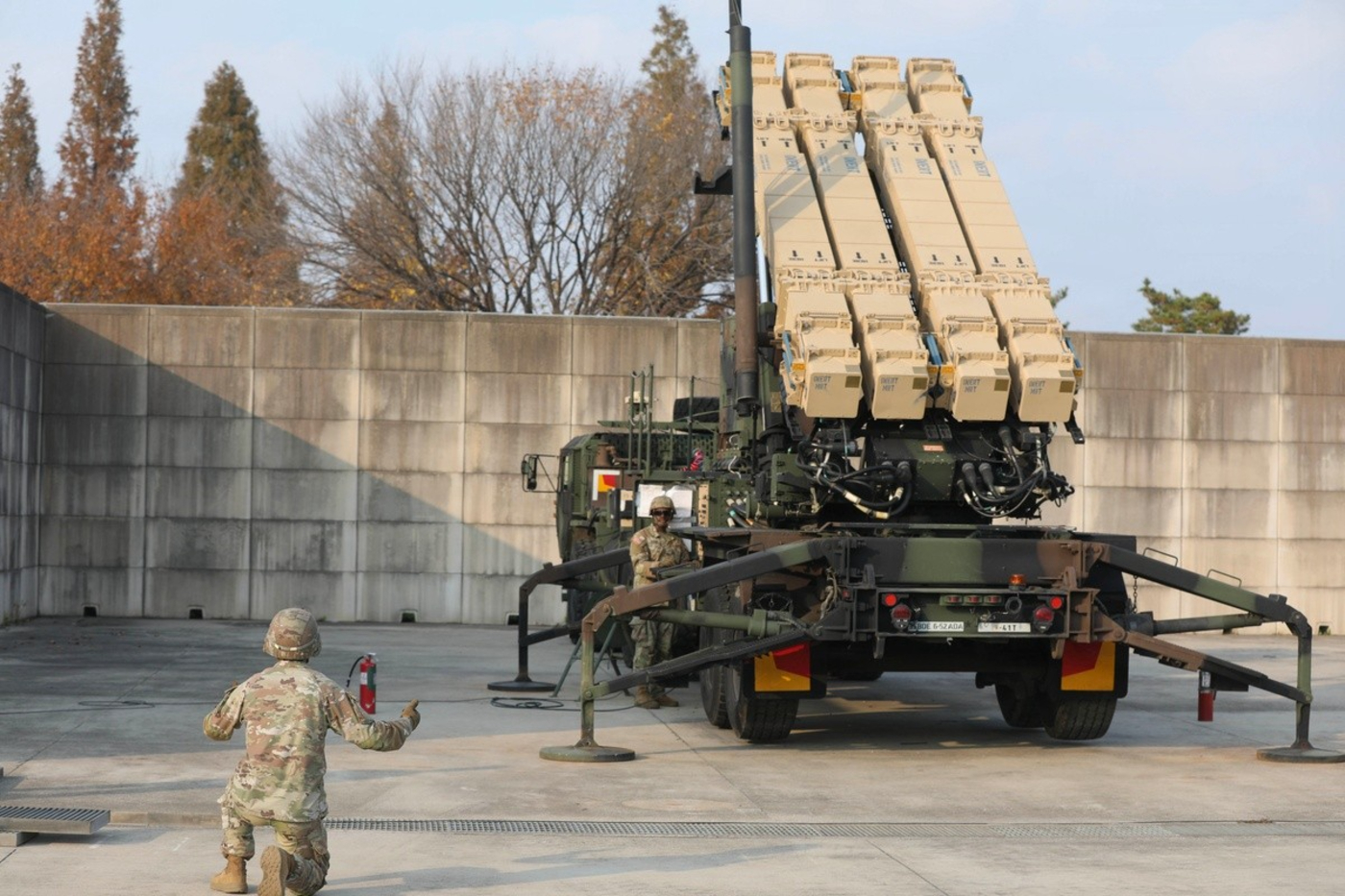
Delta Battery, 6th Battalion, 52nd Air Defense Artillery Regiment, is the first operational Patriot battery in the U.S. Army to certify on the Integrated Air and Missile Defense Battle Command System, or IBCS, Eighth Army said Nov. 18. IBCS is the Northrop Grumman-built network the service is fielding to run its air and missile defenses.
The battery belongs to the 35th Air Defense Artillery Brigade in South Korea. According to Eighth Army’s announcement on X, it became the “first operational Patriot battery to certify on the Integrated Air and Missile Defense Battle Command System,” which the command said advances the brigade’s “Fight Tonight” readiness in Korea.
According to the Eighth Army Public Affairs Office, the battery moved off legacy, stand-alone weapon networks and onto the IBCS Integrated Fire Control Network. During the evaluation, crews separated the battery’s sensors and launchers from its fire control unit. The Army says that arrangement lets a unit spread out its equipment and supports “best sensor-best shooter” engagements.
Physically separating a Patriot radar and its launchers from the fire control node could make a battery harder to locate and hit as a single site. It could also let launchers fire at threats tracked by radars other than their own.
To take a step back, a conventional Patriot battery works as a closed loop. Its AN/MPQ-65 radar feeds an engagement control station, and that station directs the battery’s own launchers. The radar watches a fixed sector instead of the full 360 degrees around a defended site. A battalion’s information coordination central sits above the batteries. IBCS was designed to replace those nodes. The Army has described the system as “the direct replacement for the mission command nodes for the Patriot weapon system” and for THAAD and higher air defense headquarters.
On the IBCS network, an engagement runs in a few steps. A connected radar produces a track. The fire control crew uses that track to assign the engagement to a connected launcher, which can be anywhere on the network. As long as the track meets fire control requirements, the launcher can fire using data from a sensor it isn’t physically attached to. The chance to engage still depends on sensor coverage and track quality, as well as on network availability and the interceptor’s own performance limits.
The program took years to get to this point. In December 2021, Northrop Grumman received a $1.4 billion contract covering low-rate initial production and full-rate production. In a developmental test in November 2022, IBCS intercepted a cruise missile target with a Patriot interceptor even though no Patriot radar was in the architecture. That was the first public demonstration that the network, and not the battery radar, could guide a Patriot engagement.
Pentagon acquisition officials approved full-rate production after an April 10, 2023, Defense Acquisition Board decision. The Army declared initial operational capability the next month. Northrop Grumman said in a statement at the time that the production decision would let the Army “set the fielding schedule for IBCS to operational air defense units.”
The first fielding went to 3rd Battalion, 43rd Air Defense Artillery Regiment at Fort Bliss, Texas, in December 2024, Defense Daily reported. “We have been laser focused on fielding IBCS to the operational force,” said Col. Chris Hill, who led the Army’s Integrated Fires Mission Command project office.
That battalion ran the IBCS follow-on operational test and evaluation. On Oct. 2, 2025, at White Sands Missile Range in New Mexico, its soldiers used IBCS to track two maneuvering cruise missile targets and destroy both with two first-interceptor kills, according to the Army’s Program Executive Office Missiles and Space. The Delta Battery certification moves the system from test events at Fort Bliss and White Sands into a forward-deployed unit on a peninsula where North Korean short-range ballistic missiles are the main threat.
Poland got there first among U.S. allies. Warsaw signed a $2.5 billion IBCS deal with the United States in 2024 and declared full operational capability for its first Patriot squadron on IBCS in December 2025. Polish Defense Minister Władysław Kosiniak-Kamysz described IBCS as the command “brain” that connects effectors and sensors. In an October 2026 release, Northrop Grumman said IBCS is in full-rate production, is operational in Poland, and has been fielded for combatant commands in Europe and the Indo-Pacific.
Earlier this year, Northrop Grumman said it could scale output to equipment for up to 24 battalions a year if the Army asks for it. The company builds IBCS at its Enhanced Production and Integration Center in Madison, Alabama.
The 6-52 “Iron Horse” battalion has carried Patriot upgrades in Korea before. In 2017, the 35th Air Defense Artillery Brigade completed what U.S. Indo-Pacific Command called the largest Patriot modernization project ever conducted outside a U.S. depot. Delta Battery soldiers validated upgraded launching stations at Osan Air Base on Aug. 3 that year.
The battalion also has a record of working with South Korean air defenders. On June 25, 2014, its soldiers and airmen from the Republic of Korea Air Force’s 177th Air Defense Artillery Battalion connected their Patriot systems during a combined interoperability exercise at Gunja Air Base.
In image captions, Eighth Army credited the result to the unit’s “technical proficiency, operational readiness,” and the release says the brigade “made military history in the Republic of Korea” with the certification.
According to Eighth Army, other Patriot units in the battalion are expected to certify on IBCS in the coming weeks as the battalion prepares for distributed command and control operations.
Content preview only. Full article available at source. View Full Article
Delta Battery, 6th Battalion, 52nd Air Defense Artillery Regiment, certified on the Integrated Air and Missile Defense Battle Command System (IBCS) in South Korea on November 18. This marks the first operational Patriot battery to achieve this certification, enhancing the brigade's readiness against North Korean threats. The IBCS enables improved engagement capabilities by allowing the separation of sensors and launchers, facilitating better operational flexibility.
- Delta Battery is the first operational Patriot battery to certify on IBCS.
- The certification enhances the brigade's readiness in Korea.
- The IBCS allows for better engagement of threats by separating sensors and launchers.