
Patriot Missile Under One Million Dollars Reveals Qatar and Gulf's Defense Predicament in 2026
 Ahmed Al-Rashid
Patriot Missile Under One Million Dollars Reveals Qatar and Gulf Defense Predicament in 2026
On May 15, 2026, Washington did not request a new flashy air defense system, but rather something more acknowledging of the problem: an interceptor missile compatible with Patriot that does not exceed one million dollars. This figure, in my estimation, is more significant than many deterrence data in the Gulf. It plainly states that the equation of launching a PAC-3 MSE missile at a cost of nearly four million dollars against a Shahed-class drone costing tens of thousands is no longer sustainable, neither in Qatar nor in the UAE nor over Israel.
The request published by the U.S. Army's Rapid Capabilities and Critical Technologies Office under the name MOSAIC-26-03 does not come from nowhere. In recent weeks, Patriot and THAAD batteries have turned into a political and military consumption meter. American reports have mentioned that the U.S. used a significant portion of some high-altitude interception stocks to defend Israel during Operation Epic Fury, while the State Department rushed to approve a package worth approximately $4.01 billion for Qatar that includes Patriot refurbishment services and related equipment. Any military personnel who has served in the region knows that Doha is not buying this quantity to beautify the military display; it is buying additional fire time around Al Udeid Air Base, ports, and energy corridors.
Why the One Million Dollar Ceiling Matters
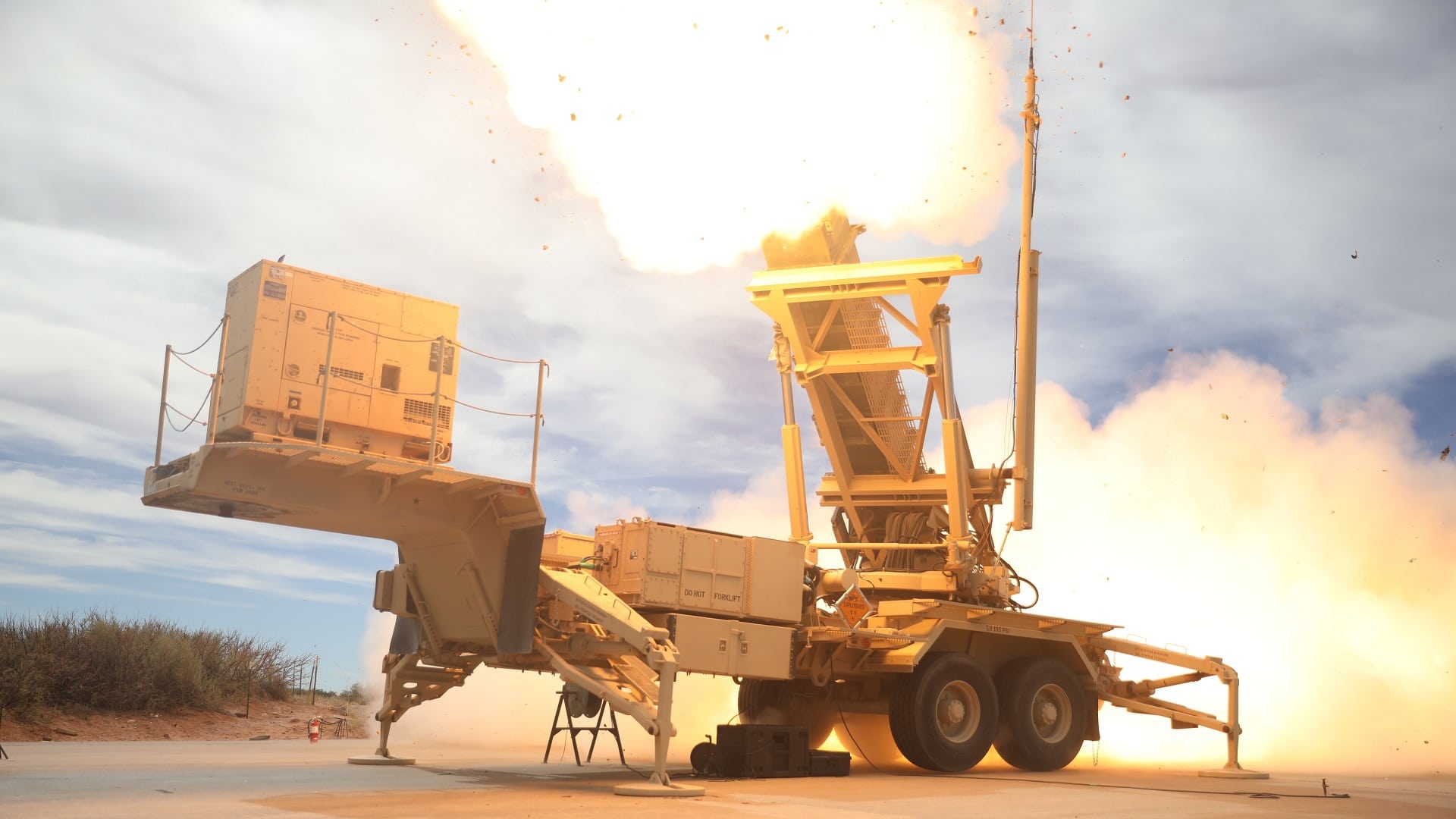
The difference between a four million dollar missile and one under a million is not just a financial calculation. In air defense, cost quickly transforms into engagement doctrine. When a commander knows that every shot consumes a rare piece of stock, they become more conservative in the launch decision and may accept higher risks on a secondary target. However, when they have a cheaper layer connected to the Patriot and IBCS systems, they can reserve the higher-priced missiles for threats that truly warrant them: a fast ballistic missile, a maneuvering warhead, or a target threatening a central base.
The American specification calls for interception within the atmosphere, at speeds exceeding Mach 5, with a range exceeding 200 kilometers, in-flight updates, and terminal guidance with a seeker head, along with a blast fragmentation warhead. This is not a counter-drone gun, nor is it a complete substitute for the PAC-3 MSE. It is a middle layer between cheap bullets and elite missiles. Here lies its importance for the Gulf, as the Iranian threat often does not come as a single precious arrow, but as a mixed bundle of drones, cruise missiles, and short or medium-range ballistic missiles that force the defender to burn through their stock quickly.
Qatar as a Model, Not an Exception
The decision to sell Patriot to Qatar for $4.01 billion, along with APKWS approvals for Qatar and the UAE and IBCS for Kuwait, outlines a clear map of Gulf fears. Qatar wants depth in stock, the UAE wants cheaper layers against drones and light missiles, and Kuwait wants to link sensors and fires into a single command network. Practically, these are not separate purchases; they are an attempt to close the gap between the speed of attack and the speed of industrial replenishment.
The Qatar package speaks of renewal, not luxury. When the base hosting the heaviest American presence in the region becomes a target for Iranian missiles or Iranian proxies, the defensive battery becomes part of national sovereignty even if the technology is American. Here the usual contradiction in the Gulf appears: countries want decision independence, but they need ammunition they do not manufacture, software for which they do not hold the keys, and supply chains over which they do not control priorities. Buying 500 interceptors does not change this reality; it merely postpones the moment of running out of breath.
The Unspoken Iranian Lesson
Iran has understood for years that Western air defense is technically strong but economically weak against saturation. Not every drone needs to hit its target. It is enough to force the opponent to use a missile that costs them dozens of times more, and to open a gap on the third or fourth night when the commander begins to calculate stock instead of targeting. Thus, a Patriot missile under one million dollars is an American acknowledgment that the problem is not in the accuracy of interception but in its sustainability.
However, reducing the price does not solve the issue alone. The cheaper missile needs a reliable engine, a seeker that works amidst jamming, secure data links, and true integration with M903 and IBCS. If it fails in the jamming environment and overlapping radars in the Gulf, it will be just another industrial promise. If it succeeds, it will force Iran and its proxies to raise the cost of attack or adjust their saturation tactics. This is the real game: it is not about who has the prettiest radar, but who can fight five consecutive nights without depleting their stock.
Industry Becomes Part of Deterrence
The $4.76 billion Lockheed Martin contract to increase PAC-3 MSE production until 2030 illustrates that Washington sees allied demand as a key driver of the production line. But even raising production to nearly 2,000 interceptors annually is not enough if the Gulf, Europe, Israel, and U.S. command in the Indian and Pacific Oceans are all in the same queue. Therefore, MOSAIC attempts to break the monopoly of the old logic: an excellent missile, one main company, a long production cycle, and a price that does not fit drone wars.
Notably, the U.S. Army hints at purchasing or leasing intellectual property and dividing interception into engines, seekers, fire control, and system integration. This is an attempt to change the relationship between the state and the contractor. For the Gulf, the issue is more sensitive: will Arab countries buy the cheaper missile only, or will they demand real manufacturing and maintenance participation? If they remain buyers of the closed box, the same crisis will persist at a lower price.
Conclusion
A missile under one million dollars will not make Qatar or the UAE defense-independent, but it reveals where the equation has broken. The Gulf has purchased the best interception systems for two decades, only to discover in the 2026 war that the best system can lose if its stock is limited and the cost of its shot is many times higher than its target. In the military, we say that a bullet you cannot replace is not ammunition but a gamble. Patriot is still necessary, but its necessity has become a testament to dependence rather than sufficiency. This is the dilemma that no single deal can hide: Gulf security is advancing technically, but it is still renting its industrial depth from abroad.
Open Sources
- Army Recognition on the MOSAIC-26-03 request for a Patriot interceptor under one million dollars
- Anadolu Agency on military sales to Qatar, Kuwait, and the UAE worth nearly $8 billion
- Army Recognition on the $4.76 billion PAC-3 MSE contract
- The Daily Beast on the pressure on U.S. interception stocks during Operation Epic Fury
The U.S. requested a new air defense missile system under $1 million on May 15, 2026, to address the high costs of existing interceptors like the PAC-3 MSE. This procurement aims to enhance Qatar's defense capabilities amid rising threats in the Gulf region. The report emphasizes the need for more sustainable defense solutions as current systems are deemed unsustainable against mixed threats from Iran.
- The U.S. requested a new interceptor missile under $1 million.
- The cost of existing interceptors like PAC-3 MSE is around $4 million.
- Qatar is purchasing additional defense capabilities for its military.
- The U.S. is concerned about the sustainability of current air defense systems.
- The report highlights the geopolitical implications of defense procurement in the Gulf.