
PCL-181 155mm Howitzer Fires in Xinjiang: PLA Western Firepower Recalculates Mobile Accounts
 Li Minghui
PCL-181 155mm Howitzer Fires in Xinjiang, PLA Western Theater Recalculates Artillery Mobility
A recent photo released by the English version of the China Military Network contains much more information than the headline suggests: a PCL-181 155mm wheeled self-propelled howitzer from a certain army regiment in the Xinjiang Military District fired at a target during live-fire training in late April. The photo itself is merely a training image, but when viewed within the context of the Western Theater's firepower system, what’s interesting is not just that "another shell has been fired," but that the PLA is recalculating the artillery mobility in the plateaus, Gobi deserts, and deep border areas.
The Trade-offs Behind a Howitzer
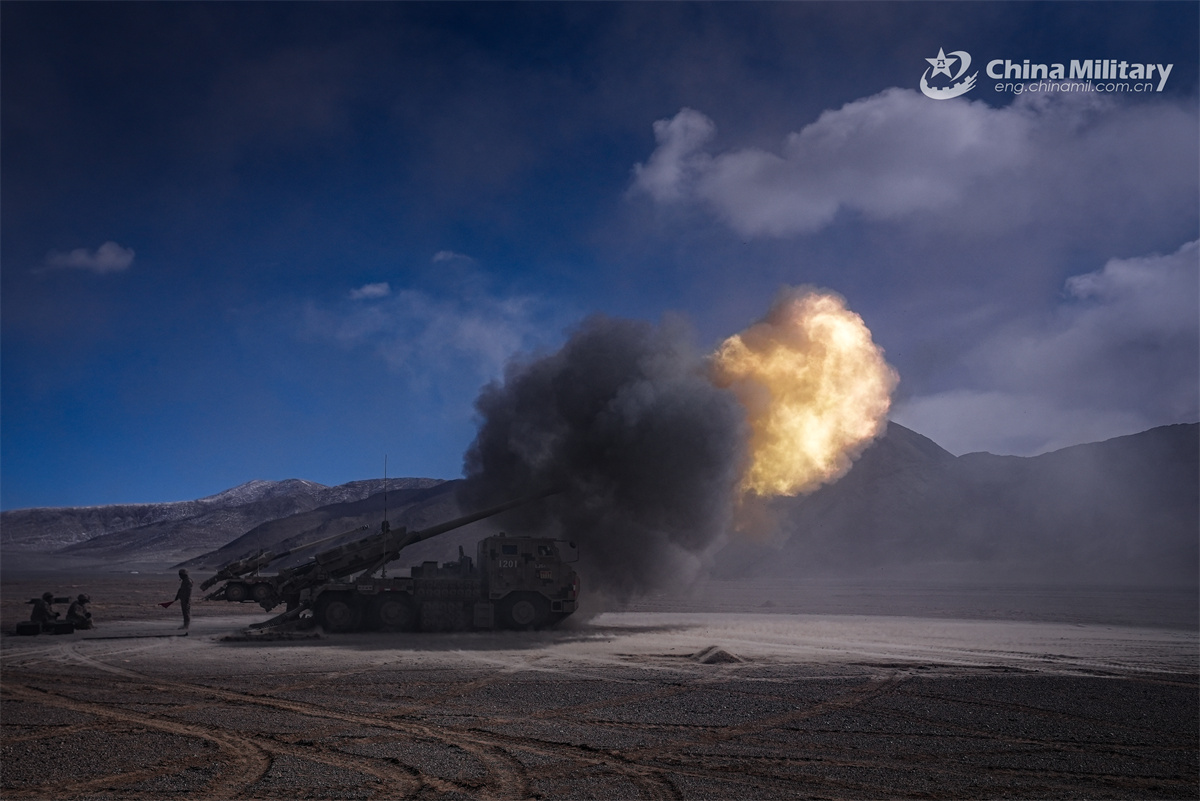
The PCL-181 is not a heavy tracked howitzer. Public information shows that it uses a 6×6 wheeled off-road chassis, has a combat weight of about 25 tons, is equipped with a 155mm 52-caliber gun, and has a crew of about 6. It features automatic fire control, satellite/inertial positioning, and semi-automatic loading capabilities. Different sources provide slightly varying descriptions of its range, but it is generally believed that conventional shells can reach about 40 kilometers, and using extended-range or rocket-assisted projectiles can further extend this range.
The key to this configuration lies not in the power of a single shot, but in its weight. At 25 tons, it can traverse roads, bridges, and makeshift sites more easily than tracked heavy artillery like the PLZ-05. Some public information also mentions its potential to be transported by Y-9 transport aircraft. In simple terms, the PCL-181 sacrifices some armor protection in exchange for rapid deployment, lower maintenance costs, and better road adaptability.
Why the Xinjiang Military District is Suitable for This Howitzer
The operational environment of the Xinjiang Military District is quite unique: long distances, open terrain, significant elevation and temperature variations, and many directions are not characterized by dense urban combat, but rather by "who can push firepower to the right position faster." Traditional towed artillery is cheap and durable, but slow to deploy and retract; heavy tracked artillery has strong firepower but is more constrained by fuel, maintenance, and road conditions. The PCL-181 occupies a middle ground, making it well-suited for rapid fire support in the deep border areas.
An easily overlooked detail is that the photo caption refers to an "army regiment" rather than a heavy combined brigade. If this type of unit continues to replace its artillery with 155mm wheeled howitzers, it means that the grassroots firepower in the western direction will no longer rely solely on 122mm-level suppression, but will instead push the commonly seen 155mm precision firepower of army artillery brigades down to lower levels and closer to the front lines. Of course, public information is insufficient to determine the complete organization of this regiment, and one photo cannot be interpreted as a full-scale replacement.
From Firepower Coverage to Ammunition Supply
Li Minghui is more concerned about the logistics aspect. 155mm ammunition is much heavier than 122mm ammunition, and the carrying capacity per vehicle is limited. What truly determines sustained combat capability is the ammunition vehicles, loading training, shooting command chain, and supply of repair parts. If the PCL-181 is merely "fast," its significance is limited; if it can integrate with unmanned reconnaissance, digital artillery command, BeiDou positioning, and meteorological measurement systems, its value will be amplified.
The Russo-Ukrainian battlefield has already proven that the survival logic of wheeled artillery is not to withstand counter-battery fire, but to quickly enter position, complete short bursts of fire, and immediately relocate. The open terrain in Xinjiang is both advantageous and demanding for a "shoot-and-scoot" approach: advantageous in that the roads and fields of vision are relatively open, but demanding in that concealment conditions are poor, and communication and supply lines are stretched long. Therefore, the focus of the PCL-181 in the western direction is not to compare its armor thickness with the world's most advanced tracked artillery, but to see if it can form high-frequency, small-batch, and sustainable firepower mobility.
Actual Impact on the Surrounding Situation
From a regional security perspective, the training of the PCL-181 in Xinjiang primarily points to rapid border response and intra-theater troop movements, which does not necessarily mean an immediate escalation in any direction. However, it will change the surrounding assessment of the PLA's army firepower response speed. In the past, external observers focused on the light tanks, air defense systems, and border airfields of the Chinese western army; now, the density of wheeled 155mm artillery also needs to be factored into the calculations.
The author believes that the most noteworthy aspects of this type of equipment are not a single live-fire training event, but three subsequent signals: first, whether more units in Xinjiang and Tibet will publicly appear with the PCL-181; second, whether training reports will begin to emphasize drone calibration and cross-day-night relocations; third, whether 155mm guided shells and extended-range projectiles are mentioned more frequently in high-altitude environments. The howitzer has already appeared, but what has not been fully disclosed is whether the PLA's western artillery reconnaissance-command-ammunition supply chain has kept pace with the mobility of this howitzer.
Main sources: China Military Network English version regarding the live-fire training photo explanation of the PCL-181 in the Xinjiang Military District; a summary of public equipment information on the PCL-181 155mm/52-caliber, 6×6 chassis, automatic fire control, and range parameters.
The People's Liberation Army (PLA) conducted live-fire training with a PCL-181 155mm self-propelled howitzer in Xinjiang in late April. This training reflects a reassessment of artillery mobility in the region, emphasizing rapid deployment capabilities. The use of this artillery system suggests a shift towards integrating heavier firepower at lower command levels, which may impact regional military dynamics.
- PCL-181 155mm howitzer was used in live-fire training in Xinjiang.
- The howitzer is designed for rapid deployment and has a combat weight of approximately 25 tons.
- The PLA is reassessing artillery mobility in the western theater.
- The training indicates a shift towards using 155mm artillery at lower command levels.
- Logistics and ammunition supply are critical for sustained operations.