
Pentagon’s use of JAGs in civilian roles would be probed under NDAA provision
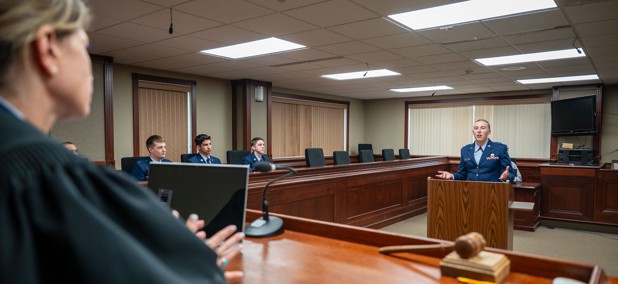

The Trump administration’s use of military lawyers for civilian roles would be probed by Congress’ watchdog agency under language added to the 2027 defense policy bill.
The provision was added to the Senate Armed Service Committee’s version of the 2027 National Defense Authorization Act by Sen. Elizabeth Warren, D-Mass. It orders the Government Accountability Office to review the Pentagon’s use of judge advocate generals to support the Justice Department’s operations, “including their use as immigration judges and special prosecutors, and its impact on morale and readiness,” Warren’s office said.
“Pete Hegseth is treating our independent military lawyers like pawns in Trump’s cruel immigration agenda and it’s hurting our military readiness and morale,” Warren said in an emailed statement to Defense One. “This independent investigation is an important step to support our service members and hold this administration accountable.”
Warren’s office said the amendment ordering up the probe had "bipartisan support” and would not be cut during debate in the Senate or in conference with the House. Her statement did not say how the SASC voted on her provision, and committee spokespeople did not return a request for comment.
Earlier this month, Republicans axed a House effort to amend U.S. law to limit JAGs to military-related matters.
The Congressional interest in the morale of judge advocate generals follows Defense Secretary Pete Hegseth’s high-level firings, harsh criticisms, and wide-ranging reforms targeted at the military’s lawyers. During his 18 months in office, Hegseth has fired the military’s top uniformed lawyers, reduced the civilian legal staff, and overseen the assignment of JAGs to civilian work, including as immigration judges and as special U.S. attorneys in Democratic-run cities during National Guard deployments.
Warren’s provision drew praise from Steve Lepper, a former Air Force JAG and a member of a group of former JAGs who have criticized the administration’s use of military lawyers.
“I agree with Senator Warren. I agree with the rationale, and, quite frankly, anything that gets into the NDAA that requires the Pentagon to justify his use of judge advocates in those roles, I think, is a good thing,” Lepper said.
Last year, about 600 JAGs were assigned to work for the Justice Department as immigration judges. Earlier this year, Defense One reported that dozens of uniformed lawyers were sent to cities to work as special U.S. attorneys as part of National Guard surges in Minneapolis, Minnesota; Memphis, Tennessee; and Washington, D.C.
Military legal experts have told Defense One that those JAGs often lack the necessary experience to work those cases. In December, one Army lawyer working as a special U.S. attorney in Minnesota was reportedly held in contempt of court when an Immigrations and Custom Enforcement detainee was released from custody without his identification paperwork.
Lepper said he believes the move to push JAGs into those civilian roles has harmed the morale of the military’s lawyers.
“The rank-and-file judge advocates don't think this is a good idea,” he said. “Americans are on the receiving end of the cases that are being prosecuted by judge advocates and immigrants are being subjected to, I believe, the lack of due process by having military officers serving as immigration judges sitting in judgment on their immigration cases.”
Congress is investigating the Pentagon's use of Judge Advocate Generals (JAGs) in civilian roles, particularly as immigration judges, due to concerns about military readiness and morale. Senator Elizabeth Warren's provision in the 2027 NDAA aims to review this practice, which has seen around 600 JAGs assigned to the Justice Department. The investigation follows significant changes made by Defense Secretary Pete Hegseth to the military's legal staff, raising concerns about the experience of JAGs in these roles.
- The Pentagon's use of JAGs in civilian roles is being reviewed by Congress under the 2027 NDAA.
- Senator Elizabeth Warren introduced the provision to investigate the impact on military readiness and morale.
- Approximately 600 JAGs were assigned to work as immigration judges last year.
- Defense Secretary Pete Hegseth has made significant changes to the military's legal staff.
- Concerns have been raised about the lack of experience of JAGs in civilian legal roles.