
Philippines Basa Air Base Gives U.S. 18 Fighters But Little Shelter
 Marcus Chen
Philippines Basa Air Base Gives U.S. 18 Fighters But Little Shelter
The number is 18. That is how many fighters the new U.S.-funded parking apron at Basa Air Base is designed to support, plus two large transport aircraft. On paper, that gives Washington and Manila a useful air node 40 miles northwest of Manila and within reach of the South China Sea. In a shooting crisis, it also gives China a fixed target with coordinates everyone already knows.
That is the hard part about the latest Basa construction. USNI News reported this week that satellite imagery shows clearing at the northwest end of the Philippine base matching earlier solicitation plans for a 625,000-square-foot apron. The project was contracted in 2024 for $32 million and sits beside planned unmanned aerial vehicle hangars and a tactical operations center. During Balikatan 2026, Marine Corps imagery also showed an MQ-9A Reaper detachment from Marine Unmanned Aerial Vehicle Squadron 1 at Basa.
For deterrence, this is a real improvement. For wartime air operations, it is only the beginning of the bill.
Basa Changes the Surveillance Geometry
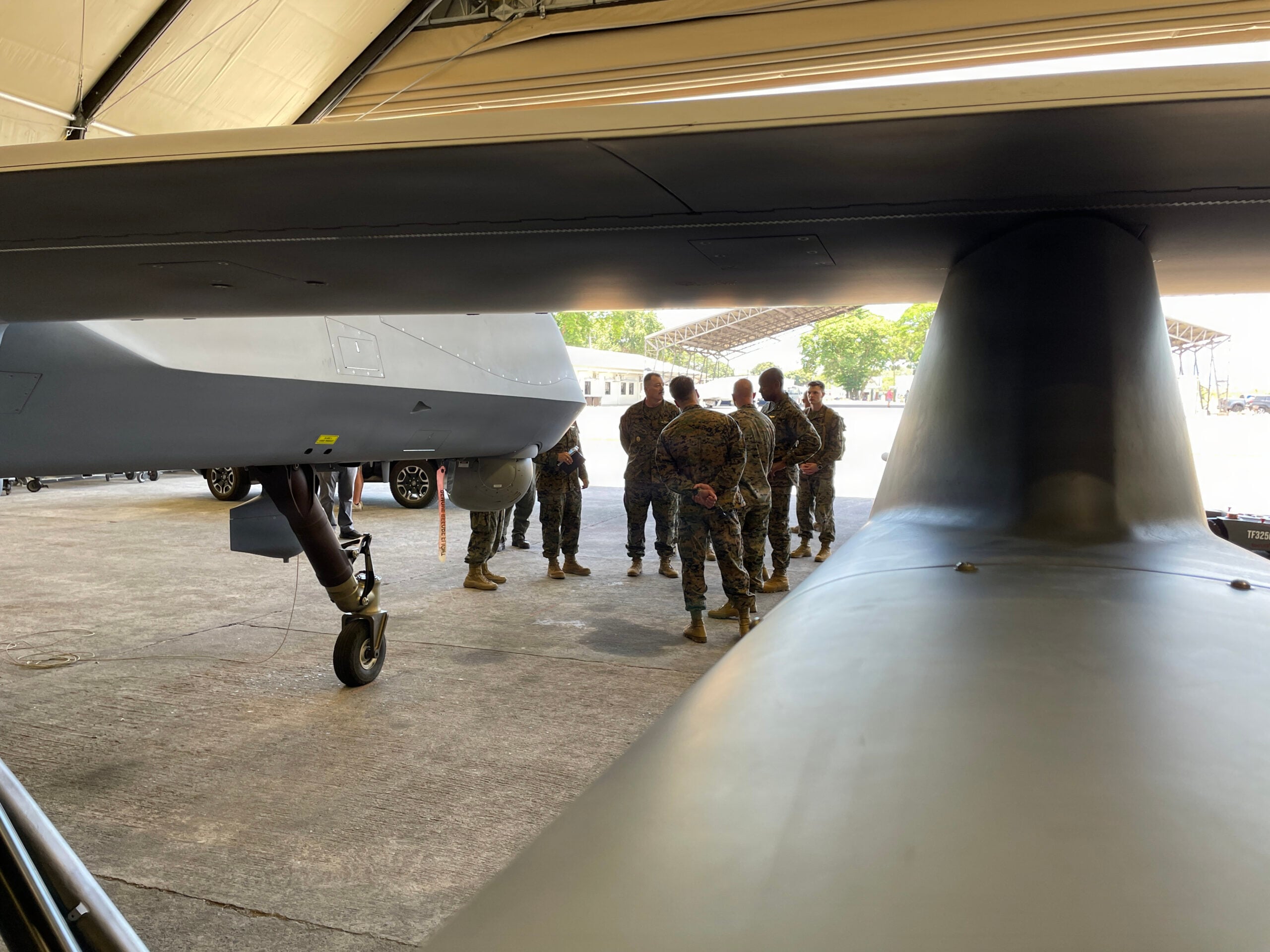
Basa's location matters because it is not a Guam problem. Andersen Air Force Base sits roughly 1,500 nautical miles from the central South China Sea. Basa is close enough for aircraft and drones to get on station, come home, and do it again without turning every sortie into a tanker-dependent expedition. From Pampanga, a Reaper looking west can help watch approaches toward Scarborough Shoal, the Luzon Strait, and the northern approaches to the Spratlys. That does not solve the kill chain, but it shortens it.
The MQ-9A is a useful aircraft for this job, not because it is survivable but because it can stay up. Naval Air Systems Command lists the Marine MQ-9A with a 27-hour endurance, 50,000-foot ceiling, 240-knot airspeed, and a 2,250-nautical-mile maximum radius. Those numbers are exactly why a Reaper at Basa is attractive for maritime domain awareness. In a gray-zone confrontation, persistence is more valuable than speed. A drone that sees a Chinese coast guard cutter early can give Manila time to publish imagery, route ships away, or cue a Philippine patrol aircraft.
But nobody should confuse that with air superiority. A Reaper is a sensor truck. It is not a combat aircraft built to live inside a dense Chinese missile and fighter envelope. If the crisis turns hot, its value depends on how long the base, control links, and ground crew can function.
The Apron Is Access, Not Protection
An 18-fighter apron sounds like combat power until you ask what the apron is sitting under. Basa is a known airfield with a 2,800-meter-class runway, existing Philippine fighter infrastructure, and now visible U.S.-funded expansion. It is useful precisely because it is fixed and improved. It is vulnerable for the same reason.
China does not need to destroy every aircraft at Basa to suppress the site. It needs to crater enough runway pavement, damage fuel distribution, hit munitions storage, disrupt the tactical operations center, or force commanders to disperse aircraft before the sortie cycle stabilizes. A parked fighter is the wrong unit of measurement. The real metric is how many combat-loaded aircraft can launch, recover, refuel, rearm, and launch again after the first missile salvo.
Anyone who has served on a ship understands the difference between capacity and sustained operations. A flight deck can be full of aircraft and still be useless if weapons elevators, fuel lines, or command circuits fail. The same logic applies ashore. An air base is not a parking lot. It is a machine. The apron is one component of that machine.
The public reporting so far points to expanded parking, UAV hangars, and a tactical operations center. Those are necessary. The missing public details are the more important wartime ones: hardened aircraft shelters, rapid runway repair kits, redundant fuel storage, camouflage and concealment, decoy aircraft, mobile air-defense coverage, and enough security forces to protect a base that will be watched before any crisis begins.
Congress Is Starting to See the Same Map
The Basa work also fits a wider U.S. shift from treating Taiwan and the Philippines as separate planning problems to treating them as one first-island-chain theater. The Senate Armed Services Committee's fiscal 2027 defense bill, also reported by USNI News, would authorize up to $1.5 billion under a First Island Chain Security Cooperation Initiative shared by Taiwan and the Philippines. It would also create a Taiwan war reserve stockpile program and require a Pentagon crisis-management strategy for the South China Sea.
That is the right conceptual move. The operational geography does not respect bureaucratic lanes. A Taiwan contingency would pull U.S. attention through Luzon and the Bashi Channel. A South China Sea clash involving a Philippine sailor or coast guardsman could trigger U.S. treaty obligations and unfold close enough to Taiwan to affect the same logistics network. Basa sits near the hinge between those problems.
CSIS's Asia Maritime Transparency Initiative has already shown how EDCA sites are less about one base than a distributed access pattern. Basa has received more U.S. infrastructure funding than any other EDCA site, while Antonio Bautista, Balabac, Lal-lo, and other locations create alternative operating points. Balikatan 2026, held from April 20 to May 8 across the archipelago, tested command and control, logistics, communications, and interoperability with allies including Japan, Australia, Canada, France, and New Zealand. That is what dispersed operations look like before the shooting starts.
The Uncomfortable Math
The optimistic reading is that Basa gives the United States and the Philippines a better air picture over the South China Sea and a faster way to move fighters into a crisis. That is true. The more honest reading is that Washington is building visible access faster than it is proving survivability.
If a future crisis remains below the threshold of open war, Basa is valuable. MQ-9s, Philippine fighters, U.S. detachments, and shared command facilities can make Chinese coercion more visible and harder to manage quietly. If the crisis becomes a missile war, Basa becomes a test of whether EDCA infrastructure has moved beyond peacetime symbolism.
The question is not whether 18 fighters can fit on the apron. The question is whether 18 fighters can still generate sorties on day two, after fuel, runway, communications, and air-defense systems have been stressed at the same time. Until the answer is visible in construction plans and exercises, Basa is a useful forward base with an unfinished survival plan.
Access is not deterrence by itself. Access that can keep operating under fire is deterrence. That is the gap Manila and Washington still have to close.
The U.S. has constructed a new parking apron at Basa Air Base in the Philippines, capable of supporting 18 fighters and 2 large transport aircraft. This development enhances military capabilities in the region, particularly for surveillance and operations in the South China Sea. The MQ-9A Reaper is stationed at the base, providing extended operational reach. However, concerns remain about the base's vulnerability and the need for additional wartime infrastructure.
- Basa Air Base can support 18 fighters and 2 large transport aircraft.
- Construction includes a 625,000-square-foot apron and UAV hangars.
- The MQ-9A Reaper has a 27-hour endurance and is stationed at Basa.
- The U.S. is increasing military infrastructure funding in the Philippines.
- Basa is strategically located for operations in the South China Sea.