
Poland’s €1.9 Billion Piorun Deal Still Leaves NATO Flying Low in 2026
 Alexandra Reeves
Poland’s €1.9 Billion Piorun Deal Still Leaves NATO Flying Low in 2026
Eight billion zloty is a lot of money to spend on a problem Europe still does not know how to solve. That is the uncomfortable truth behind Poland’s new Piorun procurement deal with Norway, Lithuania and Latvia. On paper, this is exactly the kind of joint European defence purchase Brussels has been begging for: four NATO countries, one missile family, one industrial champion, and EU-backed financing through SAFE. In practice, it is a reminder that Europe is getting better at buying launchers and missiles while still falling short on the thing that matters most in a drone-heavy war: a layered, networked air-defence system that can survive saturation.
According to Notes from Poland, the contract is worth 8 billion zloty, or roughly €1.9 billion, and covers several hundred launchers and several thousand missiles. Over 80% of the order will go to Poland’s armed forces, with the remainder split among its three allies. Defense News and Breaking Defense both framed the agreement as a major export and industrial milestone for Mesko, the Polish state defence firm behind Piorun. They are right. But an industrial success is not automatically a strategic solution.
The Deal Europe Wanted to Celebrate
The politics are easy to understand. Poland is the biggest SAFE beneficiary, with Warsaw expecting around €44 billion in loans under the wider programme. This contract lets the Polish government argue that European defence money is not disappearing into abstract Brussels mechanisms or Franco-German talking points. It is being spent in Poland, through a Polish producer, on a system that already has battlefield credibility. Deputy defence minister Magdalena Sobkowiak-Czarnecka called Poland a SAFE leader. Defence minister Władysław Kosiniak-Kamysz went further and presented the deal as proof that Poland can now act like a European defence leader rather than just a frontline customer.
That matters. Norway’s inclusion matters too. SAFE is supposed to reward joint procurement, and Norway is not even an EU member. So the deal does show some institutional flexibility that Europe badly needs. It also tells you something else: when NATO’s northern and eastern flank countries need a fast, politically acceptable answer to low-altitude threats, they are increasingly willing to buy what worked in Ukraine rather than wait for a perfect future architecture.
- Contract value: 8 billion zloty, about €1.9 billion.
- Participants: Poland, Norway, Lithuania and Latvia.
- Structure: several hundred launchers and several thousand missiles.
- Distribution: more than 80% for Poland, the rest for the three allies.
Piorun Solves One Problem Well
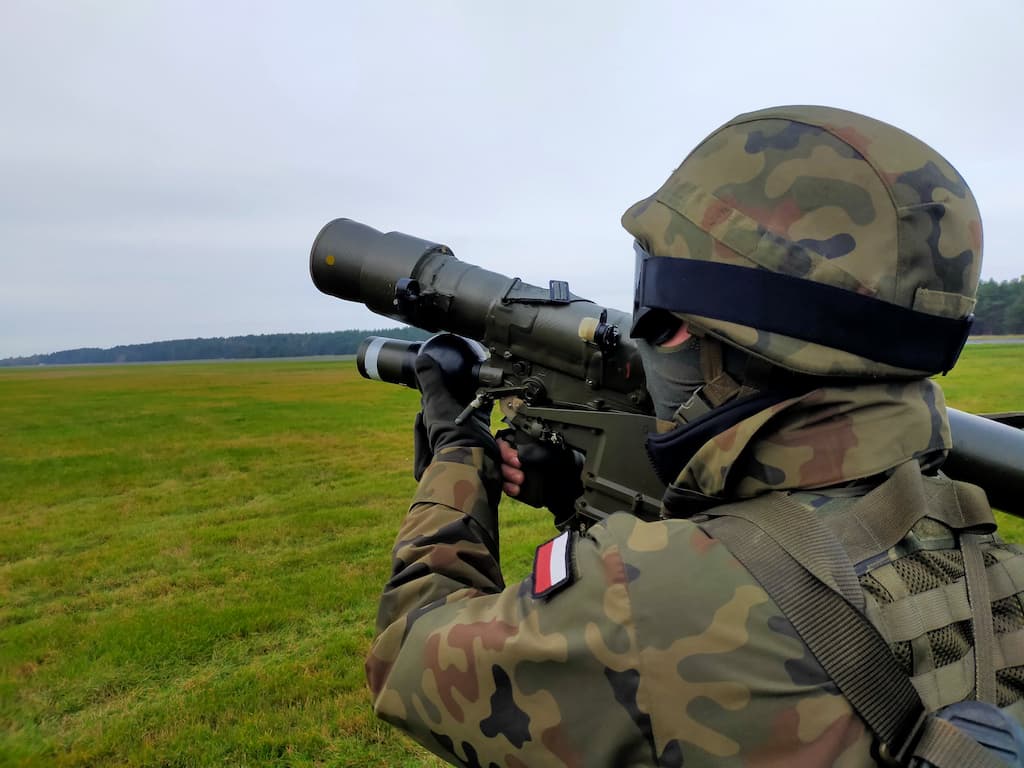
Piorun is not a paper capability. It is a shoulder-fired MANPADS designed for low-flying aircraft, helicopters and drones. Publicly available technical data puts its operational range at up to 6.5 kilometres, its effective altitude at up to 4 kilometres, and its guidance on an infrared homing seeker with improved resistance to interference compared with the older Grom family. Those specifications explain why the system has become attractive after its wartime performance in Ukraine. It is exactly the sort of weapon eastern flank states want close to frontline units, transport nodes and critical infrastructure.
That is the good news. The bad news is that NATO does not only face low, slow targets anymore. It faces mixed salvos, cheap one-way drones, loitering munitions, cruise missiles, jamming, spoofing and the political hesitation that comes with all of them. A Piorun launcher can kill what is in front of it. It cannot give you a common air picture across borders. It cannot make rules of engagement appear out of nowhere. It cannot replace the radar, command links, ammunition depth and low-cost interceptor logic that a real shield needs.
Europe Is Still Buying Shooters, Not a Shield
This is the part people in Brussels do not like saying out loud. Joint procurement is not the same thing as integrated air defence. Europe keeps acting as if the purchase itself is the strategy. It is not. SAFE can finance missiles; it cannot by itself fix fragmented command chains, uneven sensor coverage, or the fact that many European militaries are still struggling with how to engage drones before those drones drift, crash or get pushed into politically awkward airspace.
That gap matters even more on NATO’s eastern flank, where the alliance is learning that the air threat is no longer neat or expensive enough to fit old assumptions. Piorun is useful because it is relatively cheap and mobile. But the wider lesson from Ukraine is not merely that more MANPADS are good. It is that cheap air defence only works when it is part of a dense ecosystem: sensors, operators, mobility, layered fires, and the willingness to use them early rather than after a legal committee finishes its discussion.
Why Poland Wins More Than NATO Does
Poland is the clearest winner here. Mesko’s production capacity has reportedly expanded sharply, and Kosiniak-Kamysz says the company’s output is now 2.5 times what it was when the current government took office. The firm has added workers since SAFE launched. That is not trivial. Europe needs more industrial depth, and Warsaw has every reason to build a national air-defence export story around a system already validated in combat.
But look closely at the distribution of this purchase and the symbolism changes. If more than 80% of the systems are staying in Poland, then this is not really Europe solving a common air-defence problem. It is Poland using European financing and allied participation to expand a national capability at scale while its neighbours buy into the same pipeline. That is smart policy from Warsaw. It is also a sign that Europe’s defence integration still works best when it follows national urgency, not when it tries to transcend it.
What to Watch Next
Three things matter now. First, whether this procurement is followed by cross-border sensor and fire-control integration rather than just more launchers. Second, whether SAFE-backed joint buying starts moving beyond short-range systems into the messy middle layer where most European gaps still live. Third, whether the Baltic and Nordic states can agree on faster engagement rules for drones and other ambiguous air threats before the next incident forces them to improvise in public.
Piorun is a serious weapon, and this is a serious contract. But Europe should not confuse a smart buy with a solved problem. NATO’s eastern flank is still defending itself one shoulder launcher at a time. That is better than complacency. It is not yet what a real air shield looks like.
Poland secured a €1.9 billion deal for Piorun air defense systems, with over 80% allocated to its armed forces, while Norway, Lithuania, and Latvia participate. This procurement aims to enhance NATO's capabilities against low-altitude threats, reflecting Poland's growing role in European defense. However, the deal underscores ongoing challenges in achieving a fully integrated air defense system across NATO's eastern flank.
- Poland's Piorun deal is worth €1.9 billion (8 billion zloty).
- Over 80% of the order will go to Poland's armed forces.
- The deal involves several hundred launchers and several thousand missiles.
- Piorun is designed for low-flying aircraft, helicopters, and drones.
- The procurement highlights Poland's role as a leader in European defense.