
Poland's Thunder - and 155mm Offensive Does Not Yet Make Europe's Largest Army Sovereign by 2026
 Dr. Klaus Weber
Poland's Piorun and 155-mm Offensive Does Not Yet Make Europe's Largest Army Sovereign by 2026
220,000 active soldiers, a goal of 500,000 forces by 2039, and now up to 43.7 billion euros from the EU's SAFE credit instrument: On paper, Poland's rearmament looks like the linear emergence of the strongest land power in Europe. However, this is where the misunderstanding begins. An army is not made sovereign by the amount of its credit line, but by the speed at which it can produce ammunition, air defense, and spare parts in series. Poland understood this lesson earlier than Berlin or Brussels. But understanding does not mean solving.
The real news value of the past days lies not only in the Reuters report about the shift to domestic production but in the connection of several developments: Warsaw can access SAFE funds amounting to 43.7 billion euros, PGZ is negotiating with Ukrainian partners on joint ground robotics, and new supply chains for 155-mm components are being established in ammunition production. This is not another shopping round. It is the attempt to transform a procurement army into a manufacturing army.
43.7 Billion Euros Are Financing, Not Capability
Polskie Radio reported on May 8 that Poland will receive up to 43.7 billion euros in favorable EU defense loans. Donald Tusk presented this as proof of a "strong Poland in a strong Europe." Politically, this is plausible. Militarily, it remains incomplete. SAFE initially addresses a financing problem. It does not automatically solve the production problem or the personnel problem in the industry.
This is already evident in the structure of the Polish armed forces. According to the Kyiv Post, Poland now has more than 220,000 active soldiers, spent about 4.7 percent of GDP on defense in 2025, and aims to reach 5 percent in 2026. At the same time, expensive import programs continue: 32 F-35s for about 4.6 billion dollars, 96 AH-64E Apaches, new frigates, and submarines. These platforms enhance deterrence, but they also extend dependencies on software, spare parts, training, and maintenance. A country building Europe's largest army while needing to source the most valuable parts of that army from the USA and other partner states projects power but has not yet established strategic autonomy.
Piorun and 155 mm Are More Important Than Another Symbolic Purchase
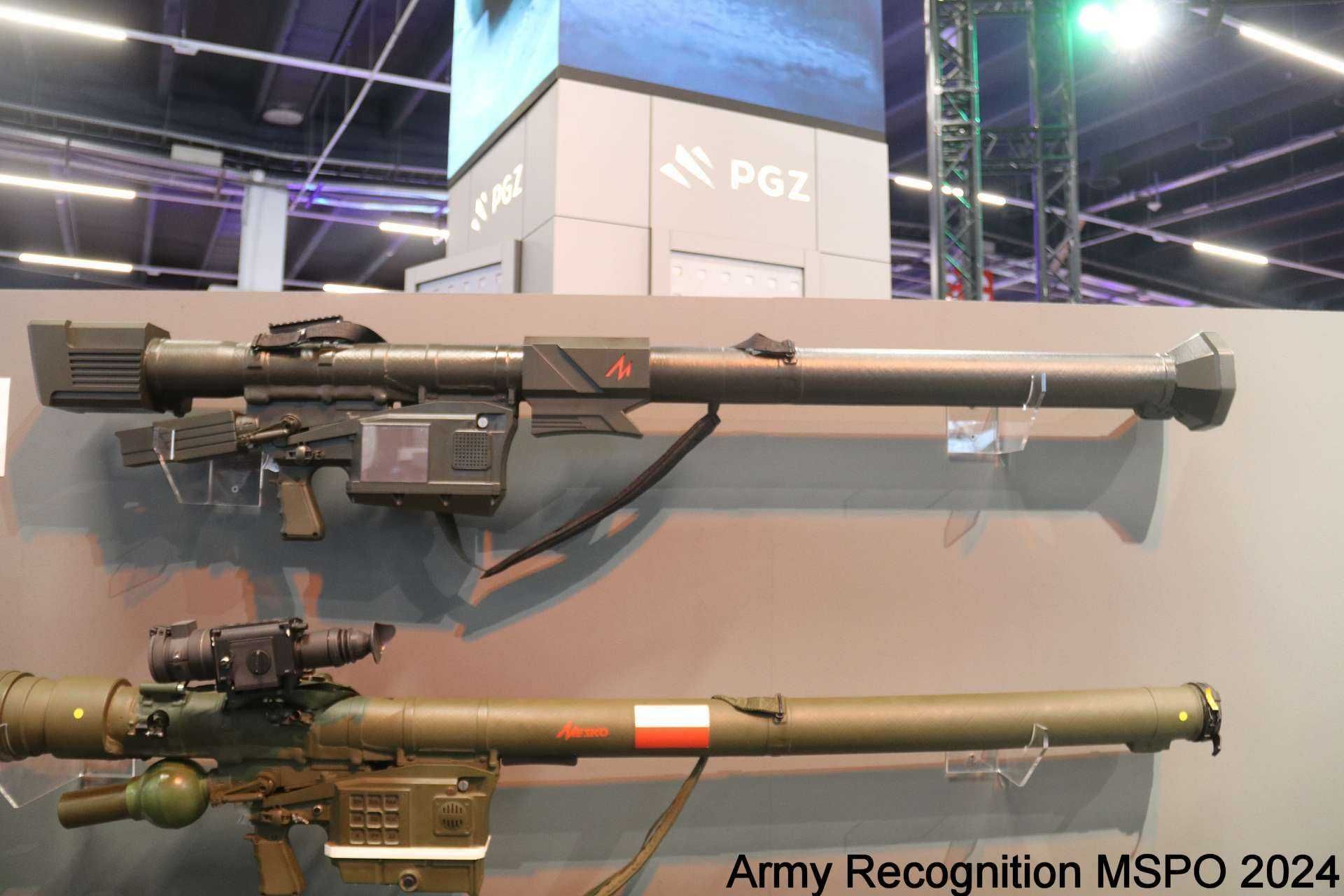
That is why the industrial aspect of Poland's turnaround is more important than any parade on the Vistula. The Piorun system visible at the MSPO is a good symbol for this. Not because a portable air defense system alone decides the war, but because it represents a category that has been chronically underestimated in Europe: affordable, scalable, nationally controllable mass capability. Breaking Defense reported at the end of August on a roughly 2-billion-dollar deal in which the Polish company Mesko equips four NATO states with Piorun systems. The crucial aspect is less the export success than the production logic behind it. Poland is trying to turn demand into industrial leverage.
This becomes even clearer with 155-mm ammunition. Defence Industry Europe reported on August 25 that ZVS from Slovakia is supplying components for Poland's long-term 155-mm program under a contract worth more than 100 million euros. The associated Polish framework reportedly includes a contract for nearly 11 billion zlotys for deliveries from 2024 to 2029, as well as a second SAFE-funded implementation contract worth more than 13.5 billion zlotys for several hundred thousand complete shells. This is the hard currency of this war. No army on the eastern flank will fail due to missing principle papers; it will fail due to empty magazines.
But is that enough? No. Because here, too, Polish sovereignty is tiered, not absolute. If central parts of the ammunition chain come from Slovakia, European resilience is created through regional interconnection, not national autarky. This is reasonable. However, it also means: Poland shows the right instinct, but even the most heavily rearming state in Europe cannot achieve industrial independence on its own.
Poland's Model Strengthens Poland Faster Than Europe
This is precisely where the uncomfortable European point lies. From Brussels' perspective, Poland is often seen as a model case of the SAFE era: high defense spending, industrial absorption capacity, clear perception of the Russian threat. In reality, Warsaw is more of a counter-model to the Brussels illusion that integration can be replaced by lending. Poland uses European money to accelerate national production capacities, national stocks, and national deterrence. This is rational. However, it is not a European defense union but a national force multiplier with EU co-financing.
The announced PGZ cooperation with Ukrainian partners on ground-based robotic systems fits this pattern. Ukrinform reported on August 31 that a confidentiality agreement was already signed in August with a potential Ukrainian partner, and the next step is to be a cooperation agreement. Again, Poland acts where Europe has been talking for years. It ties Ukrainian combat experience to the Polish production base. This is industrially wise and militarily urgent. However, it remains a bilateral or minilateral path, not the birth of a coherent European arms market.
The Strategic Lesson for Berlin and Brussels
Poland may indeed be building Europe's largest army. However, the more important message is that Warsaw is quietly reorganizing the hierarchy of capabilities: first ammunition, close air defense, robotics, and manufacturing depth; only then prestige platforms. This is precisely what distinguishes serious rearmament from political rearmament rhetoric. Germany talked for three years about a turning point and primarily bought time. Poland is buying machines, components, and production rhythms.
The paradox remains, however. The more successful Poland becomes, the clearer Europe's collective failure will be. If the continental measure of sovereignty ultimately lies in Piorun, 155-mm shells, and Ukrainian-Polish robotics projects, it is because the large European programs have too often produced governance without output. More money is necessary. But money that does not generate a factory layer, a batch of ammunition, or a maintenance chain remains accounting with camouflage patterns. Poland has understood this. Europe's strategic autonomy only begins when the rest of the continent accepts this banal truth.
Poland is ramping up its military capabilities with 220,000 active soldiers and aims for 500,000 by 2039. The country is set to receive €43.7 billion in EU defense loans to enhance its production of ammunition and air defense systems. Additionally, Poland is negotiating partnerships with Ukraine for ground robotics and establishing new supply chains for 155-mm ammunition components.
- Poland has 220,000 active soldiers and aims for 500,000 by 2039.
- Poland is set to receive €43.7 billion in EU defense loans.
- Poland is transitioning from a procurement army to a manufacturing army.
- Poland is negotiating with Ukraine for ground robotics cooperation.
- Poland is establishing new supply chains for 155-mm ammunition components.