
Pollution of "Permanent Chemicals" Around U.S. Military Bases in Japan Intensifies, One Water Body Exceeds Standards by More Than 50 Times
Xinhua News Agency, Beijing, March 27 - A recent survey released by the Okinawa Prefectural Government in Japan shows that approximately 70% of the tested water bodies surrounding U.S. military bases in the prefecture contain perfluoroalkyl and polyfluoroalkyl substances (PFAS) above the standard, with one water body exceeding the limit by more than 50 times, marking the highest level detected in the past decade. The Okinawa Prefectural Government stated that it will again request access to U.S. military bases to investigate the pollution sources of these "forever chemicals."
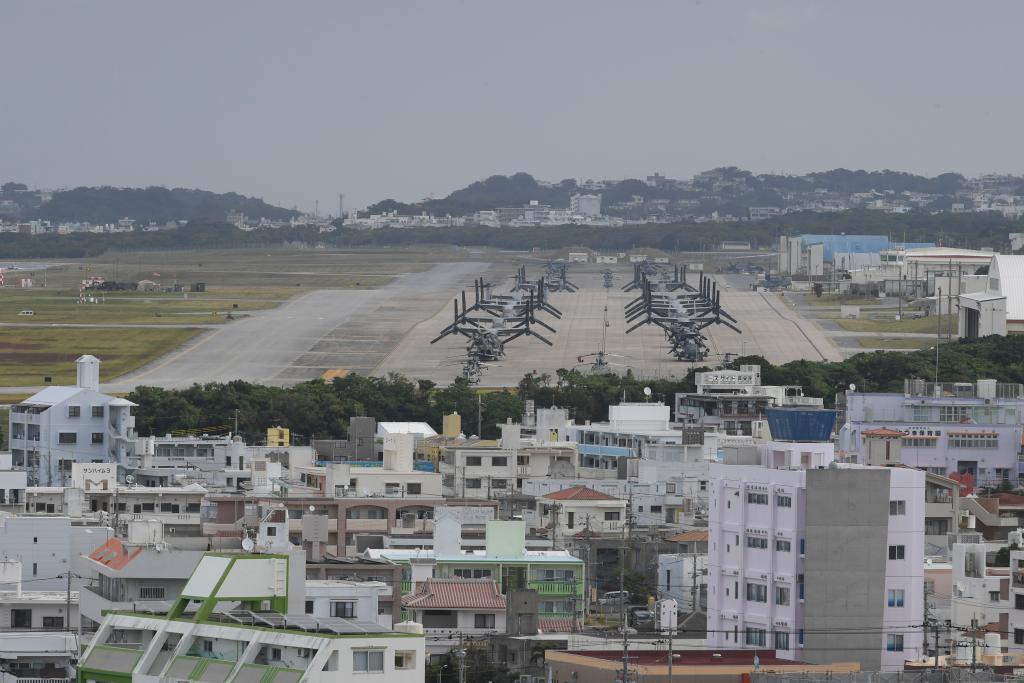
This is a V-22 Osprey transport aircraft stationed at the U.S. Marine Corps Futenma Base in Okinawa, Japan, on November 25, 2023. Photo by Xinhua reporter Feng Wuyong
On the 26th, Japanese media reported that the Okinawa Prefectural Environmental Protection Department tested 44 water bodies around the U.S. Marine Corps Futenma Base, Kadena Air Base, and Hansen Camp, with results showing that 31 of these water bodies contained PFAS above the standard, an increase compared to the last survey. Among them, the concentration of these substances in a water body near Kadena Air Base reached 2,800 nanograms per liter, which is 56 times the national standard of Japan.
The Okinawa Prefectural Government pointed out that the aforementioned values are the highest since the county began implementing related surveys in 2016. In addition, spring water flowing underground through U.S. military bases near Futenma Base and Hansen Camp has also tested positive for high concentrations of PFAS.
PFAS are difficult to degrade and can accumulate in the environment and human bodies, earning them the label of "forever chemicals." Experts indicate that long-term consumption of water contaminated with these substances may affect reproductive health and child development, and could even lead to diseases such as breast cancer and prostate cancer.
Since 2016, the Okinawa Prefectural Government has repeatedly submitted requests to the U.S. side through the Japanese Ministry of Defense to enter U.S. military bases to investigate pollution sources, but has not received a response. The Japanese Ministry of Defense stated that the U.S. military finally formally responded to the related investigation request in December 2025, stating "disagreement." The reason given by the U.S. side is that there is currently no scientific basis to prove that U.S. military bases and related facilities are the sources of pollution, and that there is no unified standard for determining the exceedance of contamination in water and soil samples between Japan and the U.S. (Zhang Jing)
The Okinawa Prefectural Government reported that about 70% of water bodies near U.S. military bases contain excessive levels of per- and polyfluoroalkyl substances (PFAS), with one site exceeding limits by over 50 times. This marks the highest contamination level in a decade. Okinawa officials have requested access to U.S. bases for further investigation, but the U.S. military has denied these requests, claiming insufficient evidence linking the bases to the pollution.
- Approximately 70% of tested water bodies near U.S. military bases in Okinawa exceed PFAS limits.
- One water body exceeded the limit by more than 50 times, marking the highest level in 10 years.
- Okinawa Prefecture has requested access to U.S. bases for further investigation into pollution sources.
- The U.S. military has denied requests for investigation, citing lack of scientific evidence linking bases to pollution.