
Putin's Statement Draws Attention, Both Sides Initiate Prisoner Exchange, Is the Russia-Ukraine Conflict "Heading Towards an End"?
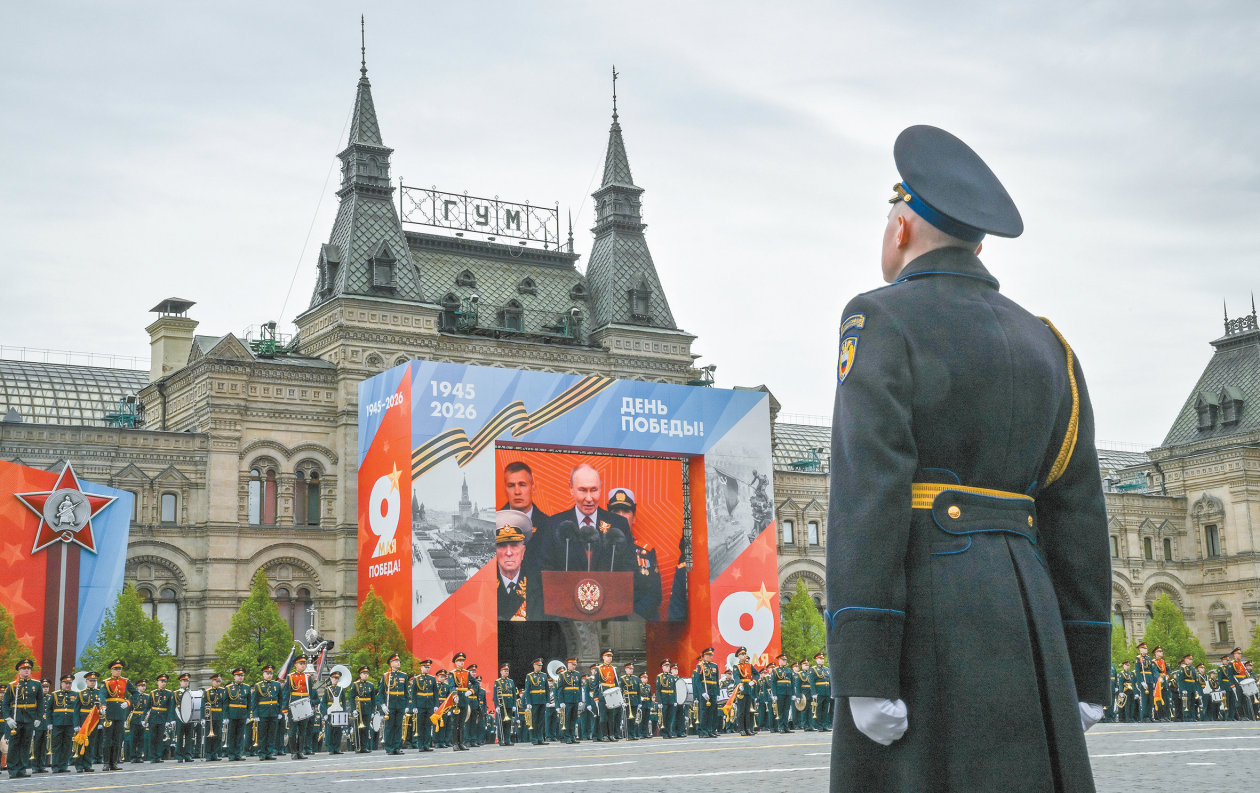
[Global Times Special Correspondent in Russia, Xiao Xinxin, Global Times Reporter Shen Sheng, Yu Wen] On May 9, Russia held a military parade in Moscow's Red Square to commemorate the 81st anniversary of the victory in the Great Patriotic War. On the evening of the 9th, Russian President Putin stated at a press conference held at the Kremlin that he believes the Russia-Ukraine conflict "is heading towards an end." This is the first time Putin has expressed this view recently, and it is seen as a hint that the situation in the Russia-Ukraine conflict may change. Putin also stated that he would neither actively propose nor refuse to meet with Ukrainian President Zelensky. He is willing to meet with Zelensky in Moscow, the Russian capital, or in a third country, but he emphasized that a meeting could only take place at a stage where both sides are prepared to sign an agreement, rather than during the negotiation stage. At the suggestion of the United States, a ceasefire between Russia and Ukraine was agreed upon from the 9th to the 11th, along with the exchange of prisoners of war, but the Russian side rejected the proposal to extend the ceasefire beyond the 11th. According to media reports, both Russia and Ukraine are preparing to resume fighting after the ceasefire ends. Zhang Hong, a researcher at the Institute of Russian, Eastern European and Central Asian Studies of the Chinese Academy of Social Sciences, told Global Times reporters on the 10th that both sides have their own needs for the three-day ceasefire, considering diplomatic and public opinion warfare. If a true cessation of hostilities is to be achieved, both sides will face difficult negotiations.
What will happen after the short ceasefire?
On the 9th, Putin attended the Victory Day parade and delivered a speech. He stated that this year marks the 85th anniversary of the outbreak of the Great Patriotic War. The soldiers participating in the special military operation are fighting against "the invading forces equipped and supported by NATO as a whole," yet they continue to advance.
Reuters reported that this year's Moscow Red Square parade was the smallest in recent years. In past parades, intercontinental ballistic missiles, tanks, and other heavy equipment rolled across the Red Square, showcasing Russia's military strength, but this year, these pieces of equipment only appeared on giant screens across from the Kremlin, where videos of these military assets in action were played. Reports indicate that the Russian military has been engaged in combat in Ukraine for over four years, which is longer than the Soviet military's combat duration during the Great Patriotic War.
During the parade, a formation of North Korean soldiers marched across Red Square to be reviewed. According to the Korean Central News Agency on the 10th, at the invitation of the Russian side, a mixed formation of the Korean People's Army's land, sea, and air forces participated in the Moscow Victory Day parade. Al Jazeera reported that this arrangement is a tribute to Pyongyang, which sent soldiers to fight alongside the Russian military to repel the Ukrainian invasion of the Russian Kursk region.
At the press conference held that evening, Putin discussed the absence of military equipment on display during the parade. He stated that this was not only for security reasons but, more importantly, the Russian military must focus on "completely defeating the enemy" within the framework of the special military operation against Ukraine.
Member of the Defense Committee of the State Duma (lower house of parliament) Sobolev told the media that the battlefield front lines need these military assets more, and there is no need to specifically withdraw personnel and equipment from the special military operation zone for the parade. Just for the rehearsal of the parade, it may require withdrawing these military assets about two months in advance.
Recently, Russia has significantly raised the security level in the Moscow region to prevent any disruptions to the Victory Day parade by Ukraine. The Russian side also announced a ceasefire from midnight on May 8 to May 10 at the front lines and warned that if Ukraine attempted to disrupt Russia's celebrations, the Russian armed forces would carry out large-scale missile strikes on central Kyiv. The BBC reported that the Moscow Red Square parade on the 9th was successfully held without major incidents.
The U.S. side also worked to avoid significant conflicts between Russia and Ukraine on this day. On the 8th, U.S. President Trump posted on social media that Russia and Ukraine had accepted his proposal to agree to a ceasefire from the 9th to the 11th and exchange prisoners of war. "This ceasefire will include a suspension of all military operations, as well as the exchange of 1,000 prisoners of war between the two countries," Trump stated, adding that negotiations to end the war "are still ongoing," and "I hope this is the beginning of the end of a long, brutal, and extremely difficult war."
Both Russia and Ukraine expressed acceptance of the U.S. proposal. Reuters reported that Zelensky issued a decree on the evening of the 8th stating that Ukraine "allows" Russia to hold Victory Day celebrations and temporarily prohibits Ukrainian military airstrikes on Red Square. The Kremlin dismissed this as a "stupid joke."
The Ukrainian newspaper Kyiv Post believes that the current three-day "fragile" ceasefire agreement between Russia and Ukraine is more symbolic and has little effect on resolving the conflict. Core issues such as territorial disputes and U.S. security guarantees for Ukraine remain unresolved. The Ukrainian "National Network" stated that regardless of the true motives of both sides, the achievement of a ceasefire should be welcomed, although a brief ceasefire does not indicate that the war will completely end.
On the 9th, the spokesperson for the Joint Forces of the Ukrainian Armed Forces, Trehubov, stated that the Russian military is using the ceasefire period from the 9th to the 11th to rotate and mobilize troops in preparation for a full resumption of offensive capabilities. At the same time, the Ukrainian military is also strengthening logistical support and conducting troop rotations.
Putin: Stable China-U.S. relations benefit Russia
On the 9th, Putin discussed Russia-China relations, stating that cooperation between Russia and China is the most important factor in maintaining stability in international relations. He said that currently, as international treaties in the fields of disarmament and nuclear non-proliferation have almost disappeared, cooperation between Russia and China has become an important factor in preventing nuclear proliferation and maintaining stability. China is an important economic and trade partner for Russia, and bilateral trade between Russia and China continues to grow. Thanks to the development of high-tech industries, the structure of economic and trade cooperation between the two sides is continuously diversifying.
According to the Russian news agency Sputnik, Putin also stated that Russia hopes that tensions will not arise in China-U.S. relations. Stable and constructive interaction between China and the U.S. will only benefit Russia.
Zhang Hong told Global Times reporters on the 10th that Russia welcomes dialogue between China and the U.S., as stable China-U.S. relations are beneficial to the global economy and international order, which also benefits Russia. On the other hand, while Russia emphasizes the implementation of the "pivot to the East" strategy, it also insists on a balanced diplomacy between the East and the West and has not abandoned efforts to normalize relations with the U.S. and Europe, while also striving to lift sanctions against Russia and restore diplomatic channels.
After the U.S. and Israel attacked Iran at the end of February, igniting conflicts in the Middle East, U.S.-mediated negotiations between Russia and Ukraine have stalled. Regarding the situation in Iran, Putin stated on the 9th that due to Russia's good relations with both Iran and Gulf Arab countries, the situation in Iran has made Russia's position "complicated." If the situation escalates, "everyone will suffer," and agreements to resolve the current conflict should align with the interests of regional countries.
Putin also revealed that the Russian side had proposed transferring Iran's enriched uranium to Russia, and at that time, "all parties involved in the conflict agreed," but the U.S. later demanded that Iran's enriched uranium could only be transferred to the U.S. After the U.S. changed its position, the then Secretary of Iran's Supreme National Security Council, Larijani, informed the Russian side that Iran "no longer wishes to transfer enriched uranium." According to media reports, how to handle Iran's existing enriched uranium is one of the three major disagreements between the U.S. and Iran.
Schroeder to serve as a mediator between Russia and Europe?
The Russia-Ukraine conflict, which erupted in early 2022, has now entered its fifth year. Reuters reported on the 10th that this conflict has resulted in hundreds of thousands of deaths, vast areas of Ukraine in ruins, and a severely damaged Russian economy. The relationship between Russia and Europe is worse than at any time since the end of the Cold War. So far, the Russian military has still not been able to fully occupy the Donbas region in eastern Ukraine, and Kyiv's forces have been pushed back to fortified cities. Moscow currently controls nearly one-fifth of Ukraine's territory, but the pace of the Russian military's advance has slowed this year.
On the 9th, Putin stated that it was the Western elites who instigated this conflict and used Ukraine as a tool to achieve their geopolitical goals. Western politicians had promised that NATO would not expand eastward, deceiving everyone from the very beginning, and all of this has contributed to the conflict. He said that in 2022, the West expected Russia to collapse within six months and attempted to seize benefits from the situation, but that did not happen. The Russia-Ukraine conflict is heading towards an end, but it remains a "serious matter."
According to RIA Novosti on the 10th, Russian presidential aide Ushakov stated in a Russian media program that U.S. presidential envoy Whitaker and Trump's son-in-law Kushner may soon visit Moscow to continue dialogue on mediation regarding the Ukraine issue. Currently, the U.S. side is more focused on handling the Middle East crisis but has not abandoned the Ukraine issue, and both Russia and the U.S. are maintaining active contact through phone calls. Ushakov stated that if the Ukrainian military does not withdraw from the Donbas region, no matter how many rounds of negotiations take place, the resolution process for the Ukraine issue will stagnate. Ukraine will eventually realize that it must withdraw its troops from Donbas and take action.
Putin stated that Europe has begun to seek contact with Russia, as they understand that escalating the situation in the Ukraine conflict will come at a heavy cost. In his view, former German Chancellor Schroeder is suitable to serve as a mediator for negotiations between Russia and the European Union. The Kyiv Independent quoted European diplomats on the 10th as saying that the EU currently has no plans to engage with Russia, as member states must first reach a consensus on their negotiating position.
AFP reported that Putin's proposal has sparked complex reactions in Germany. The 82-year-old Schroeder has maintained close ties with Russian leaders since leaving office. German officials responded cautiously, stating that they have "noted" Putin's remarks. Some in the German political sphere have expressed that Schroeder is not suitable for this role, as a mediator "cannot be a friend of Putin." Others have a more open attitude, believing that Germany should consider Putin's suggestion and discuss it with European partners. German Social Democratic Party member Ralf Stegner stated, "If we do not want Putin and Trump to decide Ukraine's future alone, Europe should seize every possible opportunity—no matter how small."
Russian President Putin announced that the Ukraine conflict is 'heading towards an end' during a press conference on May 9, 2023. Russia and Ukraine agreed to a temporary ceasefire and prisoner exchange from May 9 to 11, while both sides are preparing for potential renewed fighting. The May 9 military parade in Moscow was notably smaller than in previous years, with limited military equipment displayed.
- Putin stated the Ukraine conflict is 'heading towards an end'.
- A ceasefire and prisoner exchange were agreed upon from May 9 to 11, 2023.
- Both sides are preparing for a resumption of hostilities after the ceasefire.
- The May 9 military parade in Moscow was the smallest in recent years, with limited military equipment displayed.
- Putin emphasized the need for Russian forces to focus on defeating the enemy in Ukraine.