
Red Cat’s Blue Ops USV gets multi-orbit satellite link from Kymeta
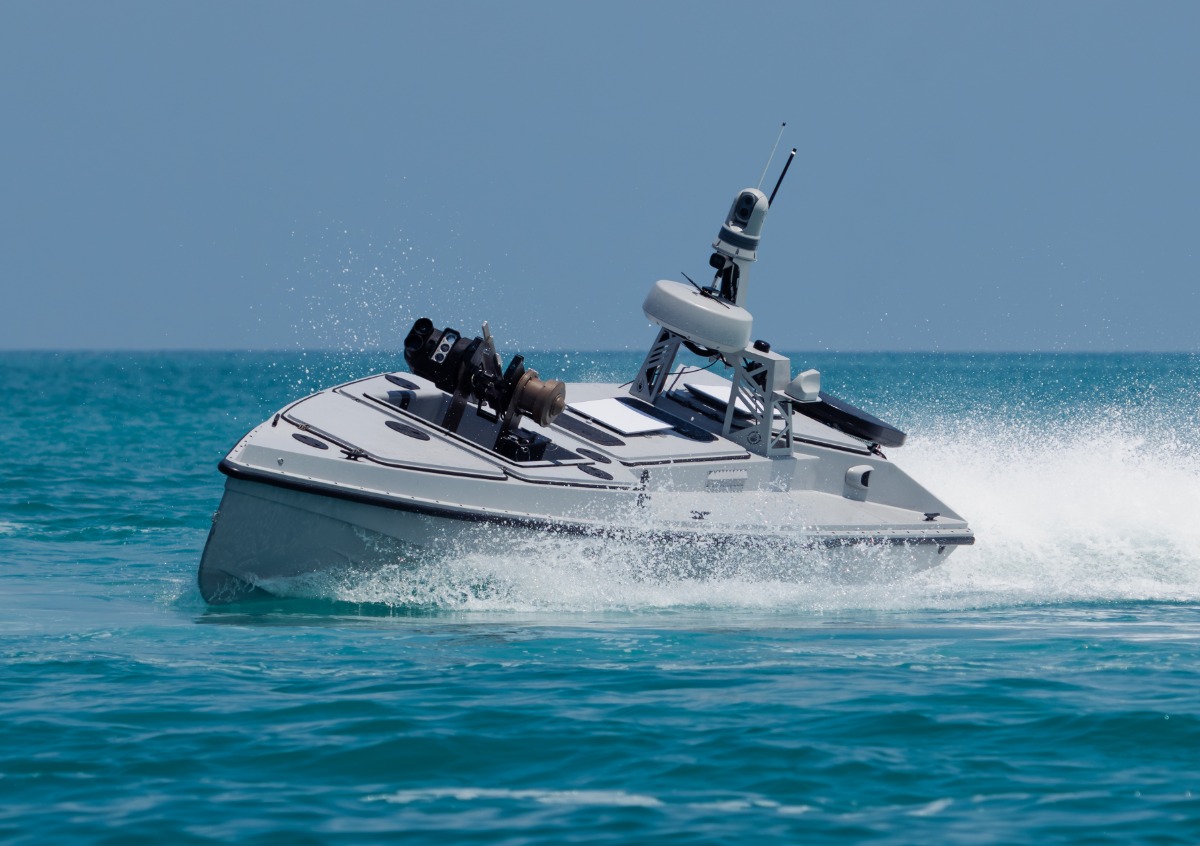
Red Cat Holdings has partnered with satellite communications company Kymeta to integrate multi-orbit connectivity into its Blue Ops Variant 7 uncrewed surface vessel, announcing the collaboration on May 14, 2026.
Kymeta, a flat-panel satellite terminal manufacturer that has shipped more than 9,000 units across deployments in more than 80 countries and territories, joins Red Cat’s Futures Initiative — the company’s industry consortium designed to accelerate advanced autonomous systems for military use. The integration pairs Kymeta’s communications platform with Red Cat’s Variant 7 USV, adding multi-orbit satellite connectivity that spans GEO, LEO, and MEO networks and allows the vessel to maintain datalinks while operating at extended range in electronically contested maritime environments, according to the joint announcement.
Red Cat Holdings, listed on Nasdaq under the ticker RCAT, describes itself as a provider of advanced all-domain drone and robotic solutions for defense and national security. Its maritime division, Blue Ops, develops the Variant 7 USV — a platform the company is positioning for the growing category of autonomous surface vessels taking on missions that previously required crewed vessels with the personnel exposure and logistics burden those missions carry. Barry Hinckley, President of Blue Ops, articulated the operational problem the Kymeta integration addresses. “As uncrewed surface vessels take on more complex and distributed missions, reliable connectivity becomes a critical enabler for coordinated operations, including swarming and real-time data sharing,” Hinckley said in the announcement. “Integrating Kymeta’s technology into our Variant 7 platform allows us to support these emerging capabilities and deliver USVs that can operate with greater range, coordination, and effectiveness in maritime environments. Multi-layered communication channels also ensure secure and resilient connectivity even with electronic warfare disruption.”
The connectivity problem Hinckley describes has become one of the defining engineering constraints in autonomous maritime system development. A USV operating in isolation, doing a predetermined task without real-time command input or data sharing, is a relatively tractable engineering problem. A USV operating as part of a coordinated swarm, sharing sensor data with other vessels and manned platforms while adapting to dynamic tactical situations, requires a communications architecture that is fast, low-latency, survivable under jamming, and capable of maintaining connectivity as the vessel moves over long distances. Kymeta’s platform addresses that requirement by integrating multiple satellite networks across different orbital regimes — geostationary, low Earth orbit, and medium Earth orbit — and switching between them as conditions and jamming attempts degrade individual links.
Manny Mora, Chief Executive Officer and President at Kymeta, described the integration’s operational significance in the announcement. “Autonomous maritime systems are only as effective as the communications that connect them, especially when operating at range and in contested environments,” Mora said. “Our technology is designed to deliver resilient, on-the-move connectivity across multiple networks in LEO, MEO and GEO and integrating it into Blue Ops’ Variant 7 enables persistent command and control for distributed USV operations. This collaboration is about ensuring operators can rely on real-time data and coordination, even in the most challenging conditions.”
The GNSS-denied persistence capability that Kymeta lists among the platform’s features is a specific and important operational characteristic. GPS denial has become a routine feature of modern contested maritime environments, with adversaries deploying jamming and spoofing systems that can degrade or defeat GPS-dependent navigation and communications at significant ranges. A communications platform that continues operating without GPS — using inertial navigation references and alternative timing sources to maintain link stability — removes a vulnerability that pure GPS-dependent systems carry into every contested operation. Kymeta describes its platform as offering proven performance in highly contested operations, a claim the company attributes to its global military deployment record, though specific operational details are not provided in the source material.
The Red Cat Futures Initiative framework through which this partnership was formed is designed to reduce what the company describes as integration friction — the time, cost, and technical complexity that slows the fielding of new capabilities onto autonomous platforms. By pre-qualifying technology partners and establishing integration pathways within the consortium, Red Cat aims to compress the timeline from technology demonstration to mission-ready fielded capability, addressing one of the persistent criticisms of defense autonomous systems programs: that the technology matures faster than the procurement and integration processes that put it in operators’ hands. Kymeta’s addition to the Initiative gives Blue Ops a communications solution that has already been through the consortium’s qualification process rather than requiring a custom integration program for each new customer.
Content preview only. Full article available at source. View Full Article
Red Cat Holdings announced a partnership with Kymeta to integrate multi-orbit satellite connectivity into its Blue Ops Variant 7 uncrewed surface vessel on May 14, 2026. This collaboration aims to enhance the operational capabilities of the USV, allowing it to maintain reliable communication in contested maritime environments. The integration supports complex missions, including swarming and real-time data sharing, while ensuring connectivity even under electronic warfare conditions.
- Red Cat Holdings partnered with Kymeta for satellite communication integration.
- The integration enhances the Blue Ops Variant 7 USV's operational capabilities.
- Multi-orbit connectivity spans GEO, LEO, and MEO networks.
- The technology addresses challenges in contested maritime environments.
- Kymeta's platform offers GNSS-denied persistence capability.