
"Regarding 'Whether to Apologize', South Korea and the U.S. Military Show 'Disharmony', Korean Media: Structural Tensions Exist Within the Alliance"
[Global Times Special Correspondent Li Zhiyin in South Korea] The controversy surrounding the large-scale aerial training conducted by the U.S. military stationed in South Korea in the Yellow Sea has revealed a significant temperature difference in the statements from the South Korean and U.S. military. After the South Korean Ministry of National Defense released information about the "apology from the U.S. Forces Korea Commander," the U.S. Forces Korea issued a rare late-night statement emphasizing that there was no need for an apology, bringing to light the differences in training notifications and military policies between the two sides. Some South Korean media analysts suggest that the U.S. Forces Korea's response reflects a certain degree of potential structural tension within the South Korea-U.S. alliance.
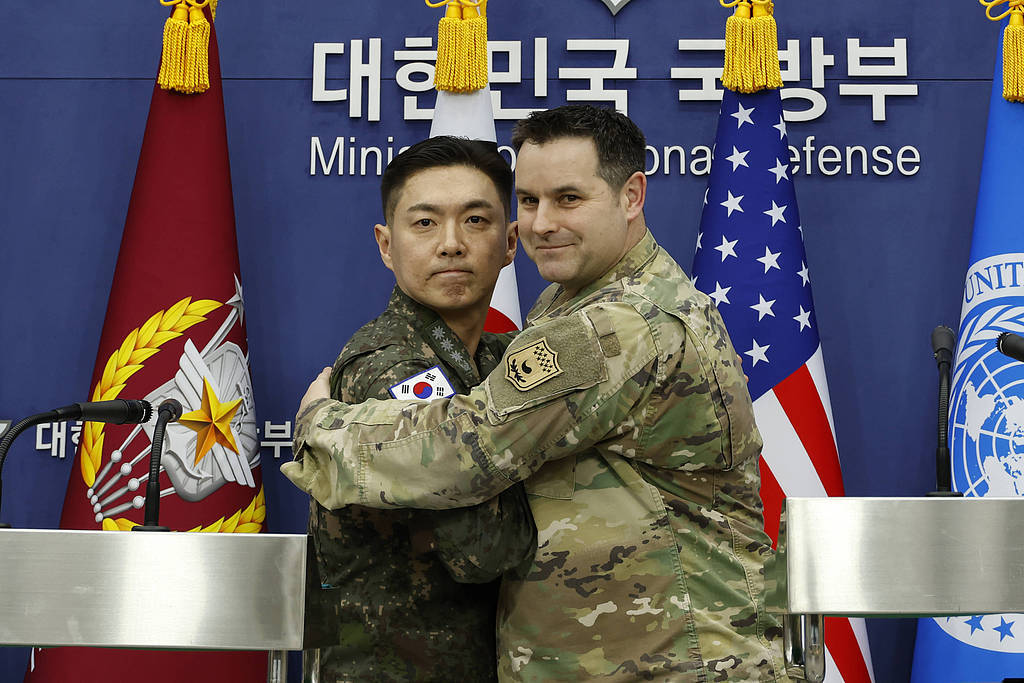
On February 24, the Korean News Agency cited military sources stating that U.S. Forces Korea Commander and Commander of the South Korea-U.S. Combined Forces Command, General Brunsen, apologized to the South Korean side regarding the tensions caused by confrontations with Chinese aircraft during the Yellow Sea training. However, after the announcement, U.S. Forces Korea issued a formal statement that night refuting the claim, stating that during a phone call with South Korean Defense Minister An Gye-beom, Brunsen only expressed "regret" that the South Korean side did not receive the training report in a timely manner, and reiterated that the training plan had been communicated in advance, emphasizing that routine readiness training "does not require an apology."
The controversy originated from the large-scale aerial training conducted by U.S. Forces Korea at Osan Air Base from February 18 to 19. According to South Korean media reports, U.S. F-16 fighter jets flew over the Yellow Sea more than 100 times. During the training, F-16s entered the area between the South Korean Air Defense Identification Zone and the Chinese Air Defense Identification Zone, where the two zones do not overlap. As U.S. Forces Korea aircraft approached the Chinese identification zone, Chinese aircraft were also dispatched in response, leading to a standoff. Upon learning of this, An Gye-beom called Brunsen on the 19th to protest, questioning why the U.S. side had not fully shared training details that could escalate regional tensions. The training was subsequently concluded early, but the dispute between the two sides did not subside.
This "apology controversy" has attracted widespread attention from South Korean media. The South Korean magazine "Shijie" characterized the incident as a "discordant note between the South Korean and U.S. military authorities," pointing out that the South Korean side was dissatisfied with the U.S. only reporting "that there was training" without specifying key information such as the specific flight objectives; the U.S. side argued that training information had been provided in advance, and the issue lay with the South Korean side's internal information sharing not being timely. Reports suggest that this apology controversy is no longer just a matter of expression or stance but exposes inconsistencies in military communication and policy coordination mechanisms between the two sides.
The "Seoul News" commented that the high-intensity training conducted by U.S. Forces Korea around the peninsula without allowing the South Korean side to fully grasp the information raises concerns about "the gears of the South Korea-U.S. alliance loosening." The commentary also pointed out that the U.S. advocacy for "strategic flexibility" shifts the focus of U.S. Forces Korea towards containing China, which may involve South Korea in regional conflicts against its own will, contradicting the current South Korean government's policy of easing regional tensions. The "Chosun Ilbo" noted that it is rare for U.S. Forces Korea to issue a statement clarifying matters late at night, while the South Korean Ministry of National Defense spokesperson only stated in response to inquiries that "some content of the relevant reports is true," without providing detailed explanations.
On the 25th, Bloomberg commented that this rare public friction between the U.S. and South Korea highlights the challenges faced by the Lee Jae-myung government in seeking to avoid taking sides between the U.S. and China, a departure from the previous government's clear prioritization of developing relations with the U.S. and Japan. The Hong Kong "South China Morning Post" also quoted experts analyzing that the South Korean side's protest to the U.S. regarding the confrontation between U.S. and Chinese aircraft indicates its disapproval of U.S. Forces Korea engaging in active confrontation with China.
In fact, recent "discordant notes" between South Korea and the U.S. regarding military affairs have been frequent; aside from the Yellow Sea training controversy, there has also been a lack of consensus on the scale of field maneuver training in the "Freedom Shield" joint exercises. The two sides announced the exercise plan without completing coordination, which is considered highly unusual. The South Korean military advocates for spreading the training throughout the year to reduce the tensions caused by concentrated training. However, U.S. Forces Korea believes that the relevant forces and budget have been deployed in advance and insists on executing according to the established plan, with the differences still unresolved. The emergence of sensitive issues has placed considerable pressure on military coordination between South Korea and the U.S.
U.S. Forces Korea conducted over 100 sorties of F-16 aircraft in the Yellow Sea from February 18-19, 2023, leading to tensions with Chinese aircraft. A diplomatic dispute arose when U.S. commanders denied needing to apologize for the training, despite initial reports suggesting otherwise. This incident reflects ongoing structural tensions within the U.S.-South Korea alliance regarding military communication and operational transparency.
- U.S. Forces Korea conducted over 100 sorties of F-16 aircraft in the Yellow Sea.
- Tensions arose with Chinese aircraft during the training exercises.
- U.S. commander apologized for communication issues, but denied needing to apologize for the training itself.
- The training was part of routine military readiness exercises.
- The incident highlights structural tensions within the U.S.-South Korea alliance.