
Report warns UK faces armored vehicle gap by 2027
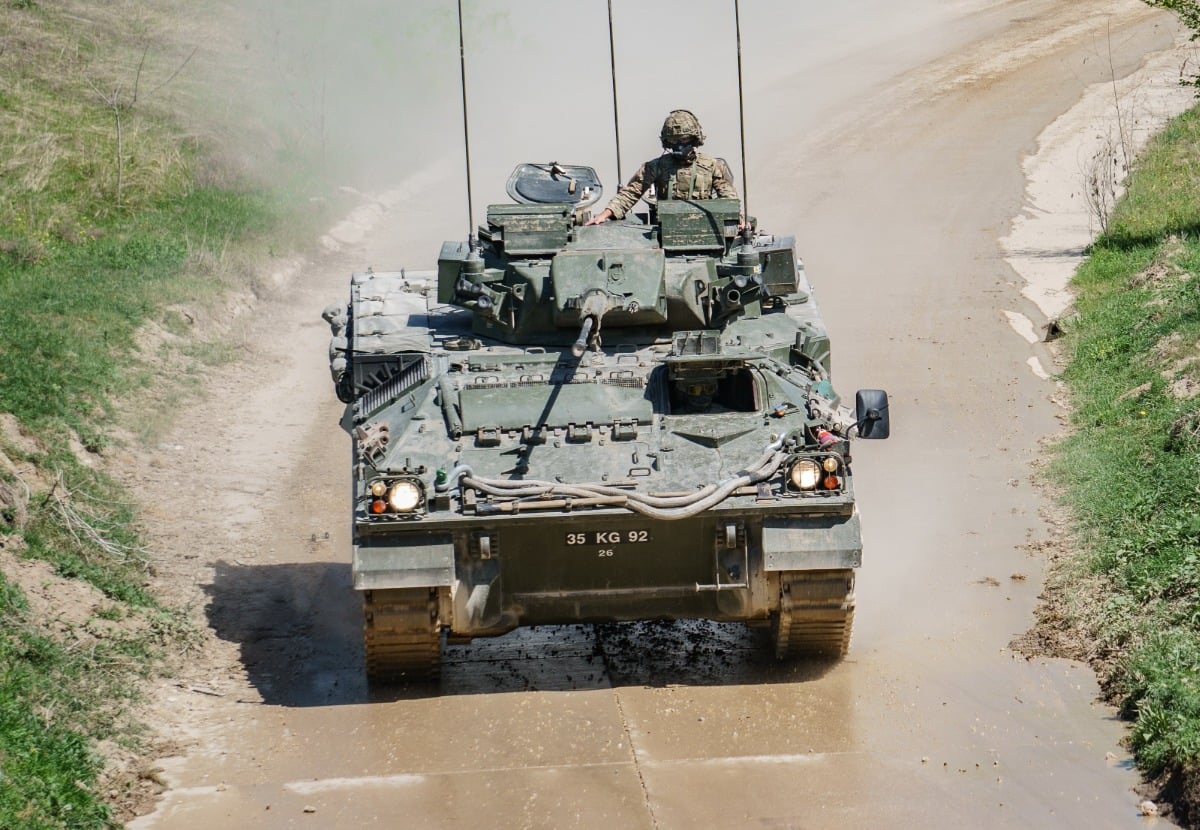
A defense think tank is telling the British government to reverse a decision it already made twice, warning that four of the Army’s armored infantry battalions are about to be left without any working vehicle at all, the UK Defence Journal reported, citing a new policy paper from the 878 Institute.
The paper, titled Britain’s Military Deterrence Gaps, argues the government should halt the ongoing decommissioning of the Warrior Infantry Fighting Vehicle and revive funding for the Warrior Capability Programme, a previously part-funded upgrade scheme the government scrapped years ago, according to the UK Defence Journal.
The £1 billion ($1.68 billion) program would have modified 380 Warrior platforms with a new turret and 40mm cannon, extending the aging fleet’s service life well past 2040. Robert Clark, the paper’s author, now estimates the revised cost of reviving that upgrade at £1.25 billion ($2.1 billion) once inflation is factored in.
Warrior has served as the backbone of British armored infantry for decades, but its planned retirement has already slipped repeatedly. The vehicle was originally due to leave service in 2014, a date pushed back multiple times as the Army waited for a proper replacement, and the current target has Warrior exiting service by 2027. That replacement was always meant to be Boxer, a modular 8×8 wheeled vehicle built by the ARTEC consortium of Rheinmetall and Krauss-Maffei Wegmann, delivered to the British Army through the intergovernmental procurement body OCCAR. Britain took delivery of its 100th Boxer vehicle on June 25, 2026, built at facilities in Telford and Stockport, a milestone The Defence Blog previously reported as a significant moment for one of the country’s largest land warfare modernization programs.
That 100th delivery sounds like solid progress, but Clark’s paper argues the underlying math still leaves a dangerous gap. Boxer missed its original Initial Operating Capability target of the fourth quarter of 2025 due to supply chain problems, and by June 2026 the British Army had received only 100 of the 623 total platforms ordered for unit trials, with no revised delivery schedule published for the remaining vehicles. Clark’s paper states plainly that this shortfall will leave a significant capability gap, with Warrior phased out of service and no operational replacement immediately available for the Army’s four armored infantry battalions.
Clark frames reviving the Warrior upgrade not as a permanent alternative to Boxer, but as a bridge to cover that specific gap.
“Enable the Boxer programme to continue at its current speed without leaving armoured infantry battalions without armour or mobility,” Clark writes, describing the intended effect of funding the upgrade.
The paper also notes a pattern already underway on the ground that makes the timing concern more urgent, observing that many units are already decommissioning their Warriors in preparation for Boxer’s arrival, a transition happening even as the replacement vehicle’s own delivery schedule remains uncertain. Clark further warns that delays affecting the first tranche of armored infantry Boxers could produce knock-on delays for 72 howitzer platforms the Royal Artillery has planned to receive starting in 2028, since production and delivery schedules across different Boxer variants remain interconnected.
General The Lord Dannatt, who wrote the paper’s foreword, went further than Clark’s own recommendation, calling for the Ajax reconnaissance vehicle program to be scrapped entirely in favor of upgrading Warrior instead. Ajax, a £6.3 billion ($10.58 billion) tracked reconnaissance vehicle program built by General Dynamics UK, has suffered years of well-documented problems, including noise and vibration issues that sickened roughly 30 soldiers during a Salisbury Plain exercise and forced a temporary program pause even after officials declared the vehicle finally ready for initial operating capability. Clark’s own recommendation in the paper is narrower than Dannatt’s, treating a revived Warrior upgrade as a temporary bridge measure rather than a wholesale substitute for either Boxer or Ajax.
This is not the first time the government has faced pressure to keep Warrior in service longer than planned. The Ministry of Defence previously ruled out retaining Warrior, a decision the UK Defence Journal itself reported on in 2025 and which Clark’s new paper directly cites as evidence the government has already considered and rejected this exact path once before. The Ministry of Defence has not yet responded to the new report, leaving open whether officials view the capability gap Clark describes as serious enough to reconsider a decision made under a previous cost-cutting review.
One partial alternative already in motion offers a narrower use for retired Warrior hulls rather than a full combat revival. The ATILLA project, an Army initiative to convert decommissioned Warrior vehicles into crewed mine-breaching platforms for the Royal Engineers, has progressed beyond initial concept work into early commercial competition, though that program repurposes old Warrior hulls for a specialized engineering role rather than restoring them to frontline infantry combat duty.
Britain’s Military Deterrence Gaps ultimately argues that armored infantry battalions cannot simply operate on faith that Boxer deliveries will accelerate fast enough to close the gap Warrior’s retirement leaves behind. Whether ministers act on Clark’s recommendation, dismiss it as they dismissed the original Warrior Capability Programme in 2021, or find some middle path remains entirely unresolved, and until the Ministry of Defence responds, four armored infantry battalions are left counting down toward 2027 with a mathematically documented gap between the vehicle they are losing and the one meant to replace it.
Content preview only. Full article available at source. View Full Article
The British Army faces a potential capability gap as four armored infantry battalions may lack operational vehicles by 2027 due to the decommissioning of Warrior Infantry Fighting Vehicles and delays in the delivery of Boxer vehicles. A defense think tank urges the government to reconsider its decision to halt the Warrior upgrade program, emphasizing the urgency of addressing this gap. The Ministry of Defence has yet to respond to these concerns, leaving the future of the armored units uncertain.
- Four armored infantry battalions may be left without operational vehicles by 2027.
- The Warrior Infantry Fighting Vehicle is being decommissioned despite calls to revive its upgrade program.
- The Boxer vehicle program is delayed, with only 100 of 623 units delivered for trials.
- The Ministry of Defence has not responded to the new report regarding the capability gap.