
Russia develops new coastal drone interceptor
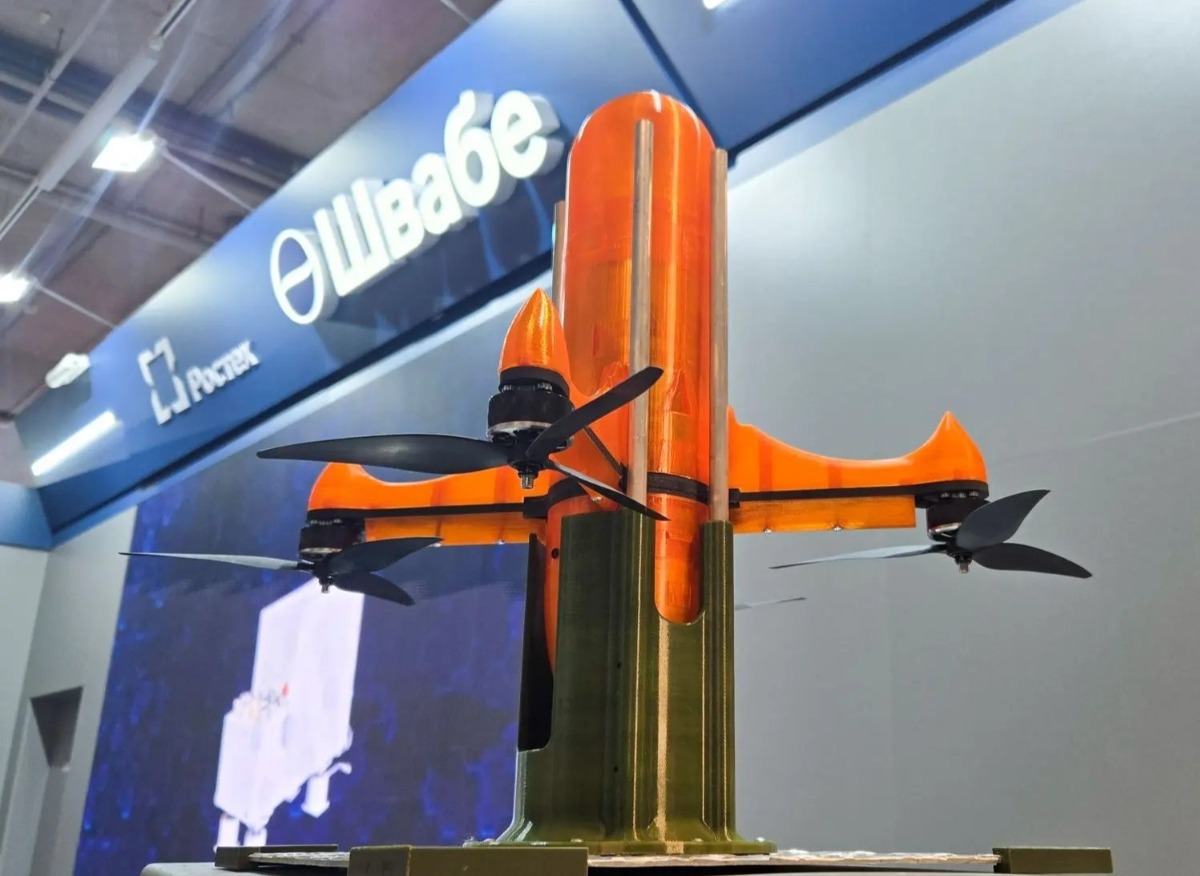
Russia’s defense industry used its premier naval exhibition to show off a new automated system that uses interceptor drones guided by artificial intelligence to counter UAV-type targets threatening maritime waters and coastal infrastructure.
Shvabe Holding, an optoelectronics and defense technology subsidiary of Rostec, Russia’s state-owned defense industrial conglomerate, presented a mock-up of the counter-drone system at Fleet 2026, held from June 10 to 14 at Kronstadt in St. Petersburg.
The system is built around three integrated components: a ground-based optical-electronic surveillance station, a fleet of interceptor drones, and an operator workstation where a human controller monitors the situation and authorizes engagement. According to TASS, the Russian state news agency that covered the announcement, images from the optical-electronic station stream continuously to a monitor at the observation point, giving the operator a real-time picture of the airspace above the protected area. When a threat is identified, the operator decides to engage and issues the launch command. The interceptor drone then navigates toward the target area following guidance commands from the ground station, and in the final phase of the intercept, neural network algorithms take over, autonomously maneuvering the drone onto the target without further human input.
That division of responsibility, human authorization for the shoot decision, machine control of the terminal engagement, mirrors the architecture that Western counter-drone developers have also converged on. It keeps a human in the legal and ethical loop for the lethal decision while removing the human reaction-time bottleneck from the phase of the engagement where speed and precision matter most. A drone flying at even modest speeds covers ground quickly, and the difference between a successful intercept and a miss often comes down to milliseconds of targeting accuracy that human hands cannot reliably deliver.
Vadim Kalyugin, CEO of Shvabe and a member of the bureau of the Russian Union of Machine Builders, described the rationale for the system in comments reported by Rostec. “Protecting water areas and the coastal strip in the face of constant changes in the nature of threats to critical infrastructural facilities also requires new approaches to their protection,” Kalyugin said. “The priority is early detection and rapid recognition of targets, which makes it possible to respond quickly to changing environment. In this regard, our holding company is actively improving optoelectronic devices and systems, introducing artificial intelligence technologies into their work.”
Shvabe is one of Russia’s primary producers of military optoelectronics, operating dozens of industrial enterprises and research centers that produce thermal imaging systems, optical sights, drone camera sensors, counter-UAV systems, and optical equipment for satellites and armored vehicles. Its parent company, Rostec, is the conglomerate that produces the majority of Russia’s conventional weapons, including the Kalashnikov family of rifles, the Pantsir air defense system, and a broad range of military aircraft avionics. The Fleet 2026 exhibition at Kronstadt was Rostec’s primary showcase for maritime and coastal defense technologies this year, with the conglomerate presenting multiple systems alongside the Shvabe drone interceptor mock-up.
The context for this announcement is the sustained and intensifying Ukrainian drone campaign against Russian coastal and maritime infrastructure. Ukrainian forces have used surface drone boats to damage and sink Russian warships, and aerial drone attacks have hit targets ranging from the Kerch Bridge in Crimea to fuel depots and radar installations along the Russian coast. Protecting the coastline from drone threats is not an abstract planning exercise for Russian military planners; it is an active operational requirement shaped by losses already sustained.
The system was shown publicly as a mock-up, and no production or deployment status has been announced. The intercept range, the number of interceptors deployable per system, the maximum target speed, and the operational altitude envelope are all unknown from the available public information. Rostec’s announcements at defense exhibitions regularly describe capabilities in general terms without the performance data that would allow independent assessment of how the system compares to competing counter-drone architectures.
Content preview only. Full article available at source. View Full Article
Russia showcased a new automated coastal drone interceptor system at the Fleet 2026 exhibition in Kronstadt from June 10 to 14, 2026. The system, developed by Shvabe Holding, utilizes AI-guided interceptor drones to counter UAV threats to maritime areas. It features a ground-based optical-electronic surveillance station and an operator workstation for real-time monitoring and engagement.
- Russia developed a new automated coastal drone interceptor system.
- The system uses AI-guided interceptor drones to counter UAV threats.
- Shvabe Holding presented the system at the Fleet 2026 exhibition in Kronstadt.
- The system includes a ground-based surveillance station and operator workstation.
- The context involves ongoing threats from Ukrainian drone campaigns against Russian maritime infrastructure.