
Russia moves to shield warships from Ukrainian drone strikes

Russia has begun arming its large surface warships with new electronic warfare systems in an apparent attempt to counter Ukrainian drone attacks, according to imagery circulating in recent days on Russian military-affiliated social media channels.
The anti-drone complex, identified as “Pereyed-M,” has reportedly been spotted installed on four vessels of the Russian Navy: the Project 1164 guided-missile cruiser Varyag, the Project 20380 corvette Steregushchiy, the Project 1155 large anti-submarine ship Udaloy, and the Project 11540 guard ship Neustrashimy.
Pereyed-M combines a drone-detection system with electronic jamming equipment, and it is built primarily to counter small unmanned aircraft, particularly FPV drones and reconnaissance quadcopters, the same category of cheap, mass-produced systems that Ukraine has used with growing effectiveness against Russian ground forces and, increasingly, against Russian ships far from any front line.
The complex is paired with a radar unit called Repeynik, a compact, wearable system Russian state media first described in late 2022, capable of detecting targets with a radar signature as small as a commercial quadcopter’s at ranges up to 15 kilometers (9.3 miles) and altitudes up to 5,000 meters (16,400 feet), tracking objects moving as fast as 200 kilometers per hour (124 mph) across a full 360-degree scan. Once Repeynik’s radar picks up a target, it can cue an automated, self-aiming turret that jams the drone’s control and video links at ranges up to roughly 2.5 kilometers (1.6 miles), operating across a broad frequency range that reportedly includes some of the nonstandard bands Ukrainian FPV operators use to evade conventional jammers, and Russian defense-industry reporting this year said the turret had cleared testing for mass production.
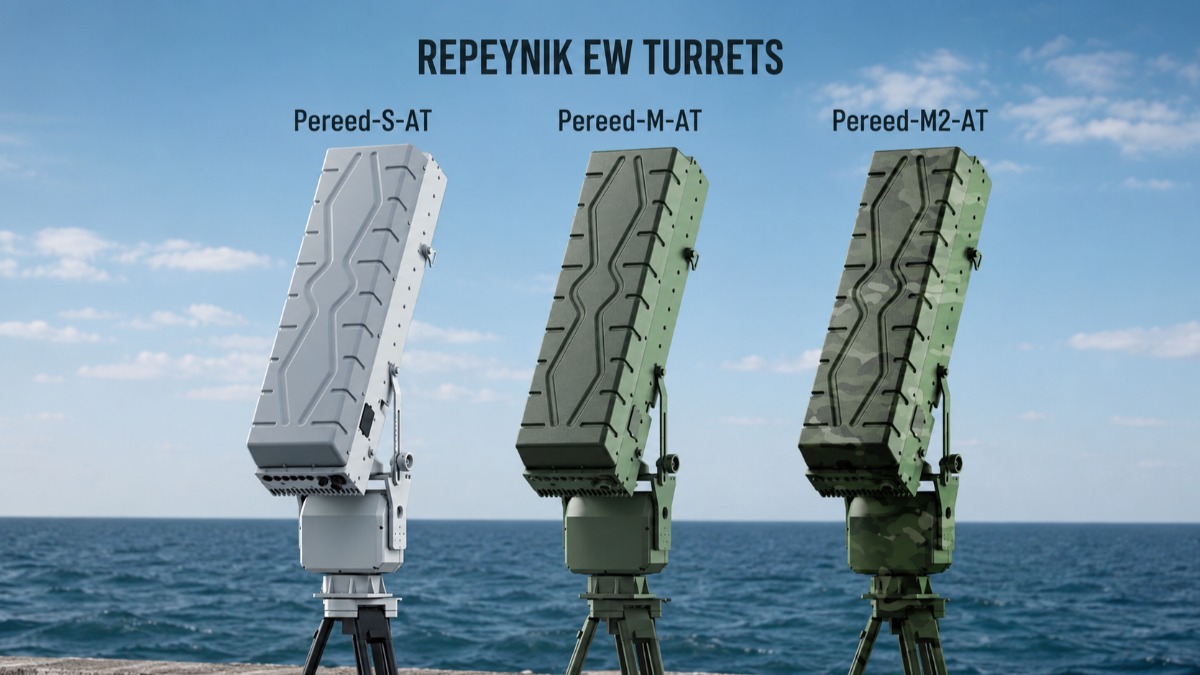
Every prior public description of this hardware framed it as portable, infantry-carried equipment, built to split into two modules light enough for a single soldier to strap to combat gear and deploy near a front line or a fixed checkpoint within about five minutes, running for up to eight hours on an internal battery before needing a recharge. Promotional material describing the turret family shows several distinct housings, one finished in plain white rather than the olive-and-camouflage pattern used on the others, a detail that could plausibly point to a maritime-specific variant intended for a ship’s superstructure rather than a trench line, though that reading remains an inference drawn from the images rather than a confirmed specification, since none of the published technical material mentions saltwater protection, shipboard power integration, or naval hardening explicitly.
The tactical rationale for moving this kind of system onto a warship’s deck fits a broader shift already underway in the naval war. Ukraine has spent much of 2026 extending its long-range strike campaign against Russian naval assets well beyond the Black Sea, combining maritime unmanned surface vessels with airborne drones launched from Ukrainian territory or smuggled close to Russian ports and shipyards. Ukraine’s Armed Forces released footage in early June that it said showed a successful drone strike on the corvette Boiky while the ship sat in dry dock near St. Petersburg, video that showed at least two impacts amidships and drew wide attention to how exposed docked Russian warships have become to cheap aerial drones that traditional ship-defense systems, designed to intercept missiles and aircraft, are poorly suited to counter. A radar-cued jamming turret capable of detecting and disabling a quadcopter’s control link before it reaches the hull addresses precisely that vulnerability, and its appearance on a cruiser, a corvette, a large anti-submarine ship, and a frigate simultaneously would suggest Russia is treating the threat as serious enough to warrant retrofitting across multiple ship classes and fleets rather than testing it on a single vessel.
Content preview only. Full article available at source. View Full Article
Russia has armed four of its naval vessels with the Pereyed-M electronic warfare system to counter Ukrainian drone attacks. This system, which includes the Repeynik radar unit, enhances the vessels' capabilities against small unmanned aircraft. The deployment reflects a strategic shift in response to Ukraine's extended strike campaign against Russian naval assets, particularly in light of recent successful drone strikes on Russian ships.
- Russia is arming its warships with the Pereyed-M electronic warfare system.
- The system has been spotted on four Russian Navy vessels.
- Pereyed-M is designed to counter small unmanned aircraft, including drones used by Ukraine.
- The system includes a radar unit called Repeynik capable of detecting small targets.
- The deployment indicates a serious response to the threat posed by Ukrainian drone strikes.