
Russia rolls out its newest nuclear attack submarine
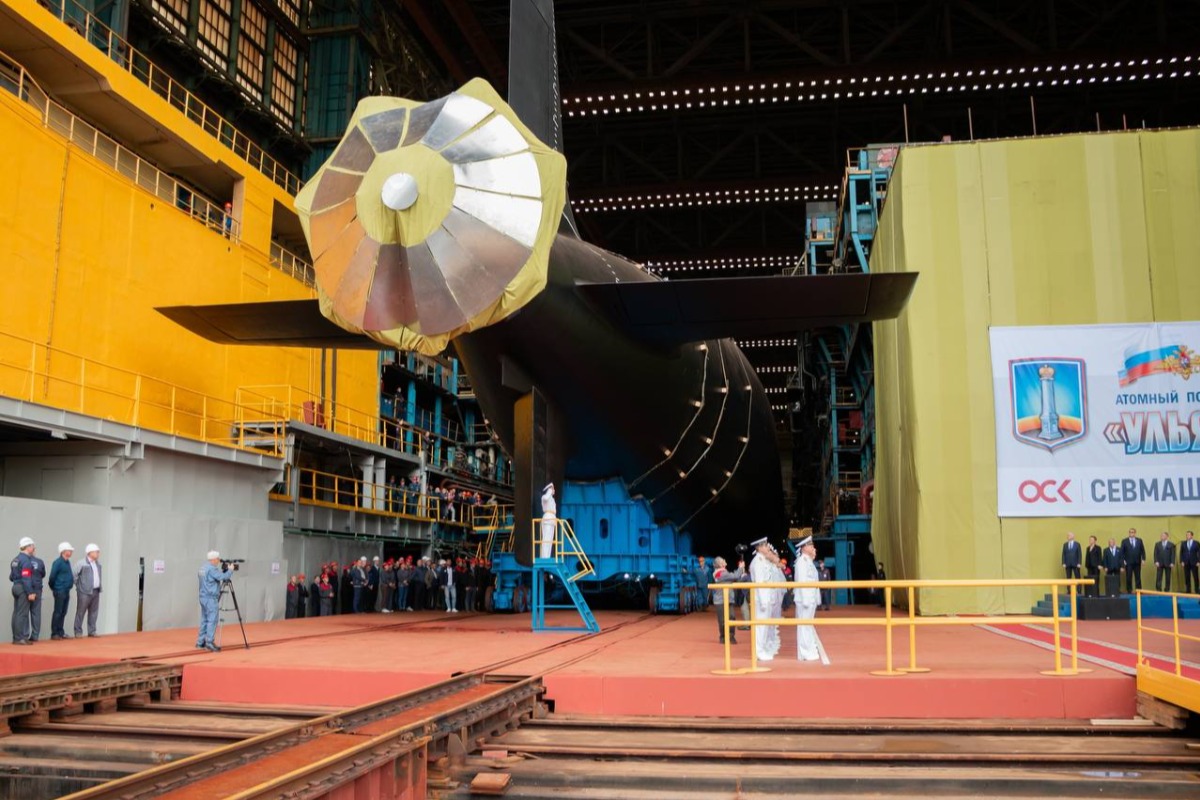
The Russian United Shipbuilding Corporation’s Sevmash shipyard held a ceremony to move the multi-purpose nuclear-powered submarine Ulyanovsk out of its construction hall, marking the completion of the vessel’s slipway construction phase, according to a statement from the shipyard.
Ulyanovsk is the sixth submarine built in Russia’s modernized Yasen-M class, known formally as Project 885M, a series of nuclear-powered attack submarines designed to strike targets on land and at sea with cruise missiles while also hunting enemy ships and submarines, making them among the most capable vessels in the Russian Navy’s current arsenal. Sevmash, based in the northern Russian city of Severodvinsk on the White Sea, has served as the country’s primary builder of nuclear submarines for decades and remains the sole yard currently producing this class.
Rolling a submarine out of its construction hangar does not mean the vessel is combat ready. The move, sometimes called a float-out or a slipway completion depending on the specific yard process involved, simply confirms the hull and major internal systems have reached the stage where the vessel can leave the covered building where it was assembled and begin the next phase of construction, typically involving mooring trials alongside the pier followed by sea trials that test propulsion, navigation, weapons systems, and deep-diving capability under real ocean conditions. Russian Navy Commander-in-Chief Alexander Moiseyev attended the ceremony and confirmed the submarine will eventually join Russia’s Northern Fleet, the naval command responsible for defending Russia’s Arctic and North Atlantic approaches, though the vessel still faces what is typically a lengthy trials period before formal handover to the fleet.
Five Yasen and Yasen-M submarines already serve in the Russian Navy today, according to the shipyard’s statement, led by the class’s original vessel Severodvinsk, joined by four modernized Yasen-M boats named Kazan, Novosibirsk, Krasnoyarsk and Arkhangelsk. Several additional submarines in the series remain under construction at various stages, and just over a month before the Ulyanovsk ceremony, on June 17, 2026, Sevmash laid the keel for a ninth Yasen-M submarine named Murmansk, the first new vessel in the series to begin construction in six years, according to a statement from Russia’s Defense Ministry. That gap between new keel layings reflects both the enormous cost of nuclear submarine construction and the technical complexity involved, with unit costs for the class estimated to range from roughly $700 million to more than $1.5 billion depending on the specific boat and the exchange rates in effect during its build period, according to Army Recognition.
The Yasen-M class carries particular weight in Western naval planning circles because of what it represents rather than simply how many hulls exist. Each submarine is designed to carry a mix of Kalibr land-attack cruise missiles, Oniks anti-ship missiles, and increasingly the Zircon hypersonic cruise missile, a weapon capable of speeds that current Western missile defense systems struggle to intercept reliably. The class’s combination of reduced acoustic signature and long-range precision strike capability drew a pointed warning from Britain’s First Sea Lord, Admiral Gwyn Jenkins, in December 2025, when he cautioned that the Western alliance’s traditional advantage in the North Atlantic could erode as Russia continues strengthening this submarine fleet. Russian officials have stated publicly that they intend to eventually replace the Navy’s entire aging fleet of Soviet-era attack submarines, including older Oscar II, Akula and Sierra II class vessels, with Yasen and Yasen-M boats, targeting a total fleet of roughly 10 to 12 submarines of the class by 2035.
The submarine is expected to undergo roughly a year of sea trials covering navigation systems, deep-diving operations in the Norwegian Sea, weapons testing and crew training before any formal transfer to the Northern Fleet, with some reporting placing that handover as late as December 2027. That timeline is not unusual for the class. The previous Yasen-M submarine launched at Sevmash, Perm, first began sea trials more than a year ago and still has not been formally handed over to the Navy, a reminder that Russian shipbuilding schedules for these vessels have historically run longer than initially announced.
Content preview only. Full article available at source. View Full Article
The Russian United Shipbuilding Corporation's Sevmash shipyard moved the Ulyanovsk submarine out of its construction hall in June 2026, marking a significant milestone in its development. This submarine is the sixth in the Yasen-M class, designed for advanced strike capabilities. It will eventually join the Northern Fleet after undergoing extensive trials, reflecting Russia's ongoing efforts to modernize its naval forces.
- The Ulyanovsk submarine is the sixth in the Yasen-M class.
- The submarine will join Russia's Northern Fleet after a lengthy trials period.
- The Yasen-M class submarines are designed to carry advanced missile systems.
- Sevmash is the sole yard currently producing this class of submarines.
- The construction of nuclear submarines is complex and costly, with estimates ranging from $700 million to over $1.5 billion.