
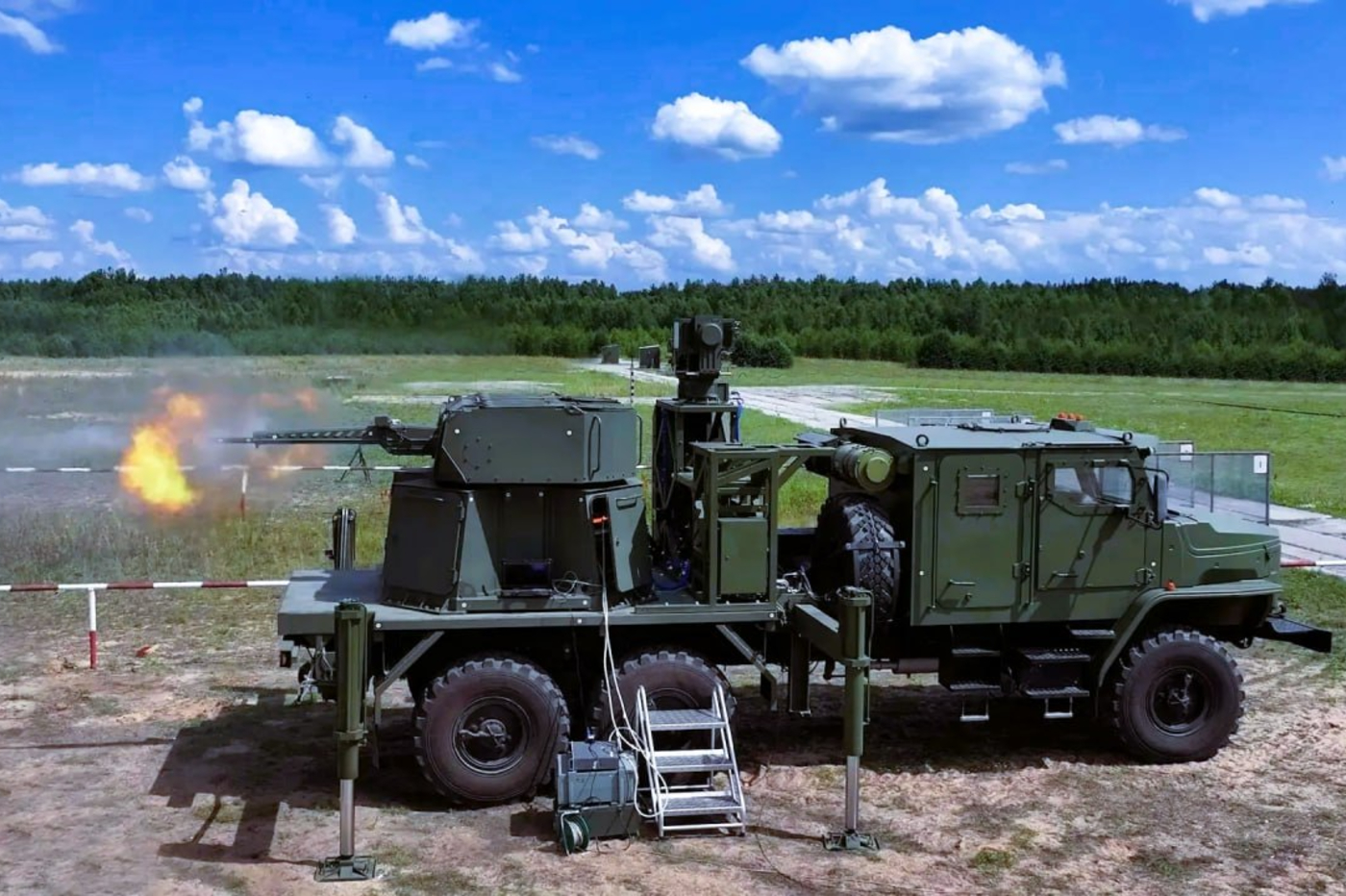
Russia’s state defense conglomerate Rostec has shown a mobile version of its Tsitadel anti-aircraft gun system, with the weapon and its sensors mounted on a truck chassis, the company said.
Until now, Tsitadel had been fielded as a stationary system designed to guard fixed sites against drones.
“The combat module, as well as the radar and optical detection systems, are now installed on a vehicle chassis. This will allow the air defense system to be quickly moved to different sites that require protection from air attack. The mobile version of the system will also give mobile fire groups expanded capabilities for hitting targets,” Rostec said.
In June, Russian media reported that the company planned to put the system, also known as ZAK-30, on a Ural military truck.
Tsitadel is a remotely controlled turret armed with 30 mm automatic cannons that fire programmable airburst shells. The shells are set to explode at a calculated point just in front of a drone, releasing a cloud of fragments, so the gun does not need a direct hit. The combat module carries 300 rounds. Rostec says the system can engage fixed-wing drones out to about 1 km (0.6 miles) and small quadcopters out to about 800 meters (2,600 feet).
Radar and electro-optical sensors, including a thermal camera, let the system find and track targets day and night. The fire control system aims the guns and decides when to detonate the shells automatically, and several firing units can be run from one command post about 1 km away.
Rostec says the stationary Tsitadel has proven itself in combat and can shoot down different types of drones as well as cruise missiles. The company also says its airburst shells and new fire control system mean Tsitadel uses far less ammunition than standard anti-aircraft guns. A Rostec representative told the Russian daily Izvestia in October that the savings can be several-fold per target. Those claims have not been independently verified.
Rostec first presented Tsitadel in May at a security forum near Moscow, when Russia showed off the counter-drone cannon with programmable shells. In September, the company displayed the system abroad for the first time at the El Alamein International Airshow in Egypt, aiming it at foreign buyers.
Gun systems like Tsitadel are meant to give Russia a cheaper way to stop the long-range Ukrainian drones that regularly strike refineries, airfields and other targets deep inside Russia, without spending expensive surface-to-air missiles on each one. The truck-mounted version is designed to let units move that protection between sites instead of building fixed positions at each one.
Content preview only. Full article available at source. View Full Article
Rostec unveiled a mobile version of the Tsitadel anti-aircraft gun system in October 2023, designed to protect against drones. This system, mounted on a Ural military truck, features 30 mm automatic cannons and programmable airburst shells, allowing it to engage targets at significant distances. The mobile capability enhances operational flexibility for Russian forces in air defense.
- Rostec unveiled a mobile version of the Tsitadel anti-aircraft gun system.
- The system is designed to protect against drones and can be quickly relocated.
- It features 30 mm automatic cannons and programmable airburst shells.
- The system can engage drones at distances of up to 1 km for fixed-wing and 800 meters for quadcopters.
- The mobile version allows for enhanced operational flexibility compared to stationary systems.